manuals.online logo
Brands
  1. Home
  2. •
  3. Brands
  4. •
  5. Roland
  6. •
  7. Power Tools
  8. •
  9. Roland MODELA PRO II series Use and care manual

Roland MODELA PRO II series Use and care manual

This manual suits for next models

1

Other Roland Power Tools manuals

Roland DWX-51D User manual

Roland

Roland DWX-51D User manual
Roland DWX-51D User manual

Roland

Roland DWX-51D User manual

Roland MDX-40A User manual

Roland

Roland MDX-40A User manual
Roland iModela iM-01 User manual

Roland

Roland iModela iM-01 User manual
Roland CAMM-3 PNC-3200 Operating and maintenance manual

Roland

Roland CAMM-3 PNC-3200 Operating and maintenance manual

Roland CAMM-3 PNC-3200 User manual

Roland

Roland CAMM-3 PNC-3200 User manual
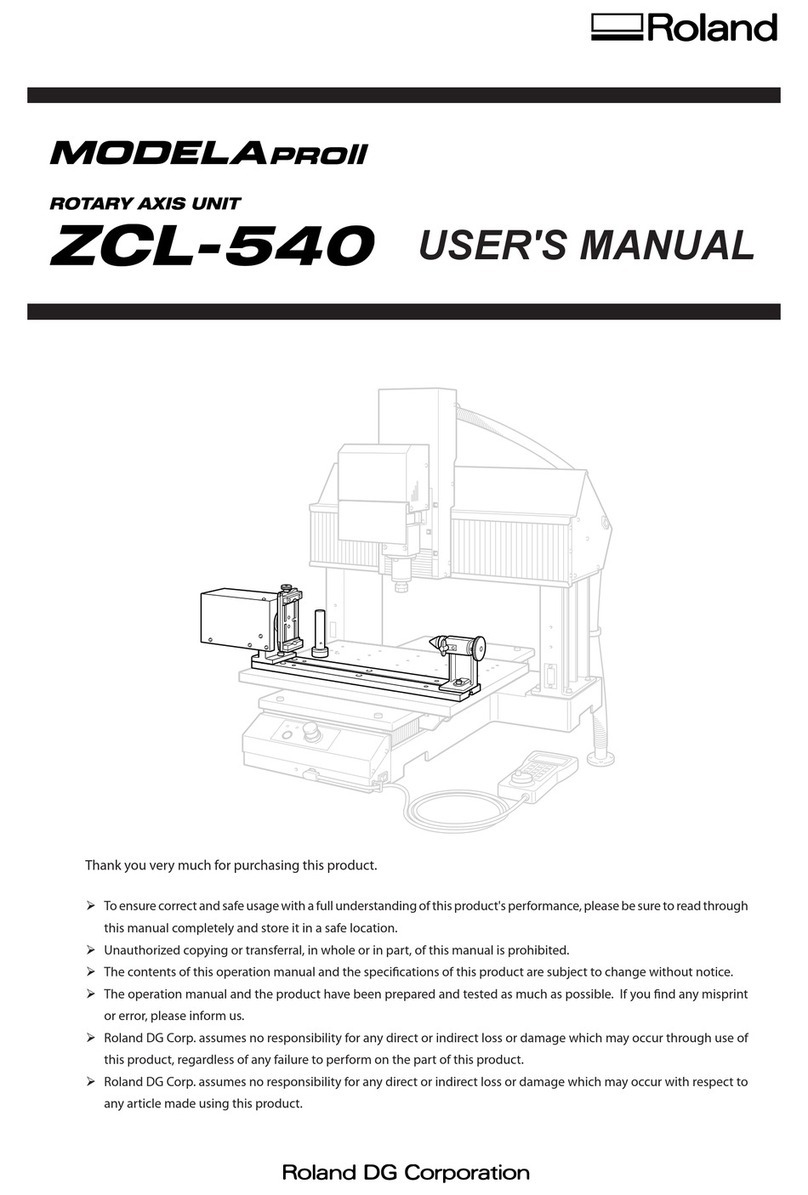
Roland MODELA Pro II ZCL-540 User manual

Roland

Roland MODELA Pro II ZCL-540 User manual

Roland ZAT-540 User manual

Roland

Roland ZAT-540 User manual
Roland CAMM-3 PNC-300 User manual

Roland

Roland CAMM-3 PNC-300 User manual
Roland MDX-40A User manual

Roland

Roland MDX-40A User manual
Roland PNC-3100 CAMM-3 User manual

Roland

Roland PNC-3100 CAMM-3 User manual
Roland CAMM-3 PNC-3200 User manual

Roland

Roland CAMM-3 PNC-3200 User manual
Roland monoFab SRM-20 User manual

Roland

Roland monoFab SRM-20 User manual
Roland MODELA MDX-50 User manual

Roland

Roland MODELA MDX-50 User manual
Roland monoFab SRM-20 User manual

Roland

Roland monoFab SRM-20 User manual

Roland MODELA Pro MDX-650A User manual
Roland

Roland MODELA Pro MDX-650A User manual

Roland RML-1 Instruction Manual

Roland

Roland RML-1 Instruction Manual

Roland MODELA Pro ZCL-650A User manual
Roland

Roland MODELA Pro ZCL-650A User manual

Roland DWX-50 Operating manual

Roland

Roland DWX-50 Operating manual

Popular Power Tools manuals by other brands

ISLAND HOPPER Power Egg HT-309 operating instructions

ISLAND HOPPER

ISLAND HOPPER Power Egg HT-309 operating instructions

Sioux Tools SSR6P25 Instructions-parts list

Sioux Tools

Sioux Tools SSR6P25 Instructions-parts list

Makita HM1317C technical information

Makita

Makita HM1317C technical information

ABB Smart Tool + quick start guide

ABB

ABB Smart Tool + quick start guide

Baumr-AG BMJK-24S user manual

Baumr-AG

Baumr-AG BMJK-24S user manual

Bosch Professional GST 18 V-LI S Original instructions

Bosch

Bosch Professional GST 18 V-LI S Original instructions

Ronix RA-2702 quick start guide

Ronix

Ronix RA-2702 quick start guide

Nordson ProBlue user guide

Nordson

Nordson ProBlue user guide

aoyue int6028 instruction manual

aoyue

aoyue int6028 instruction manual

Hitachi CJ 65VA2 Instruction manual and safety instructions

Hitachi

Hitachi CJ 65VA2 Instruction manual and safety instructions

Makita HM1304 instruction manual

Makita

Makita HM1304 instruction manual

Kurtz Ersa Ersa X-TOOL VARIO operating instructions

Kurtz Ersa

Kurtz Ersa Ersa X-TOOL VARIO operating instructions

SCHUNK KSO 65 Installation and operating instruction

SCHUNK

SCHUNK KSO 65 Installation and operating instruction

Harken LokHead 500 user manual

Harken

Harken LokHead 500 user manual

Senco DuraSpin ExTPro installation instructions

Senco

Senco DuraSpin ExTPro installation instructions

Ferm JSM1020 Original instructions

Ferm

Ferm JSM1020 Original instructions

Milwaukee M12 FUEL 2559-20 Operator's manual

Milwaukee

Milwaukee M12 FUEL 2559-20 Operator's manual

EINHELL BT-CD 12/2 operating instructions

EINHELL

EINHELL BT-CD 12/2 operating instructions

manuals.online logo
manuals.online logoBrands
  • About & Mission
  • Contact us
  • Privacy Policy
  • Terms and Conditions

Copyright 2025 Manuals.Online. All Rights Reserved.

Advanced Calibration
The purpose of this document is to assist users of the Roland MDX-540
fine tune the accuracy of their machine when using the 4th-axis option
(ZCL-540) – The following steps will assist users who observe any shifts
or offsets when performing double sided milling. We will cover two
sections:
•Section 1 - Setting Origins
•Section 2 – Manual Adjustments
Section 1
•Make sure to have your ZCL-540 user manualhandy.
•Begin the Y-origin sensor detection process. (pg 43-46)
oConnect the sensor cable to the Z-origin sensor. (pg 43)
oInstall Y-origin sensor bar. (pg 44)
oBegin the “Detect Center of Rotation” process. (pg 45-46)
•Set your Y and Z origins at the center of the A axis. (pg 47-49)
oOpen Base Point settings and use the “Set ___ at center of
rotation” drop down menu to set the Y-origin. (pg 47)
oConnect the sensor cable to the Z-origin sensor and install a
tool. (pg 48)
oOpen Base Point settings and use the “Set ___ at center of
rotation” drop down menu to set the Z-origin. (pg 49)
•Set your X and A axis origins. (pg 50- 51)
oMove your tool to the right of your work piece along the X-
axis and set your X-origin using the “Set ___ here” drop down
menu. (pg 50)
oMove you’re Axis to a zero degree position and use the “Set
___ here” drop down menu to set the A-origin. (pg 51)
Section 2
•Once you have milled out your part using double index milling,
check the “seam” of the part to find any adjustment values. (pg 53)
•Observe what direction this shift occurs to determine what type of
adjustment value you will use. For example, if the “top” of the part
looks like it shifted upwards the Y direction, then your adjustment
value will be negative. (pg 53)
•Divide your adjustment value by two and use “Set Base Point” in
VPanel to correct your Y origin position. For example, if you had a
measured adjustment value of 2mm then you would change the
location of your Y origin by 1mm only. (pg 53)
•Check your part in the Z direction for any similar adjustment
values. (pg 53)
•Divide your Z adjustment value by two and use “Set Base Point” in
VPanel to correct your Z origin position. Again, if you measure an
offset of 2mm, your adjustment will be 1mm. (pg 53)
•Re-cut your part under these new origin settings to double check
that your adjustments were correct. If you continue to have issues
return to Section 2 and repeat the calibration process. You can
also visit our product support page to download a 20mm cubic test
file (ZCL-540_Calibration_Cube) to help with this process.