- 5 -
Installation
The information contained in this book is intended to
assist operating personnel by providing information on
the general characteristics of the purchased equipment.
IT DOES NOT relieve the user of the responsibility of
using accepted engineering practices in the installation,
operation and maintenance of this equipment, and
complying with Federal, State and local rules and
regulations, including OSHA.
Location
Select a location for the motor and driven unit that will:
1. Be clean, dry, well ventilated, properly drained, and
provide accessibility for inspection, lubrication and
maintenance. Outdoor installations may require
protection from the elements.
2. Provide adequate space for motor removal without
shifting the driven unit.
3. Permit the motor to safely deliver adequate power.
Temperature rise of a standard motor is based on
operation at an altitude not higher than 3,300 feet
above sea level.
4. Avoid condensation of moisture in bearings and on
windings. Motors should not be stored or operated
in areas subject to rapid temperature changes
unless motors are energized or protected with
space heaters.
Foundation
Concrete (reinforced as required) makes the best
foundation, particularly for large motors and driven
units. In sufficient mass it provides rigid support that
minimizes deflection and vibration. It may be located
on soil, structural steel, or building floors provided the
total weight (motor, driven unit, foundation) does not
exceed the allowable bearing load of the support.
Allowable bearing loads of structural steel and floors
can be obtained from engineering handbooks. Building
codes of local communities give the recommended
allowable bearing loads for different types of soil. For
rough calculation the foundation should be
approximately 2-1/2 times total unit weight.
NOTE
If normal vibration or noise will be objectionable (as in
office buildings), it may be advisable to use vibration
dampeners between the machine or driven/drive unit,
Mounting
Mount the machine securely and align accurately with
the driven equipment.
1. Direct mounted to driven/drive equipment: the two
units must be firmly secured and the driven
equipment placed on an adequate foundation.
2. Floor plate mounted equipment must be very rigid
and free from vibration.
Any excessive vibration of either method will cause
loss of alignment, premature bearing wear and
eventual breakdown.
If motor is driving a pump and the back pressure is
maintained after shut-down, protect the motor with quick-
acting check values or non-reverse mechanism within
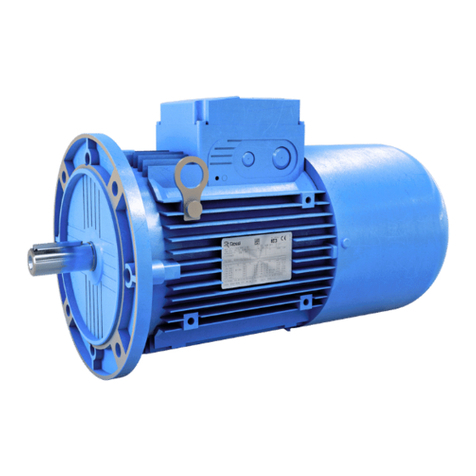
Flange Mounting
Solid Shaft Motors
To mount round frame motor to driven unit proceed as
follows:
Round frame motors can be rotated within flange
mounting bolt spacing to gain a satisfactory position for
grease fittings and conduit attachments, and to mate
run-out differences to avoid shimming flange fits.
Terminal boxes without accessory devices can be turned
to four equally spaced positions for access to conduit
system; arrange the system so that water will not
accumulate and drain into motor connection box.
1. Use a hoist; rig a sling around the lifting lugs.
2. Position motor (per note above) and move toward
driven unit - engaging cleaned flanged surfaces.
3. Insert flange mounting bolts and tighten to snug
tight.
4. Secure attachments between motor and shaft and
load. (i.e. set screws tightened against shaft key.)
5. Turn shaft by hand; check for free rotation; binding;
scraping; sticking.
6. Tighten all flange bolts. (Avoid warping or
springing the flange.)
7. Turn shaft again to check for free rotation.