manuals.online logo
Brands
  1. Home
  2. •
  3. Brands
  4. •
  5. Siemens
  6. •
  7. Thermostat
  8. •
  9. Siemens RDG400KN User manual

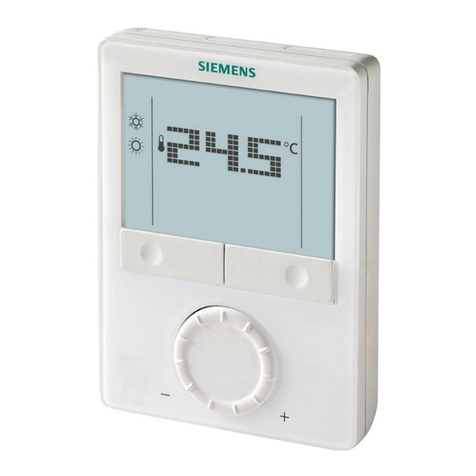
Siemens RDG400KN User manual

Other manuals for RDG400KN

6

This manual suits for next models

3

Other Siemens Thermostat manuals

Siemens G2255 series User manual

Siemens

Siemens G2255 series User manual

Siemens RDY2000 User manual

Siemens

Siemens RDY2000 User manual

Siemens Connected Home RDZ100ZB User manual

Siemens

Siemens Connected Home RDZ100ZB User manual

Siemens RDS110 User manual

Siemens

Siemens RDS110 User manual

Siemens RDG1 series User manual

Siemens

Siemens RDG1 series User manual

Siemens RDG200KN Operator's manual

Siemens

Siemens RDG200KN Operator's manual

Siemens RDF302 Operator's manual

Siemens

Siemens RDF302 Operator's manual

Siemens RDJ100 User manual

Siemens

Siemens RDJ100 User manual

Siemens 8MR2172-1A User manual

Siemens

Siemens 8MR2172-1A User manual

Siemens RDG110U User manual

Siemens

Siemens RDG110U User manual

Siemens DF301 Operator's manual

Siemens

Siemens DF301 Operator's manual

Siemens Powers TH 192 S User manual

Siemens

Siemens Powers TH 192 S User manual

Siemens RAB20 Series Owner's manual

Siemens

Siemens RAB20 Series Owner's manual

Siemens RDD100 Series User manual

Siemens

Siemens RDD100 Series User manual

Siemens RDG100KN User manual

Siemens

Siemens RDG100KN User manual

Siemens RDF800KN User manual

Siemens

Siemens RDF800KN User manual

Siemens RDF600 Series User manual

Siemens

Siemens RDF600 Series User manual

Siemens BRTRF User manual

Siemens

Siemens BRTRF User manual

Siemens TH 192 HC Owner's manual

Siemens

Siemens TH 192 HC Owner's manual

Siemens ZIEHL TR 1200 User manual

Siemens

Siemens ZIEHL TR 1200 User manual

Siemens RDG100 Series Operator's manual

Siemens

Siemens RDG100 Series Operator's manual

Siemens RDF300 Series Operator's manual

Siemens

Siemens RDF300 Series Operator's manual

Siemens RAA20LD-GB User manual

Siemens

Siemens RAA20LD-GB User manual

Siemens RDE100 Series User manual

Siemens

Siemens RDE100 Series User manual

Popular Thermostat manuals by other brands

Full Gauge TIC-17C product manual

Full Gauge

Full Gauge TIC-17C product manual

Imit Chronomix S manual

Imit

Imit Chronomix S manual

ChiliTec ST-35 ana instruction manual

ChiliTec

ChiliTec ST-35 ana instruction manual

Salus VS05 Installer's/user's manual

Salus

Salus VS05 Installer's/user's manual

Azel D-500 user guide

Azel

Azel D-500 user guide

Honeywell Chronotherm III owner's manual

Honeywell

Honeywell Chronotherm III owner's manual

Charmeg MP-R user manual

Charmeg

Charmeg MP-R user manual

dixell WING XW40LS Installing and operating instructions

dixell

dixell WING XW40LS Installing and operating instructions

Network Thermostat NetX X7C-WIFI Installation and programming manual

Network Thermostat

Network Thermostat NetX X7C-WIFI Installation and programming manual

Radio Thermostat CT80 Operation guide

Radio Thermostat

Radio Thermostat CT80 Operation guide

HAI Omnistat RC-120 installation manual

HAI

HAI Omnistat RC-120 installation manual

Lennox iComfort E30 Installation and setup guide

Lennox

Lennox iComfort E30 Installation and setup guide

Lux Products PSD011Ba Installation and operating instructions

Lux Products

Lux Products PSD011Ba Installation and operating instructions

Computherm Q20 operating instructions

Computherm

Computherm Q20 operating instructions

Heatmiser neoStat user manual

Heatmiser

Heatmiser neoStat user manual

Mars HEAT CONTROLLER IR Wireless Thermostat user manual

Mars

Mars HEAT CONTROLLER IR Wireless Thermostat user manual

LUX LP0511D user manual

LUX

LUX LP0511D user manual

Saswell SAS920XWHB-7-S-RF User manual and warranty card

Saswell

Saswell SAS920XWHB-7-S-RF User manual and warranty card

manuals.online logo
manuals.online logoBrands
  • About & Mission
  • Contact us
  • Privacy Policy
  • Terms and Conditions

Copyright 2025 Manuals.Online. All Rights Reserved.

CE1N3192en
2017-11-21 Building Technologies
s
3
1
9
2
RDG400KN
Room thermostats with
KNX communications RDG400KN
RDG405KN
For VAV heating and cooling systems
For room temperature and indoor air quality control
∂KNX bus communications (S- and LTE-Mode)
∂Backlit display
∂PI/P control
∂Output for VAV box/air damper: DC 0…10 V/3-position/KNX LTE-Mode
∂Output for heating/cooling coil: On/Off, PWM or 3-position/DC 0...10 V
∂Output signal inversion as an option (DC 0...10 V ⇓DC 10...0 V)
∂2 multifunctional inputs for keycard contact, external sensor, etc.
∂1 DC 0…10 V input for external sensor or feedback of air damper position
∂Operating modes: Comfort, Economy and Protection
∂Control depending on room or return air temperature
∂Optimized operation of supply air fan: Input DC 0...10 V for feedback of air
damper position
∂Automatic or manual heating/cooling changeover
∂Minimum and maximum limitation of room temperature setpoint
∂Minimum and maximum limitation of air flow signal
∂Adjustable commissioning and control parameters
∂Commissioning with Synco ACS790, ETS or via local HMI
∂Integration into Synco; integration into Desigo via group addressing (ETS)
or individual addressing
∂Integration into third-party system via group addressing (ETS)
∂Indoor air quality (IAQ) control loop with external CO2sensor (DC 0...10 V
or KNX LTE- and S-Mode) (RDG405KN)
∂Operating voltage AC 24 V
∂Interworking with KNX CO2/temperature sensors (LTE- and S-Mode)
RDG405KN
2 / 14
Siemens RDG40..KN Room thermostats with KNX communications CE1N3192en
Building Technologies 2017-11-21
Use
The RDG40..KN room thermostats are designed for the following types of system:
VAV systems via On/Off or modulating control outputs or KNX LTE-Mode:
∂Single-duct system
∂Single-duct system with electric heater
∂Single-duct system and radiator/floor heating
∂Single-duct system with heating/cooling coil
The room thermostats are delivered with a fixed set of applications.
The required application is selected and activated during commissioning using one
of the following tools:
∂Synco ACS
∂ETS
∂Local DIP switch and HMI
Functions
∂Room temperature control via built-in temperature sensor or external room
temperature/return air temperature sensor
∂Indoor air quality control via external CO2sensor (DC 0…10 V, KNX LTE- or S-
Mode) (RDG405KN)
∂Changeover between heating and cooling mode (automatically via local sensor
or bus, or manually)
∂Selection of applications via DIP switches or commissioning tool (ACS790, ETS)
∂Parameter download with commissioning tool (ACS, ETS)
∂Selection of operating mode via operating mode button on the thermostat
∂Temporary Comfort mode extension
∂Minimum and maximum limitation of room temperature setpoint
∂Minimum and maximum limitation of air flow signal (selectable via ETS)
∂External CO2sensor, DC 0…10 V; 0…2000 ppm (RDG405KN)
∂External CO2sensor, KNX; 0…5000 ppm (RDG405KN)
∂Button lock (automatic or manual)
∂2 multifunctional inputs, freely selectable for:
,Operating mode switchover contact (keycard, window contact, etc.)
(RDG400KN)
,Window contact switches operating mode to Protection (RDG405KN)
,Presence detector switches operating mode to Comfort (RDG405KN)
,Changeover sensor for automatic heating/cooling mode
,External room temperature or return air temperature sensor
,Dewpoint sensor
,Electric heater enable
,Faults
,Monitor input for temperature sensor or switch status
∂1 input DC 0…10 V for external sensor and feedback of air damper position
∂Optimization of pressure control using …
,feedback of air damper position and current air flow value via KNX bus,
,or feedback of air damper position via DC 0...10 V input
∂Floor heating temperature limit
∂Reloading factory settings for commissioning and control parameters
∂KNX bus (terminals CE+ and CE-) for communication with Synco or KNX
compatible devices
∂Display of outside temperature or time of day via KNX bus

3 / 14
Siemens RDG40.. KN Room thermostats with KNX communications CE1N3192en
Building Technologies 2017-11-21
∂Display of current room temperature or setpoint in °C and/or °F
∂Display of CO2external sensor value in ppm or with symbols (+++; ++-; +--)
(RDG405KN)
∂Time scheduling and central control of setpoints via KNX bus
∂RMB7../RMU7.. controller (signal exchange over KNX) using …
,the air demand signal of the thermostat to optimize the supply air
temperature,
,the energy demand signals of the heating/cooling equipment to optimize the
supply of energy,
,the feedback of the air damper position (DC 0...10 V or KNX) to optimize
operation of the supply air fan
Applications
The thermostat supports the following applications, which can be configured using
the DIP switches at the rear of the unit or a commissioning tool.
DIP switches 1...5 need to be set to OFF (remote configuration, factory setting) to
select an application via commissioning tool.
Application DIP switches
Remote configuration
Via commissioning tool (factory setting)
∂Synco ACS
∂ETS 1
ON
2 3
OFF 4 5
Single-duct
∂DC 0…10 V damper actuator (P47 = 0)
∂3-position damper actuator (P47 = 1)
∂VAV compact controller with
KNX LTE-Mode
3192S07
B1
T
M
VM
V
YV
1
ON
2 3
OFF 4 5
Single-duct with electric heater
∂DC 0…10 V damper actuator and On/Off,
PWM or 3-position electric heater (P47 = 0)
∂3-position damper actuator and
DC 0…10 V electric heater (P47 = 1)
∂VAV compact controller with KNX
LTE-Mode and electric heater
3192S08
YE
B1
T
M
VM
V
YV
1
ON
2 3
OFF 4 5
Single-duct and radiator/floor heating
∂DC 0…10 V damper actuator and On/Off,
PWM or 3-position radiator (P47 = 0)
∂3-position damper actuator and
DC 0…10 V radiator (P47 = 1)
∂VAV compact controller with KNX
LTE-Mode and radiator
3192S09
MV MV
YV
YR
B1
T
1
ON
2 3
OFF 4 5
4 / 14
Siemens RDG40..KN Room thermostats with KNX communications CE1N3192en
Building Technologies 2017-11-21
Single-duct heating and cooling coil
∂DC 0…10 V damper actuator and On/Off,
PWM or 3-position heating and cooling
(P47 = 0)
∂3-position damper actuator and
DC 0…10 V heating and cooling
(P47 = 1)
∂VAV compact controller with KNX
LTE-Mode and heating/cooling coil
3192S11
(B1)
T(B1)
M
VM
V
YV
Y1
T
1
ON
2 3
OFF 4 5
- P47 is used to change air damper output from DC 0...10 V (factory setting) to
3-position
- P46 is used to change valve output from On/Off (factory setting) to PWM
- DIP switch 4 is used to change output of Y10 from DC 0...10 V to DC 10...0 V
- DIP switch 5 is used to change valve output from On/Off to 3-position
Type summary
Product No. Features
Operating
voltage Number of control outputs Backlit
LCD
On/Off PWM 3-pos. DC
0…10 V
VAV
control via
KNX
LTE-Mode
IAQ
RDG400KN AC 24 V 11) 11) 11) 1--- 
RDG405KN AC 24 V 11) 11) 11) 1 
1) Selectable: On/Off, PWM or 3-position (triac outputs)
Ordering
Order valve actuators separately.
Equipment combinations
Type of unit Product No. Data
Sheet
Cable temperature sensor QAH11.1 1840
Room temperature sensor QAA32 1747
Condensation monitor QXA21.. A6V10741072
Flush-mount KNX room sensor
(base and front module)
AQR2576N..
AQR2532NNW
AQR2530NNW
AQR2532NNW
AQR2535NNWQ
1411
Note
Product No. Stock No. Description
RDG400KN S55770-T165 Room thermostat
RDG405KN S55770-T346 Room thermostat
Sensors
5 / 14
Siemens RDG40.. KN Room thermostats with KNX communications CE1N3192en
Building Technologies 2017-11-21
Wall-mount KNX sensor QMX3.P30
QMX3.P70 1602
Electric actuator, DC 0...10 V
(for radiator valves) SSA61.. 4893
Electric actuator, DC 0...10 V
(for 2- and 3-port valves/V..P45) SSC61.. 4895
Electric actuator, DC 0...10 V
(for small valves 2.5 mm V..P47) SSP61.. 4864
Electric actuator, DC 0...10 V
(for small valves 5.5 mm V..P45) SSB61.. 4891
Electric actuator, DC 0...10 V
(for CombiValves VPI46) SSA61.. 4893
Electromotoric actuator, DC 0...10 V
(for valves 5.5 mm) SAS61.. 4581
Thermal actuator, DC 0...10 V
(for small valves and radiator valves) STP63 4884
Damper actuator DC 0…10 V,
damper actuator 3-position
GQD161..
GQD131.. 4605
GDB161..
GDB131.. 4634
GLB161..
GLB131..
GMA161..
GMA131.. 4614
GEB161..
GEB131.. 4621
GCA161..
GCA131.. 4613
GBB161..
GBB131.. 4626
GIB161..
GIB131..
VAV compact controller
GDB181.1E/3
3544
GLB181.1E/3
Damper actuators
DC 0...10 V and
3-position, VAV
compact controllers
Valve actuators
DC 0...10 V
6 / 14
Siemens RDG40..KN Room thermostats with KNX communications CE1N3192en
Building Technologies 2017-11-21
VAV compact controller
for KNX LTE-Mode GDB181.1E/KN
3547
GLB181.1E/KN
Electromotoric On/Off valve and
actuator
(only available in AP, UAE, SA and IN)
MVI../MXI.. 4867
Electromotoric On/Off actuator SFA71.. 4863
Thermal actuator (for radiator
valves) STA73.. 4884
Thermal actuator
(for small valves 2.5 mm) STP73.. 4884
Electric actuator, 3-position
(for radiator valves) SSA81.. 4893
Electric actuator, 3-position
(for small valves 2.5 mm V..P47) SSP81.. 4864
Electric actuator, 3-position
(for small valves 5.5 mm V..P45) SSB81.. 4891
Electric actuator, 3-position
(for CombiValves VPI46) SSA81.. 4893
Electromotoric actuator, 3-position
(for valves 5.5 mm) SAS81.. 4581
* With PWM control, it is not possible to ensure exact parallel running of more than one thermal actuator. If several
actuators are controlled by the same room thermostat, preference should be given to motorized actuators with
On/Off or 3-position control
For more information about parallel operation and the maximum number of actuators that
can be used, refer to the Data Sheets of the selected type of actuator and the following
listing:
Maximum number of actuators in parallel operation in connection with RDG400KN and
RDG405KN:
∂6 actuators S..81 (3-position)
∂4 actuators ST..73 (On/Off)
∂4 actuators SFA.., MVI.., MXI.. (On/Off)
∂10 damper actuators G..16.. DC
∂6 damper actuators G..13.. (3-position)
Accessories
Description Product No./stock No. Data
Sheet*)
KNX power supply unit 160 mA (Siemens BT LV) 5WG1 125-1AB02 --
KNX power supply unit 320 mA (Siemens BT LV) 5WG1 125-1AB12 --
KNX power supply unit 640 mA (Siemens BT LV) 5WG1 125-1AB22 --
*) Documents can be downloaded from http://siemens.com/bt/download
Mechanical design
The room thermostat consists of 2 parts:
∂Plastic housing with electronics, operating elements and room temp. sensor
∂Mounting plate with screw terminals
The housing engages in the mounting plate and is secured with 2 screws.
Note
VAV compact
controllers
KNX LTE-Mode
On/Off valve
actuators
AC 24 V
On/Off/PWM valve
actuators
AC 24 V*
3-position
valve actuators
AC 24 V
7 / 14
Siemens RDG40.. KN Room thermostats with KNX communications CE1N3192en
Building Technologies 2017-11-21
1. Operating mode selector/Esc
2. Protection and OK
3. Rotary knob to adjust setpoints
and parameters
Operation and settings
Display
#
Symbol
Description
#
Symb
ol
Description
1Heating mode 13 Primary fan active (only supported with
Synco700 primary controller)
2Heating mode,
electric heater active 14 Degrees Celsius
Degrees Fahrenheit
3Cooling mode 15 Digits for room temperature and setpoint
display
4Comfort 16 Button lock active
5Economy 17 Condensation in the room (dewpoint
sensor active)
6Auto Timer mode according to
schedule (via KNX) 18 Weekday 1…7 from KNX bus
1 = Monday/7 = Sunday
7
8Protection mode 19 Fault
9Escape 20
Temporary timer function; visible when
operating mode is temporarily extended
(extended presence or absence)
10
Additional user information, like outside
temperature or time of day from
KNX bus; selectable via parameters
21 Fresh air (RDG405KN)
11 am/pm
ppm
am and pm: Real time clock in either
24-hour or 12-hour (am/pm) mode
ppm: CO2external sensor value
(RDG405KN)
22 Indicates that room temperature is
displayed
12 Confirmation of parameters
2
1
3
RDG400KN
RDG405KN
8 / 14
Siemens RDG40..KN Room thermostats with KNX communications CE1N3192en
Building Technologies 2017-11-21
Engineering notes
See "Reference documentation" below for information on how to engineer the KNX
bus (topology, bus repeaters, etc.) and how to select and size connecting cables
for power supply and field devices.
Mounting and installation
Do not mount on a wall in niches or bookshelves, behind curtains, above or near
heat sources, or exposed to direct solar radiation. Mount about 1.5 m above the
floor.
Mounting ∂Mount the room thermostat on a clean, dry indoor place without direct air flow
from a heating/cooling device, and not exposed to drip or splash water
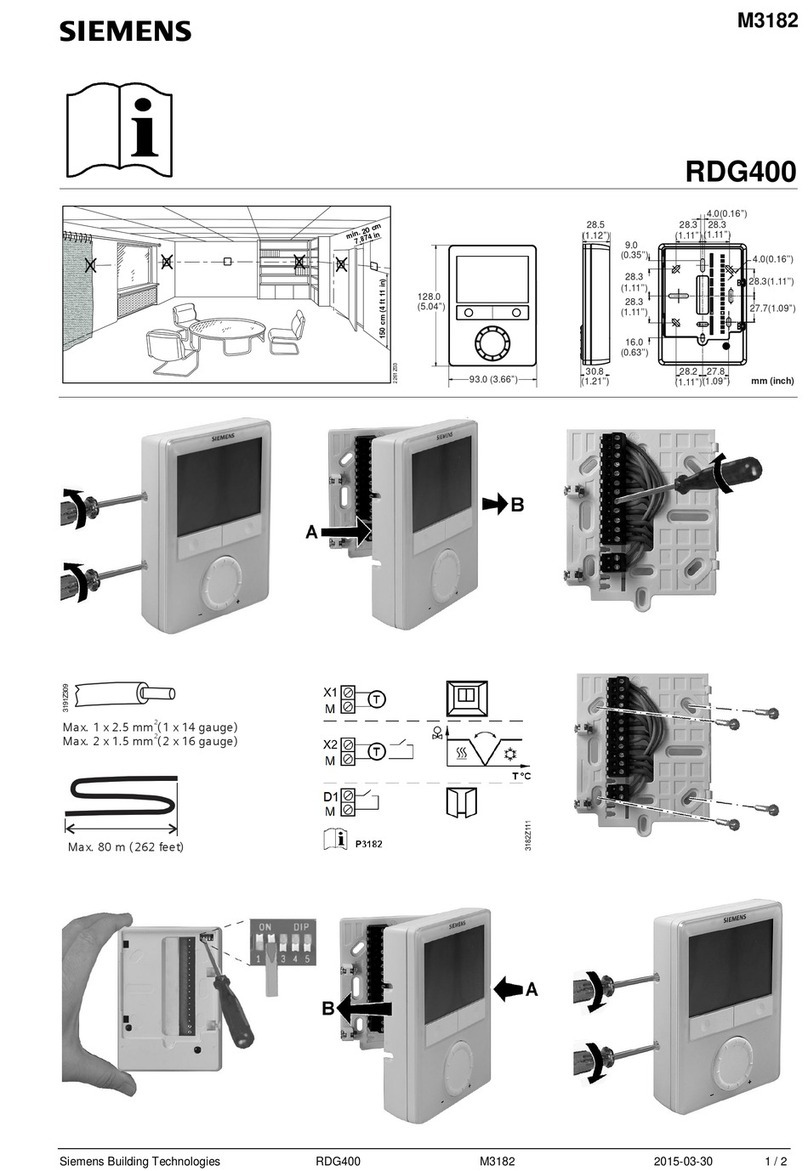
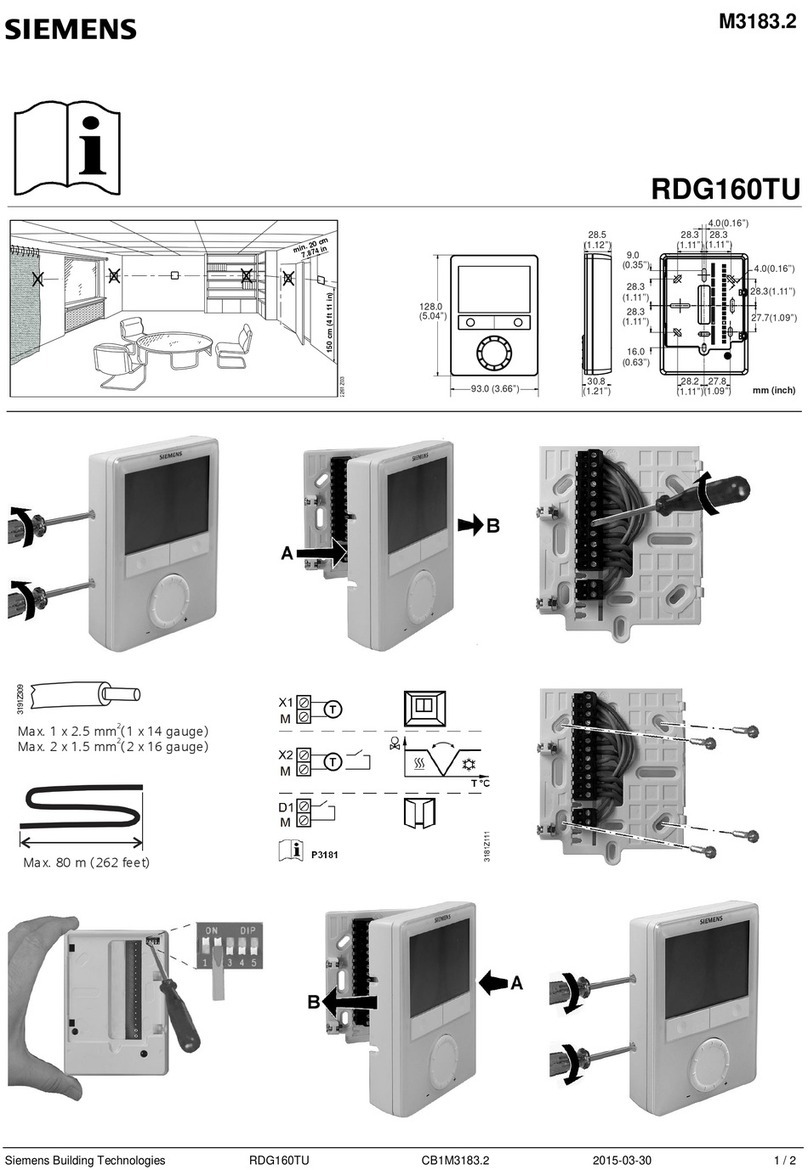
Wiring See Mounting Instructions M3192 (RDG400KN) or A6V10733804 (RDG405KN)
enclosed with the thermostat.
∂Comply with local regulations to wire, fuse and earth the thermostat
∂Power supply line must have a circuit breaker with a rated current of no more
than 10 A
∂Isolate the cables of inputs X1-M, U1-G0 and D1-GND for 230 V if the conduit
box carries AC 230 V mains voltage
∂Inputs X1-M or D1-GND: Several switches (e.g. summer/winter switch) may be
connected in parallel. Consider overall maximum contact sensing current for
switch rating
∂Isolate the cables of KNX communication input CE+/CE- for 230 V if conduit box
carries AC 230 V mains voltage
∂Disconnect the unit from power supply before removing it from its mounting plate
∂If a KNX bus power supply is connected to the line with communicating
thermostats and a Synco controller, the internal KNX power supply of the Synco
controller must be switched off
9 / 14
Siemens RDG40.. KN Room thermostats with KNX communications CE1N3192en
Building Technologies 2017-11-21
Commissioning notes
The room thermostats are delivered with a fixed set of applications.
Select and activate the required application during commissioning using one of the
following tools:
,Local DIP switch and HMI
,Synco ACS
Version 5.11 or higher (for RDG400KN)
Version 10.03 or higher (for RDG405KN)
,ETS
Set the DIP switches before snapping the unit to its mounting plate, if you want to
select an application via DIP switches.
All DIP switches must be set to OFF (remote configuration), if you want to select an
application via commissioning tool.
After power is applied, the thermostat resets and all LCD segments flash, indicating
that the reset was made correctly. After the reset, which takes about 3 seconds,
the thermostat is ready for commissioning by qualified HVAC staff.
If all DIP switches are set to OFF, the display reads NO APPL to indicate that
application commissioning via tool is required.
Each time the application is changed, the thermostat reloads the factory settings
for all control parameters, except for KNX device and zone addresses!
For commissioning, connect the Synco ACS or ETS tool to the KNX bus cable at
any point:
ACS and ETS3 require an interface:
,RS232 KNX interface (e.g. Siemens UP146/02, UP152)
,OCI702 USB-KNX interface
An external KNX bus power supply is required if an RDG.. is connected directly to
a tool (ACS or ETS) via KNX interface.
Applications
Note
Connect tool
Note
10 / 14
Siemens RDG40..KN Room thermostats with KNX communications CE1N3192en
Building Technologies 2017-11-21
The thermostat's control parameters can be changed to ensure optimum
performance of the entire system (see Basic Documentation P3192).
The parameters can be adjusted using …
,the local HMI
,Synco ACS
,ETS
∂The control sequence may need to be set via P01 depending on the application.
The factory setting is "Cooling only"
∂Recalibrate the temperature sensor if the room temperature displayed on the
thermostat does not match the room temperature measured (after min. 1 hour of
operation). To do this, change P05
∂We recommend to review the setpoints and setpoint ranges (P08…P12) and to
change them as needed to ensure maximum room comfort and to save energy
The programming mode helps identify the thermostat in the KNX network during
commissioning.
Press the left and right buttons simultaneously for 6 seconds to activate
programming mode, which is indicated on the display with PrOg.
Programming mode remains active until identification of the thermostat is complete.
Assign the device address (P81) via HMI, ACS or ETS.
To deactivate communication, set the device address to 255 (no
exchange of process data).
Use ETS to assign the KNX group addresses of the RDG communication objects.
Each device has a unique KNX serial number inside the plastic housing.
An additional sticker with the same KNX serial number is enclosed in the packa-
ging box. This sticker is intended for installers for documentation purposes.
Disposal
The device is considered an electronic device for disposal in terms of the
European Directive 2012/19/EU and may not be disposed of as domestic
garbage.
∂Dispose of the device through channels provided for this purpose.
∂Comply with all local and currently applicable laws and regulations.
Control parameters
Control sequence
Calibrating the sensor
Setpoint and setpoint
range limitation
Programming mode
Assigning the KNX
device address
Assigning the KNX
group addresses
KNX serial number