Stretcher Operation
5
RAISING AND LOWERING LITTER HEIGHT
NOTE
For user convenience, there are two stretcher bases available: a ”three–sided”base with pump pedals and
control pedals on both sides of the stretcher and on the foot or head end and a ”four–sided”base with pump
pedals and control pedals on both sides and on both ends.
CAUTION
Be sure to move any equipment that may be in the way before raising or lowering stretcher height.
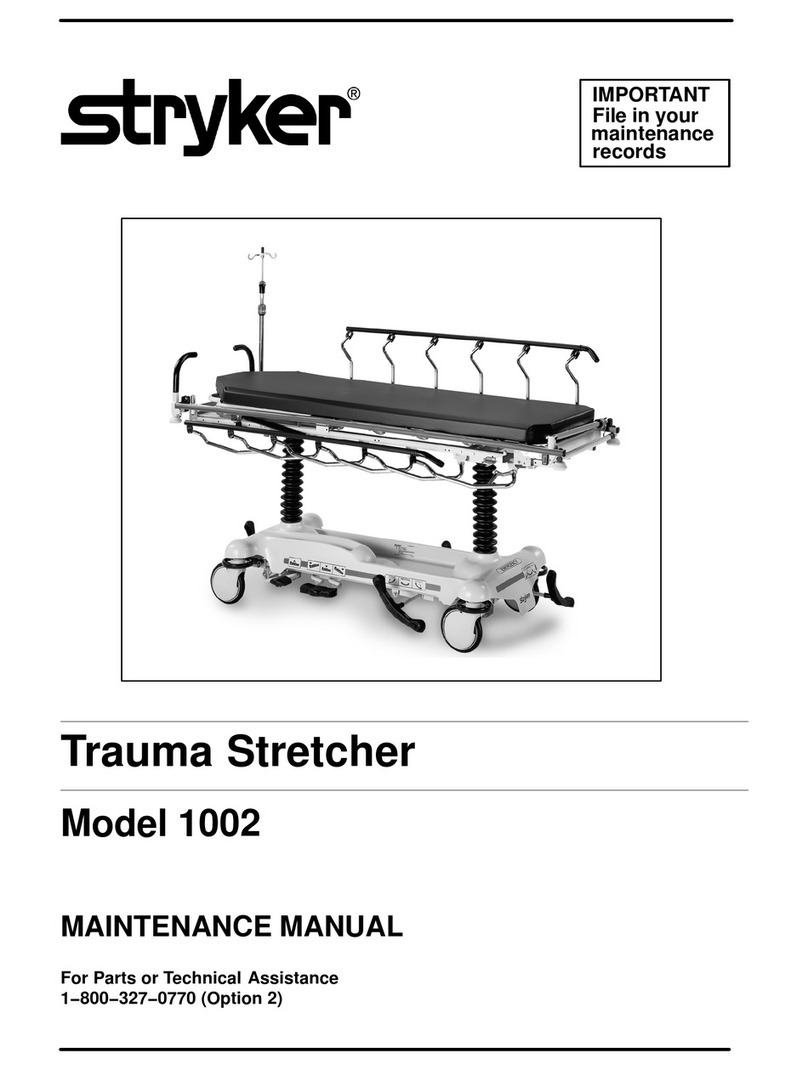
To raise the litter height, pump the foot pump pedal (A) repeatedly until desired height is achieved. (See il-
lustration, page 3 for ”three–sided”bases or page 4 for ”four–sided”bases).
To lower the litter height, depress pedal (B) to lower the head end and depress pedal (C) to lower the foot
end of the stretcher. (See illustration, page 3 or page 4). The base may be equipped with optional variable
descent controls. With variable descent controls, the farther you press down on the pedal, the faster the litter
will lower.
NOTE
When lowering both ends of the stretcher simultaneously, activate both pedals (B) and (C) using the same
foot.
TRENDELENBERG/REVERSE TRENDELENBERG POSITIONING
NOTE
Litter height must be raised first in order to achieve a trend. or reverse trend. position.
CAUTION
Be sure to remove any equipment that may be in the way before lowering stretcher.
For Trendelenberg positioning (head down), depress pedal (B). (See illustration, page 3 or page 4).
For Reverse Trendelenberg positioning (foot down), depress pedal (C). (See illustration, page 3 or page
4).
NOTE
The higher the litter is before pedals (B) or (C) are activated, the greater the trend. or reverse trend. angle
will be. (Maximum trend. angle is +18_. Maximum reverse trend. angle is –18_).
OPERATING DIRECTIONAL STEERING CASTER/5TH WHEEL OPTIONS
The purpose of the steer wheel and 5th wheel options are to help guide the stretcher when transporting a
patient along a straight line and also for pivoting at corners.
NOTE
Stretchers cannot be equipped with both steering caster and fifth wheel options. The choice was made at
the time the stretcher was purchased.
Important: For proper ”tracking”of the steer caster or fifth wheel options, push the stretcher approximately
10 feet to allow the wheels to face the direction of travel before engaging the steer pedal. If this procedure
is not followed, proper ”tracking”will not occur, causing difficulty with steering the stretcher.
The steer wheel is located at the foot end of the stretcher on the patient’s left. The 5th wheel is located under-
neath the center of the base assembly.
To engage the steer wheel/5th wheel on a ”Dual Side Control”stretcher, push the right side of pedal (D) to
the full down position. (See illustration page 3).
To engage the steer wheel/5th wheel on a ”Dual End Control”stretcher, pull pedal (D) to the full up position.
(See illustration page 4).