Daily checks
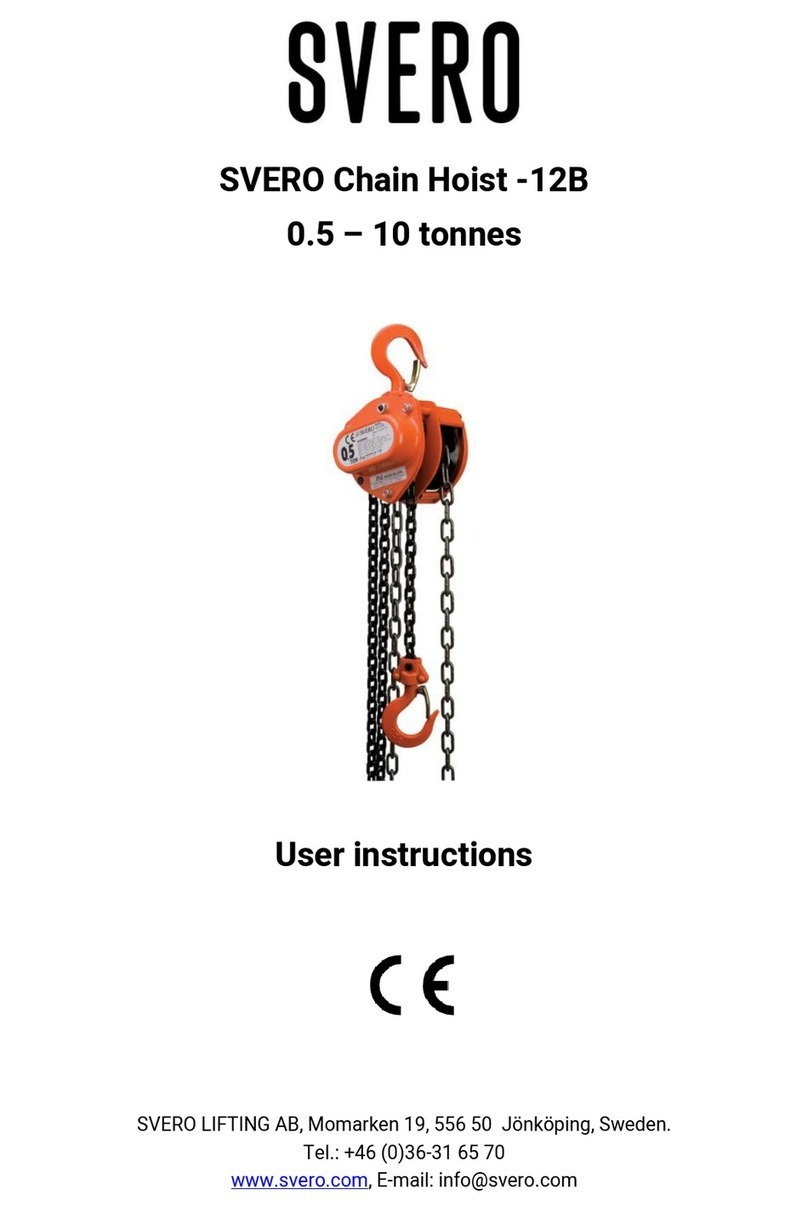
After every working day on which the lever hoist has been used, the following should be checked:
•Is the lever hoist deformed or otherwise damaged? Are any parts missing?
•Is any deformation or other damage visible on the suspension device (eye, shackle,
bolt or similar)?
•Are the hooks intact or have any hooks opened? Are the hook latches correct and functional?
•The selector must work without problems.
•Wipe down the lever hoist and oil the chain as required.
•The chain must be undamaged, i.e. no signs of wear and no deformed or otherwise damaged
links.
The chain must not be kinked or twisted. With 2-fall lever hoists (6 t), there is a risk of the
chain twisting if the bottom hook assembly ends up looped through the chain sling –usually
during refitting or moving the hoist between work stations. See Fig 6.
•The chain stop must free of deformation or other damage.
•The brake function must be intact.
In the event of faults or failures, the hoist must be repaired and carefully checked by a specialist before
reuse.
Continuous maintenance - lubrication
Oil the hook latches and bearings. Grease the pawl and ratchet and also the gear. Lubrication must
be sparingly and carefully applied so no grease gets on the brake disk. Oil the chain for longer life.
Periodic checks
Periodic checks are normally carried out yearly to detect and remedy any faults. If required (e.g.
high frequency of use), more frequent checks may be carried out. See “Checklist for periodic
checks”. Measure hooks and chain to detect any changes in shape.
Hook checks (See Fig. 5 and Table 2)
Opening dimension A on the hooks is important. A hook with too large a maximum dimension has
been exposed to overloading or overheating. It therefore does not have the necessary load
capacity. The hooks may also have been exposed to long-term wear (dimension B).