manuals.online logo
Brands
  1. Home
  2. •
  3. Brands
  4. •
  5. Synthes
  6. •
  7. Medical Equipment
  8. •
  9. Synthes Dorsal User manual

Synthes Dorsal User manual

This manual suits for next models

1

Other Synthes Medical Equipment manuals
Synthes Pelvic C-Clamp User manual

Synthes

Synthes Pelvic C-Clamp User manual

Synthes Hybrid Fixator User manual

Synthes

Synthes Hybrid Fixator User manual

Synthes Small Stature USS User manual

Synthes

Synthes Small Stature USS User manual

Synthes CODMAN NEURO CODMAN CERTAS Plus User manual

Synthes

Synthes CODMAN NEURO CODMAN CERTAS Plus User manual

Synthes MatrixRIB User manual

Synthes

Synthes MatrixRIB User manual

Synthes Pelvic C-Clamp II User manual

Synthes

Synthes Pelvic C-Clamp II User manual

Synthes FMS 283573 User manual

Synthes

Synthes FMS 283573 User manual

Synthes Titanium Trochanteric FixationNail System User manual

Synthes

Synthes Titanium Trochanteric FixationNail System User manual

Synthes SynFrame Light-transmitting Rod 387.362 User manual

Synthes

Synthes SynFrame Light-transmitting Rod 387.362 User manual

Synthes PEAK User manual

Synthes

Synthes PEAK User manual

Synthes Maintenance Unit User manual

Synthes

Synthes Maintenance Unit User manual

Synthes ComPact Air Drive II User manual
Synthes

Synthes ComPact Air Drive II User manual

Synthes Small Battery Drive II User manual

Synthes

Synthes Small Battery Drive II User manual

Synthes Delta Xtend User manual

Synthes

Synthes Delta Xtend User manual

Synthes USS Universal User manual

Synthes

Synthes USS Universal User manual

Synthes LISS DF User manual

Synthes

Synthes LISS DF User manual

Synthes DFN User manual

Synthes

Synthes DFN User manual

Synthes TFN User manual

Synthes

Synthes TFN User manual

Synthes ComPact Air Drive II User manual

Synthes

Synthes ComPact Air Drive II User manual

Synthes Colibri II User manual

Synthes

Synthes Colibri II User manual

Synthes LCP Distal Humerus Plates User manual
Synthes

Synthes LCP Distal Humerus Plates User manual

Synthes DHS User manual

Synthes

Synthes DHS User manual
Synthes EXPEDIUM VERSE Parts list manual

Synthes

Synthes EXPEDIUM VERSE Parts list manual

Synthes Hybrid Fixator Proximal Tibia Frame User manual
Synthes

Synthes Hybrid Fixator Proximal Tibia Frame User manual
Popular Medical Equipment manuals by other brands

Itamar Medical WatchPAT Operation manual

Itamar Medical

Itamar Medical WatchPAT Operation manual

PROTEOR 1P650 KNEE Assembling and adjustment instructions

PROTEOR

PROTEOR 1P650 KNEE Assembling and adjustment instructions

Liberate Medical VentFree user manual

Liberate Medical

Liberate Medical VentFree user manual
Dicarre DA20 user guide

Dicarre

Dicarre DA20 user guide

Stryker Medical M Series Operation manual

Stryker Medical

Stryker Medical M Series Operation manual

Invacare ScanBed 750 user manual

Invacare

Invacare ScanBed 750 user manual

Getinge Arjohuntleigh Nimbus 3 Professional Instructions for use

Getinge

Getinge Arjohuntleigh Nimbus 3 Professional Instructions for use

Mettler Electronics Sonicator 730 Maintenance manual

Mettler Electronics

Mettler Electronics Sonicator 730 Maintenance manual

Pressalit Care R1100 Mounting instruction

Pressalit Care

Pressalit Care R1100 Mounting instruction

Denas MS DENAS-T operating manual

Denas MS

Denas MS DENAS-T operating manual

bort medical ActiveColor quick guide

bort medical

bort medical ActiveColor quick guide

AccuVein AV400 user manual

AccuVein

AccuVein AV400 user manual

agiliti NP Trio user manual

agiliti

agiliti NP Trio user manual

Rocket Medical Rocket Digital Oocyte Aspiration Pump Service manual

Rocket Medical

Rocket Medical Rocket Digital Oocyte Aspiration Pump Service manual

Monteris Medical Neuroblate Instructions for use

Monteris Medical

Monteris Medical Neuroblate Instructions for use

Otto Block 8E33 7 manual

Otto Block

Otto Block 8E33 7 manual

ADVANCED HOME CARE Helios Guide

ADVANCED HOME CARE

ADVANCED HOME CARE Helios Guide

NeuLog NUL-208 Guide

NeuLog

NeuLog NUL-208 Guide

manuals.online logo
manuals.online logoBrands
  • About & Mission
  • Contact us
  • Privacy Policy
  • Terms and Conditions

Copyright 2025 Manuals.Online. All Rights Reserved.

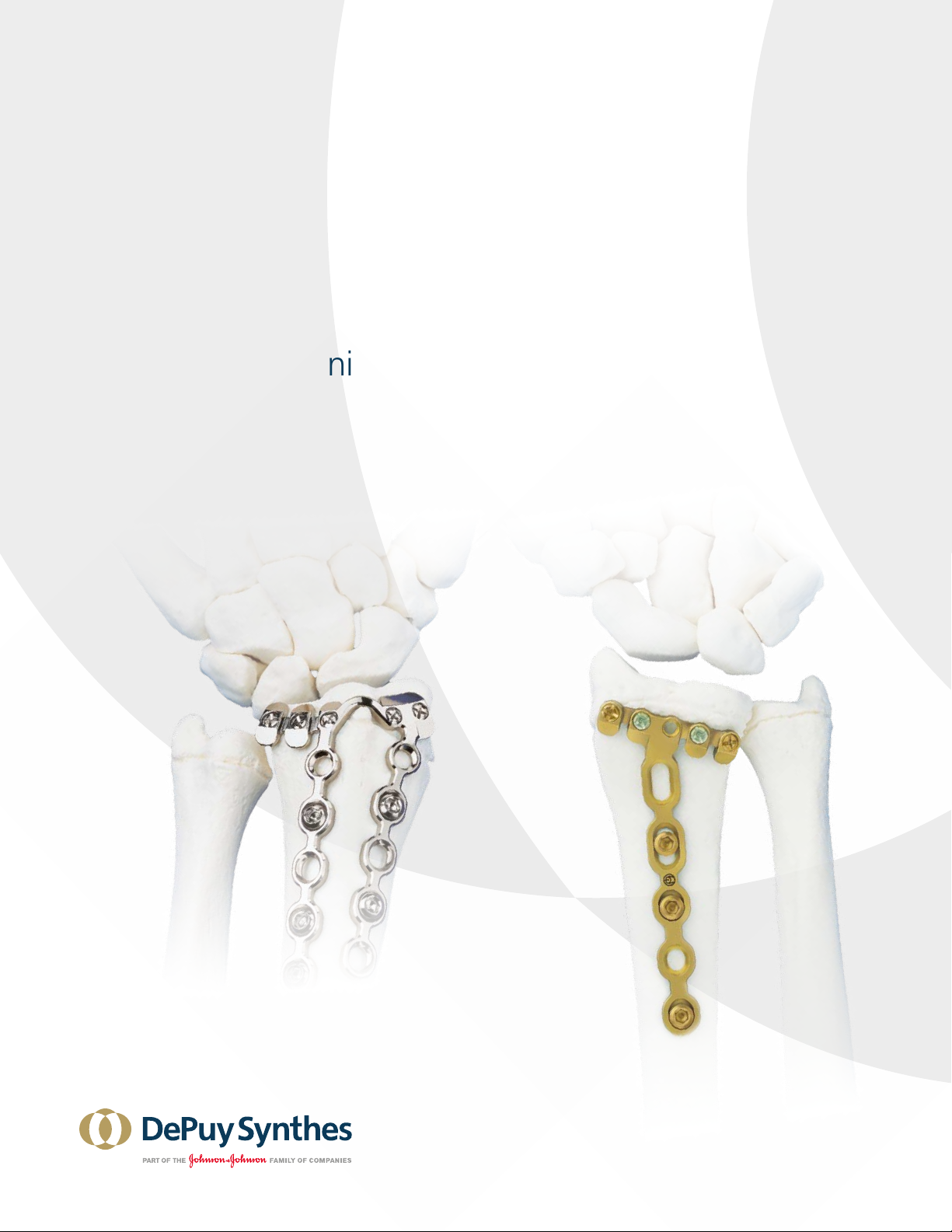
Distal Radius Plate
Instrument and Implant Set
Surgical Technique
1 DePuy Synthes Distal Radius Plate Instrument and Implant Set Surgical Technique
Indications
For xation of fractures and osteotomies,
including carpal fusions involving the
distal radius.
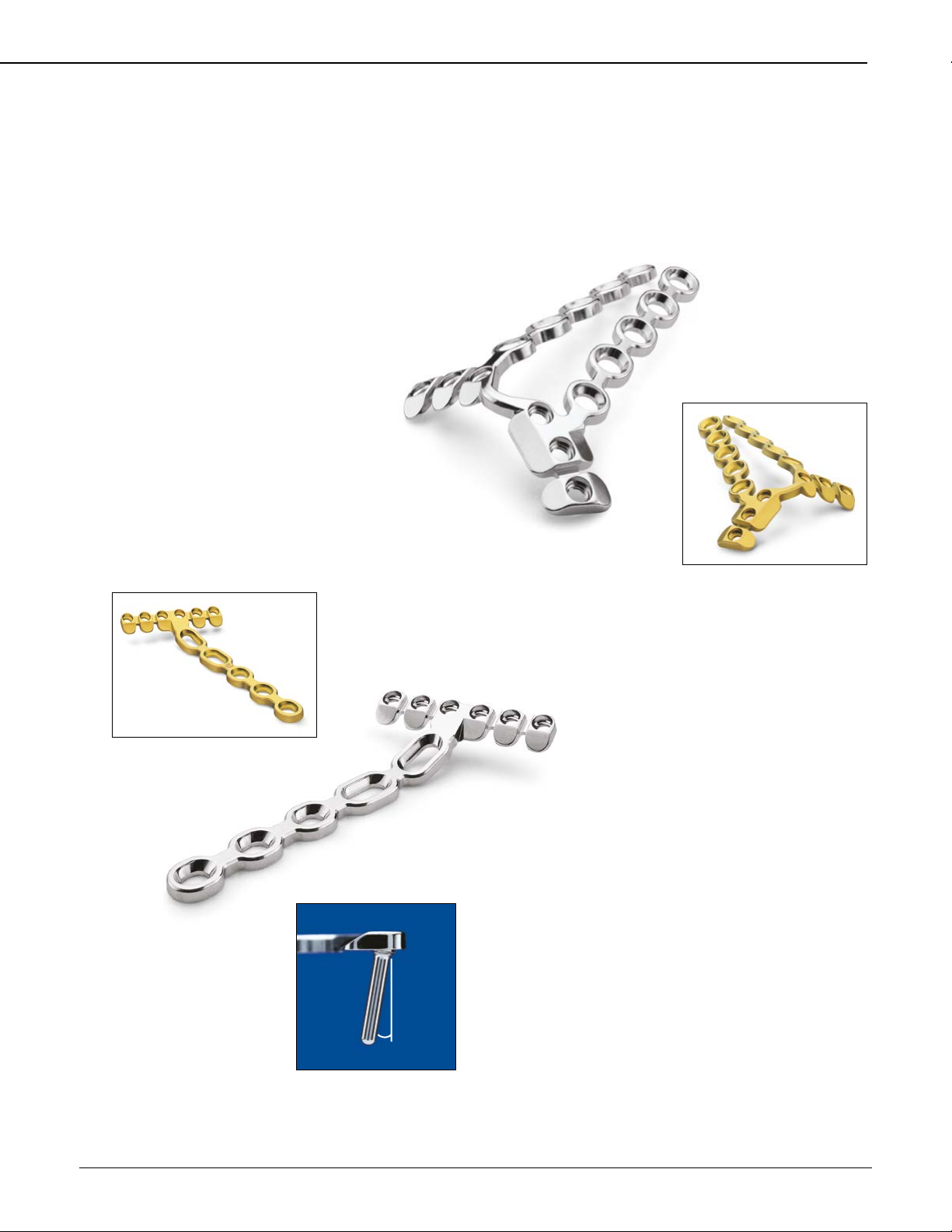
e Distal Radius Plates
Unique distal articular plate arms:
•Accept 1.8 mm threaded buttress pins that lock into
the threaded plate holes, providing a xed-angle
construct to buttress the articular surface
•2.4 mm self-tapping cortex screws can be used as an
alternative to, or in conjunction with, the 1.8 mm
buttress pins for increased hold and to lag together
dorsal and volar articular fragments
•Provide multiple points of xation and the
ability to buttress small fragments, allowing the
articular surface to be more easily reconstructed
readed holes in the
distal arms accept
1.8 mm buttress pins or
2.4 mm self-tapping
cortex screws.
Features
•Dorsal and volar plates available in right and
left designs
•Ramped edges and low prole plate/screw construct
minimize tendon and soft tissue irritation
•Precontoured for anatomical t
•Cut-to-length design to minimize inventory
•Elongated holes in the proximal shaft allow
for compression
•Available in stainless steel and titanium alloy
Distal Radius Plate Instrument and Implant Set Surgical Technique DePuy Synthes 2
Dorsal Distal Radius Plate
•Precise anatomical contour minimizes the
need to remove Lister’s tubercle
•Two proximal legs allow independent planes
of xation
Volar Distal Radius Plate
•20° AP bend ts the volar surface of
the distal radius
•18° angulation of distal plate arm provides
anatomic t for radial inclination
•10° angulation of threaded holes allows
more distal placement of the plate
10°
Titanium alloy
Titanium alloy
3 DePuy Synthes Distal Radius Plate Instrument and Implant Set Surgical Technique
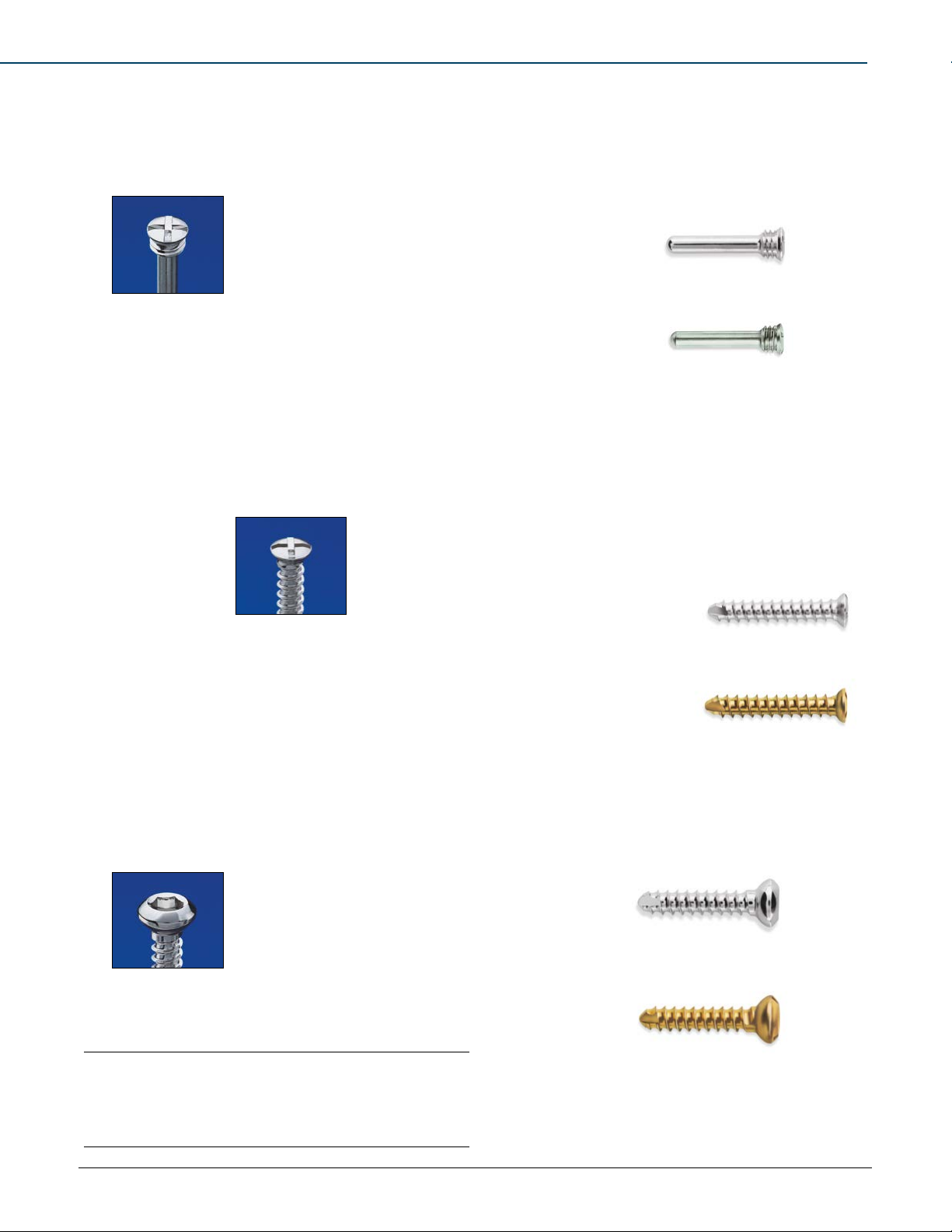
Implants (stainless steel and titanium)
1.8 mm Buttress Pin
•For use in the distal plate arms in multifragmented
articular fractures, or in poor quality bone
where screw purchase may be compromised
•readed head locks into plate hole to
provide a xed pin-plate construct and
a buttress for the articular surface
•Smooth shaft inserts into bone without
displacing fragments
2.4 mm Self-Tapping Cortex Screw
•For use in the distal plate arms to
provide xation for restoration of the
articular surface
•Used when bone quality is good,
lag screw technique is required,
or large fragments of poor quality
bone are present
•Small cruciform head provides a low
prole when seated into the plate hole
2.7 mm Self-Tapping Cortex Screw
•For use in the proximal plate legs
•Standard self-tapping screws also available
in the DePuy Synthes Mini Fragment Instrument
and Implant Sets [105.488] and [125.488]
201.962–201.980
201.612–201.630
202.810–202.826
402.810–402.826
401.962–401.980
401.612–401.630
MR Information
The Distal Radius Plate Instrument and Implant Set System has not been evaluated for
safety and compatibility in the MR environment. It has not been tested for heating,
migration or image artifact in the MR environment. The safety of the Distal Radius
Plate Instrument and Implant Set System in the MR environment is unknown. Scanning
a patient who has this device may result in patient injury.
Distal Radius Plate Instrument and Implant Set Surgical Technique DePuy Synthes 4
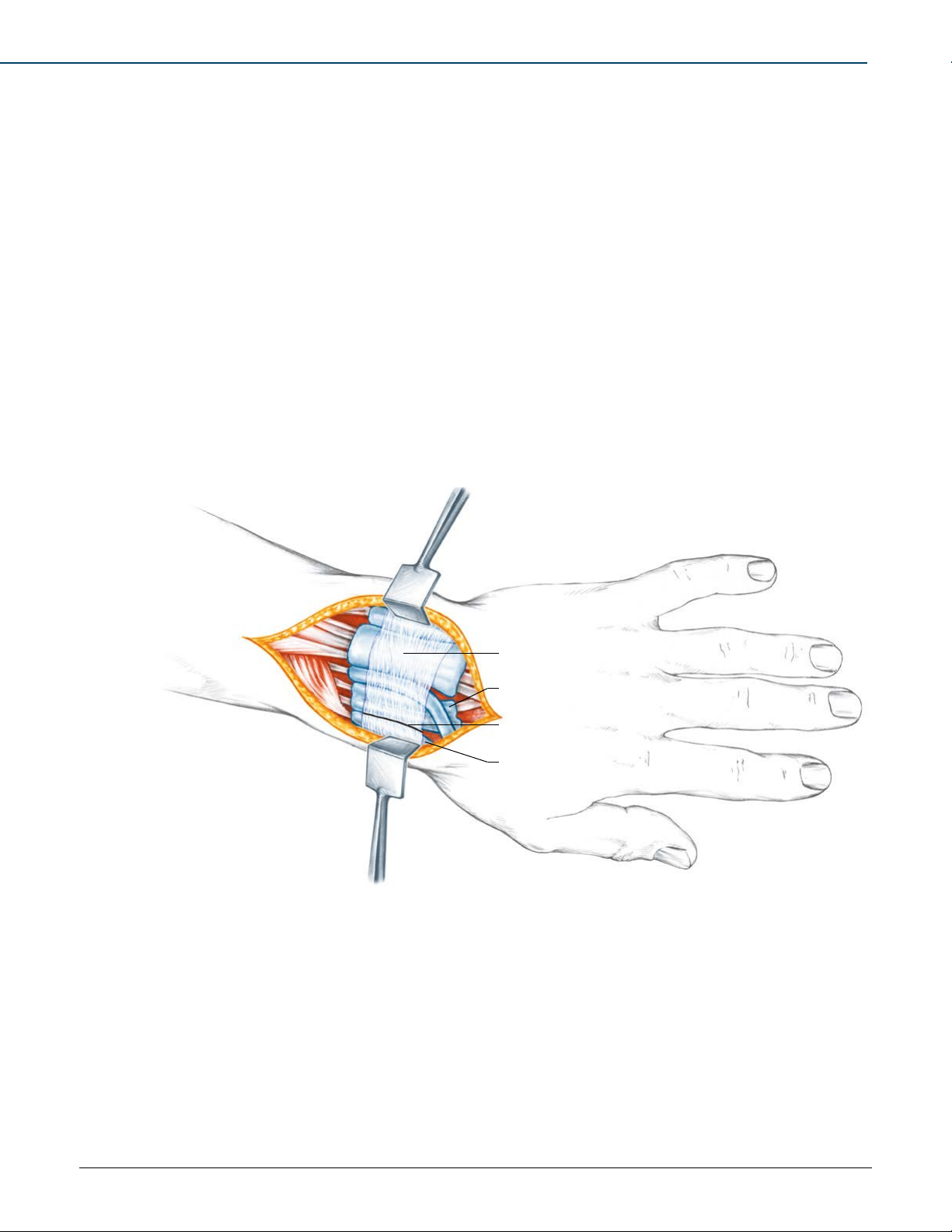
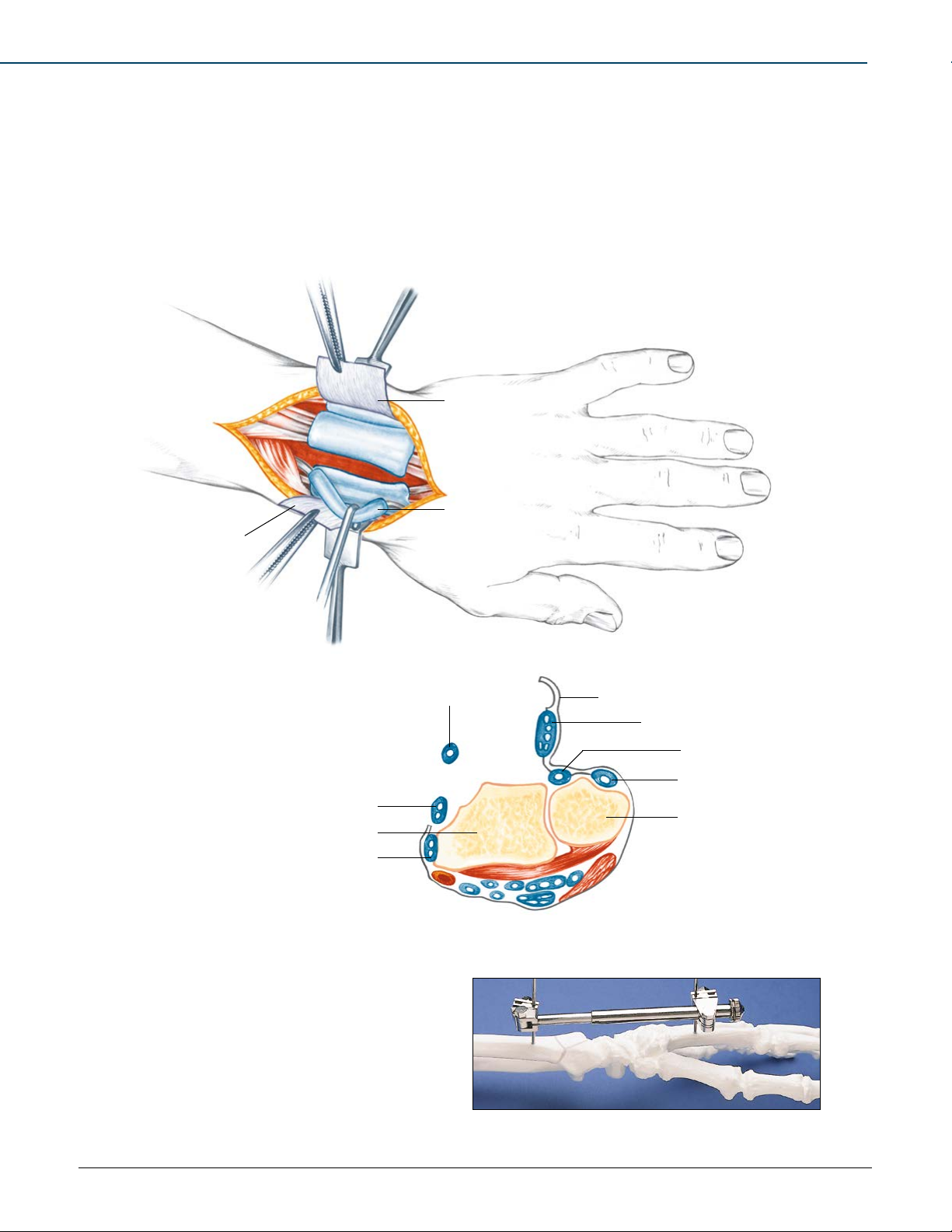
Dorsal Surgical Approach
Place the patient in the supine position with
the hand and arm on a hand table, preferably
radiolucent for uoroscopic imaging.
Make a straight longitudinal incision over the
dorsal radius, between the second and third
extensor compartments, extending 7 to 12 cm.
Open the extensor retinaculum using a
longitudinal incision between the rst and
second extensor compartments as shown below.
Extensor retinaculum
Incision
Compartment 2
Compartment 1
5 DePuy Synthes Distal Radius Plate Instrument and Implant Set Surgical Technique
Dorsal Surgical Approach (continued)
Elevate the second and fourth dorsal
compartments subperiosteally
(as shown in cross-sectional view)
to preserve the integrity of these
compartments.
Note: If the fracture morphology dictates, use
of the additionally available mini lengthening
apparatus [394.08] will provide gentle indirect
reduction of complex fractures and minimize
soft tissue dissection.
Extensor retinaculum
Compartment 4
Compartment 6
Ulna
Cross-sectional view
Compartment 1
Compartment 3
Extensor pollicis longus
Extensor retinaculum
Compartment 5
Mini Lengthening Apparatus
394.08
Radius
Compartment 2
Compartment 3
Extensor pollicis longus
Extensor retinaculum
Take care to elevate and mobilize the third compartment (extensor pollicis
longus tendon) proximally and distally, and translocate it radially for better
access to the fracture site.
Distal Radius Plate Instrument and Implant Set Surgical Technique DePuy Synthes 6
Dorsal Plate Technique
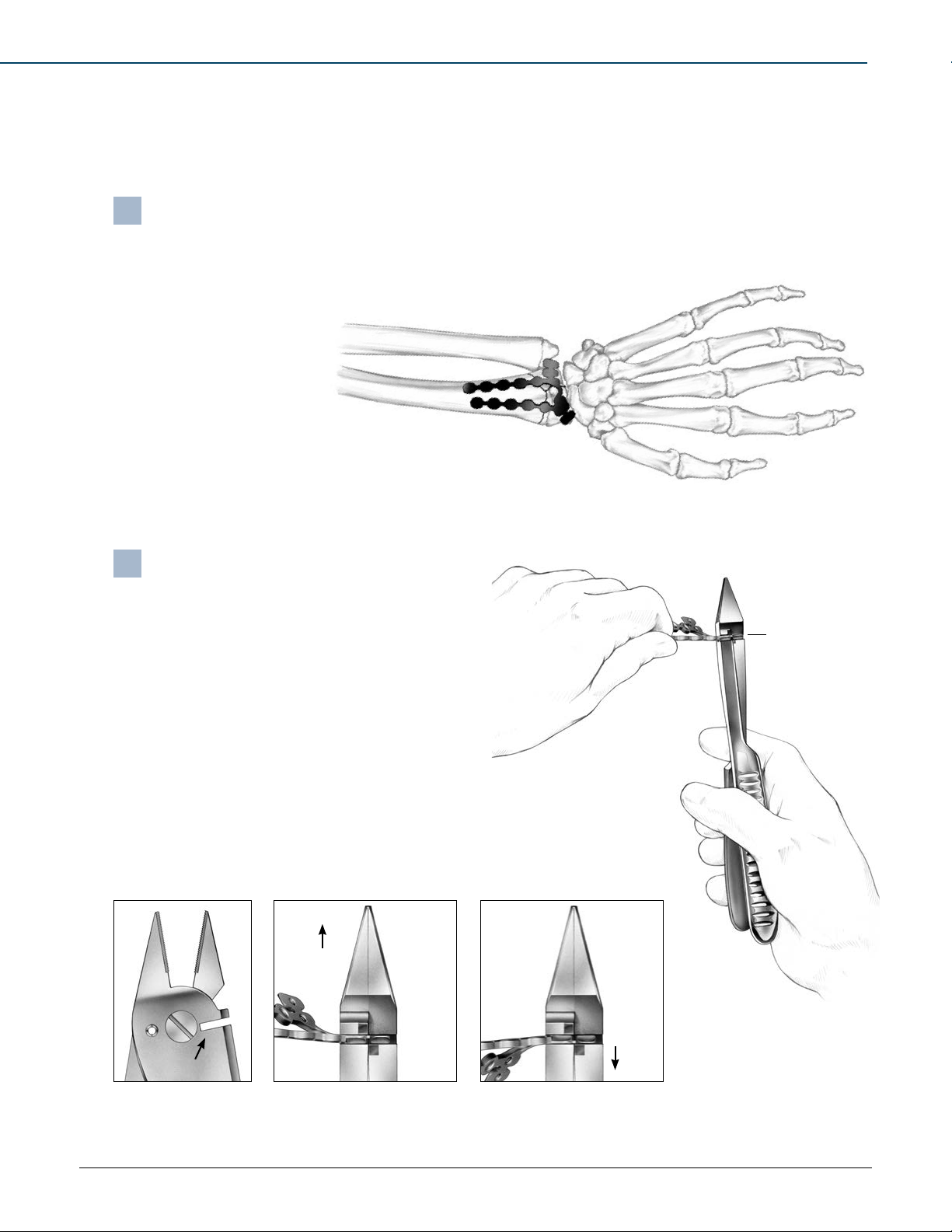
Cut plate
Place the pliers in the right hand. To cut the plate,
open the pliers and slide the plate into the cutting
slot from the left side as shown. e underside
of the plate must be oriented toward the tip
of the pliers. Cut the plate between the holes by
aligning the plate in the center of the cutting slot.
Do not cut through a plate hole. Squeeze the
pliers closed to cut the plate.
Note: Most cases will require removing holes from
each arm and leg of the plate in order to t patient
anatomy and provide sucient stability without
increasing tissue dissection.
Shape template
Temporarily position the bending template [329.599]
over the distal radius. Verify plate length and contour,
then compare it to the distal radius plate.
Note: e bending template
can be used for either
right- or left-hand plates.
Note: If a more proximal plate
placement is desired, it may be
necessary to remove 1–2 mm
of the distal portion of
Lister’s tubercle.
1
2
Bending/
Cutting Pliers
391.962
With pliers open,
insert plate into
left side of
cutting slot
CORRECT: Underside of plate
towards tip of pliers. Cut between
plate holes where handles
interface.
INCORRECT: Top of plate towards
tip of pliers.
Underside
of plate
Cutting slot
Underside
of plate
must be
UP
7 DePuy Synthes Distal Radius Plate Instrument and Implant Set Surgical Technique
#
Dorsal Plate Technique (continued)
Contour distal plate arms
If required, use the bending irons to contour
the plate’s articular arms to t the distal radius.
read a bending iron into a distal-arm plate
hole. read another bending iron into the
adjacent hole and gently spread the irons
apart to create a convex bend.
Note: Contour the plate in small increments
to avoid over-bending and the need to
re-bend. Excessive back-and-forth bending
may weaken or fracture the plate.
3
Contour proximal plate legs
If needed, use the bending pliers to gently
contour the proximal legs to better t the
distal shaft of the radius.
4
Universal
Bending Pliers
391.963
Bending Iron
329.09
Distal Radius Plate Instrument and Implant Set Surgical Technique DePuy Synthes 8
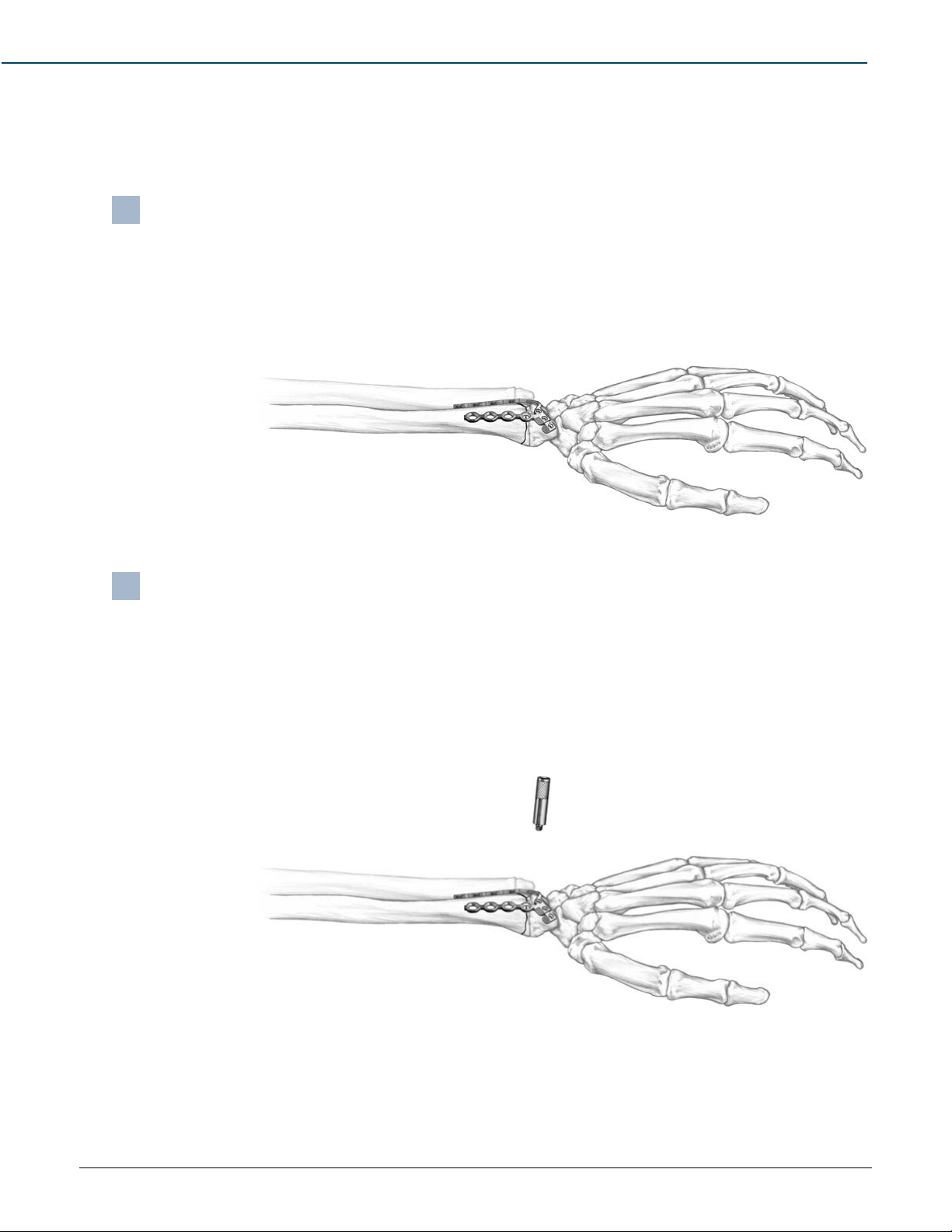
Apply plate
Place the plate on the distal radius and
determine which holes will be used for
xation. e fracture pattern and clinical
situation will determine the specic order
of xation (proximal leg or distal arm).
5
Secure distal arms
6
1.8 mm Threaded
Drill Guide
312.92
6A: To secure the plate with 1.8 mm buttress
pins, screw a 1.8 mm threaded drill guide into
the threaded plate hole until seated.
Note: e threaded drill guide must be used to ensure
the proper drilling angle. Otherwise, the buttress pins
may not thread into the plate holes.
Determine whether 1.8 mm buttress pins
or 2.4 mm self-tapping cortex screws will
be used for xation. A combination of both
implants may be used.
9 DePuy Synthes Distal Radius Plate Instrument and Implant Set Surgical Technique
Dorsal Plate Technique (continued)
Remove the drill guide and use the depth gauge
[319.006] to measure and select the appropriate
length buttress pin.
Note: Be sure to consider the width of any gap between
the bone and plate when determining pin length.
Tightening the screws will close this gap and result in
pin tip protrusion beyond the far cortex, potentially
causing soft tissue irritation.
Using the cruciform screwdriver, push the buttress
pin through the hole and turn until the threaded
portion of the pin head locks into the plate.
Cruciform Screwdriver Shaft
with Holding Sleeve
314.67.97
Secure distal arms (continued)
Using the 1.8 mm drill bit and guide, drill through
both cortices. Buttress pins should be used
bicortically. Exercise caution to avoid excessive
protrusion through the far cortex.
1.8 mm Threaded
Drill Guide
312.92
Handle with
Mini Quick Coupling
311.01
6
1.8 mm Drill Bit
310.510