VIPA System 200V Manual Chapter 1 Introduction
HB97E - Rev. 01/46 1-3
Components
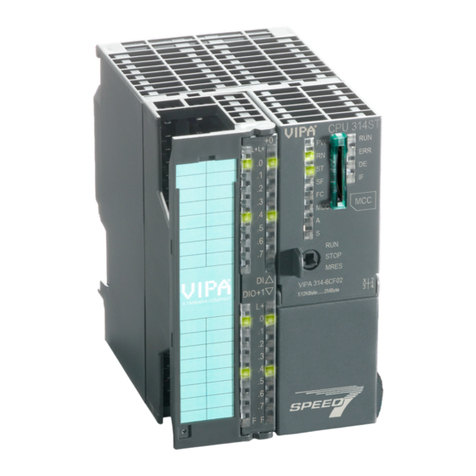
The System 200 series consists of a number of PLC-CPUs. These are
programmed in STEP5 of Siemens and they are compatible with existing
programs that are executable on the Siemens series 90U through 115U,
STEP7 of Siemens or in accordance with IEC 61131-3.
CPUs that are fitted with integrated Ethernet interfaces or additional serial
interfaces simplify the integration of the PLC into an existing network or the
connection from additional peripheral equipment.
The application program is saved in Flash RAM or an additional plug-in
memory module.
The PC based CPU 288L can be used to implement operating/monitoring-,
control applications or other file-processing applications.
The modules are programmed in C++, Pascal or in accordance with
IEC 61131-3.
The PC 288-CPU provides an active interface to the back panel bus and it
can be employed as central controller for all peripheral and function
modules of the VIPA System 200V.
With the appropriate expansion interface the System 200V can support up
to 4 rows.
In combination with a Profibus DP-Master and -Slave the PLC-CPU's or the
PC-CPU form the basis for a Profibus-DP network in accordance with DIN
19245-3. The DP network can be configured with any configuration tool.
Parameters are saved in a plug-in Flash ROM module.
The module can also be configured directly via the Profibus network by
means of the VIPA software WinNCS when this is used in conjunction with
a Profibus-Master PC plug-in module that is available from the company
Softing. Alternatively, all Profibus modules are available with a plastic FO-
connector.
Other field-bus systems can be connected by means of slaves that can
interface with Interbus, CANopen and DeviceNet.
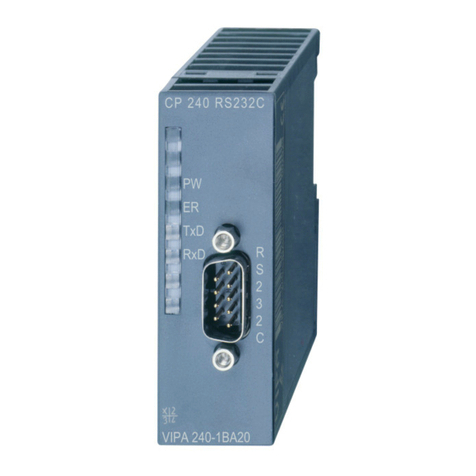
A large number of peripheral modules are available form VIPA, for
example digital as well as analog inputs/outputs, counter functions,
displacement sensors, positioners and serial communication modules.
These peripheral modules can be used in centralized as well as
decentralized mode.
Centralized
system
Decentralized
system
Peripheral
modules