3. Handling Precautions
CAUTION
• Each probe has its own maximum and minimum operating temperatures,
so ensure that its temperature does not fall outside the specied range.
• As the probe is susceptible to corrosion, do not use the instrument for the measurement of
gas or liquid, and refrain from measuring semi-solid particles and semi-viscous substances.
After measurement, wipe the probe with a dry cloth.
• Do not apply a strong force to the upper and lower parts of the probe as doing so may
result in the bending of the probe connector.
• When using the instrument be careful not to bend, drop, or strike the measurement probe.
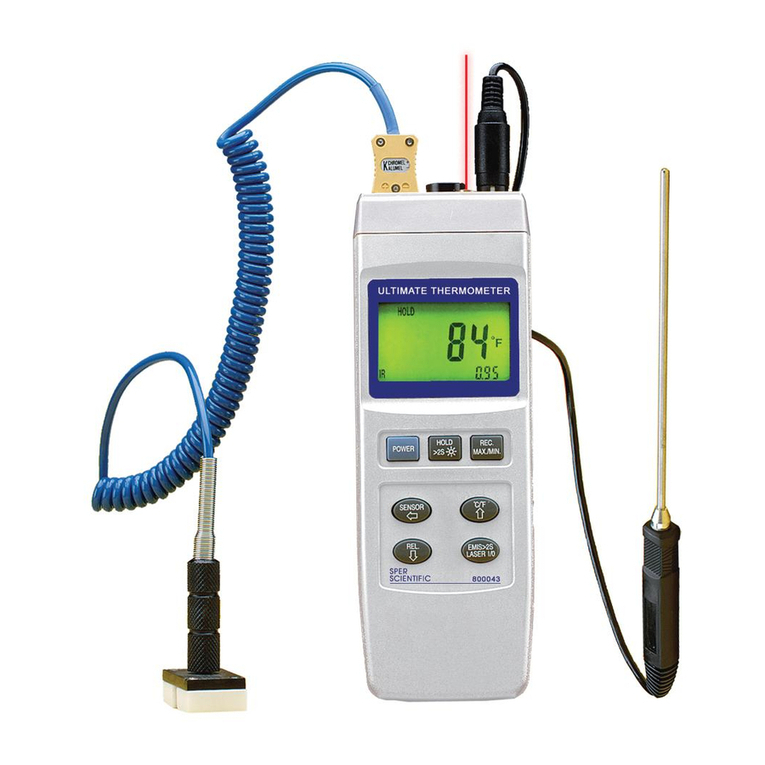
• When measuring surface temperature using a surface-type probe, position the probe
perpendicular to the surface of the object. Also note that the application of oil to the probe
for the means of providing better contact can improve measurement accuracy.
• When measuring non-metallic surface temperature, make sure the measurement time is
long enough to compensate for poor thermal conductivity.
• To ensure stable measurement, the instrument should not be subjected to a sudden
temperature change.
• This instrument, with the exception of the connector section, is water-resistant but not
waterproof. Therefore the instrument should not be immersed in water.
If it is mistakenly immersed in water, remove it immediately and check to ensure that no
water has penetrated inside the case. Although this instrument is designed so that
any water penetrating into the connector does not permeate into the circuit inside the case,
try to prevent any water entering the connector. If water does enter the connector,
the burnout display may be unavailable.
Attention
• Chaque sonde possède ses propres températures de fonctionnement maximales et
minimales. Il faut donc s'assurer que sa température ne tombe pas sous la plage spéciée.
• La sonde étant sensible à la corrosion, ne pas utiliser l'instrument pour la mesure de
gaz ou de liquide et éviter de mesurer des particules semi-solides et des substances
semi-visqueuses. Après la mesure, essuyer la sonde avec un chion sec.
• Ne pas exercer une force puissance sur les parties supérieures et inférieures de la sonde,
car cela risquerait de faire plier le connecteur de sonde.
• Lors de l'utilisation de l'instrument, faire en sorte de ne pas plier, faire tomber ou cogner
la sonde de mesure.
• Lors de la mesure de la température de surface à l'aide d'une sonde de type sonde
de surface, placer cette dernière perpendiculairement à la surface de l'objet.
Noter que l'application d'huile sur la sonde an d'assurer un meilleur contact peut
améliorer la précision de la mesure.
• Lors de la mesure de la température sur une surface non-métallique, s'assurer que
la durée de la mesure est susante pour compenser la mauvaise conductivité thermique.
• Pour assurer une mesure stable, l'instrument ne doit pas subir de changement de
température brutal.
• Cet instrument, à l'exception de la partie connecteur, est résistant à l'eau, mais pas
étanche à l'eau. C'est pourquoi l'instrument ne doit pas être immergé dans l'eau.
S'il se retrouve par erreur immergé dans l'eau, le retirer immédiatement et s'assurer que
l'eau n'a pas pénétré à l'intérieur du boîtier. Même si l'instrument est conçu pour que toute
quantité d'eau pénétrant dans le connecteur n'entre pas dans le circuit du boîtier,
il faut essayer d'éviter que de l'eau entre dans le connecteur.
Si de l'eau entre dans le connecteur, l'écran endommagé risque d'être indisponible.
4.Specications
Thermocouple type: K, J, E, T
Measuring range: Type K: -200°C to 1372°C
Type J: -200°C to 1000°C
Type E: -200°C to 700°C
Type T: -200°C to 400°C
Measurement resolution: -200.0°C to 199.9°C: 0.1°C
200°C or higher: 1°C
Accuracy (instrument): -200.0°C to -100.1°C: 0.1% of rdg + 1.0°C
-100.0°C to 199.9°C: 0.1% of rdg + 0.7°C
200°C or higher: 0.2% of rdg + 1°C
when the temperature at input jacks are stabilized
Temperature coecient: ±(0.015% of rdg +0.06°C)/°C
Measurement cycle: Approx. 1 second
Operating temperature/humidity: 0°C to 50°C, 20 to 80% RH (no condensation)
Storage temperature/humidity: -10°C to 60°C, 5 to 95% RH (no condensation)
Power requirements: Two AA alkaline dry batteries (LR6)
Battery life: Approx. 450 hours
Display: Reective LCD;
7-segment, 4-digit display and 30 character segments
Dierence between 2 channels (2ch model only)
Battery alarm: Displayed on LCD ( )
Key operation sound: Internal buzzer sounds during key operation
Auto power-o: Turns o the power 10 minutes after the last key operation
(can be disabled)
Degree of protection provided by enclosures:
Equivalent to IP54 (when using the waterproof cover)
Dimensions: Approx. 151 (H) × 56 (W) × 33 (D) mm (excluding protrusions)
Weight: Approx. 180 g (including batteries)
Accessories: User's manual, Two AA alkaline dry batteries (LR6)
Safety standards: EN 61010-1, EN 61010-2-030
Measurement category O (Other)
Indoor use, altitude 2000 m or less, pollution degree 2
EMC standards: EN 61326-1 Class B Table 1, EN 55011 Class B Group 1
EMC Regulatory Arrangement in Australia and New Zealand
Korea Electromagnetic Conformity Standard
( 한국전자파적합성기준 )
The accuracy rating of all ranges are the sum of the accuracy levels
in standard applications and the accuracy tolerances shown below,
where the overall length of cable, including the probe, is assumed to
be shorter than 3 m.
Accuracy tolerance of all available ranges: ±5% of span
Environmental standards: EU RoHS Directive compliant
For conformity to environmental regulations and/or standards other
than EU, contact your nearest YOKOGAWA oce (PIM113-01Z2).
5. Accessories(Optional)
TC-K Probe (Temperature probes for thermocouple type K)
Model Probetype Measuring
range
Sensor
Diameter/
Length
(mm)
Tolerance
90020B Rounded end -50 to 600°C 3.2/200 T < 375°C: ± 1.5°C
375°C ≤ T: ± 0.004 × T°C
90021B Rounded end -50 to 600°C 1.6/150
90022B Rounded end -50 to 600°C 3.2/500
90023B
Needle
-50 to 500°C 1.6/100
90024B Needle -50 to 500°C 2.1/100
90030B Surface straight -20 to 250°C 15 *1(T-Ts) ≤ 100°C: ± 2.5°C
100°C < (T-Ts): -0.03 × T to +2.5°C
T: -20°C to 250°C, Ts: 0°C to 40°C
90031B Surface angled -20 to 250°C 15 *1
90032B Surface straight -20 to 500°C 15 *1(T-Ts) < 333°C: +2.5°C
333°C ≤ (T-Ts): +0.0075 × T°C
(T-Ts) < 167°C: -2.5°C
167°C ≤ (T-Ts): -0.015 × T°C
T: -20°C to 500°C, Ts: 0°C to 40°C
90033B Surface angled -20 to 500°C 15 *1
90029B Bead TC -40 to 260°C 1200 mm *2± 2.5°C
T: measurement temperature, Ts: ambient temperature
245921 Extension cable (5 m)
245922 Extension cable (10 m)
93011 Waterproof cover (5 pcs)
93012 Carrying case
[ Note ]
*1: Diameter of thermosensitive part 15 mm dia.
*2: Length of probe (included cord)
6. RegulationsandSalesinVariousCountriesandRegions
6.1 WasteElectricalandElectronicEquipment(WEEE)
(EU WEEE Directive valid only in the EEA* and UK WEEE Regulation in the UK)
This product complies with the WEEE marking requirement.
This marking indicates that you must not discard this electrical/electronic product
in domestic household waste.
When disposing of products in the EEA or UK, contact your local Yokogawa oce
in the EEA or UK respectively. (*EEA: European Economic Area)
6.2 BatteriesandWasteBatteries
(EU Battery Directive/Regulation valid only in the EEA and UK Battery Regulation in the UK)
Batteries are included in this product.
When you remove batteries from this product and dispose them,
discard them in accordance with domestic law concerning disposal.
Take a right action on waste batteries, because the collection systems in the EEA and UK
on waste batteries are regulated.
Battery type: Alkaline dry cell
This marking indicates they shall be sorted out and collected as ordained in the EU battery
Directive/Regulation and UK battery Regulation.
How to remove batteries safely:
For further details, see chapter 9, “Battery Replacement” in the User's Manual
(IM TX10-01-02EN).
6.3 AuthorizedRepresentativeintheEEA
Yokogawa Europe B.V. is the authorized representative of Yokogawa Test & Measurement
Corporation for this product in the EEA.
To contact Yokogawa Europe B.V., see the separate list of worldwide contacts,
PIM 113-01Z2.
6.4 Disposal
When disposing of this instrument, follow the laws and ordinances of the country or region
where the product will be disposed of.
If you are disposing of the product in the EEA or UK, see also section 6.1,
“Waste Electrical and Electronic Equipment (WEEE).”
IM TX10-01E <P2>
■ RegardingThisManual
• The information contained in this manual is subject to change without notice.
• Copying or reproduction of any or all of the content of this manual without
Yokogawa's permission is strictly prohibited.
• Every eort has been made to ensure the information contained herein is accurate.
However, should any concerns, errors, or emissions come to your attention,
or if you have any comments, please contact us.