9
1.0 APPLICATIONS
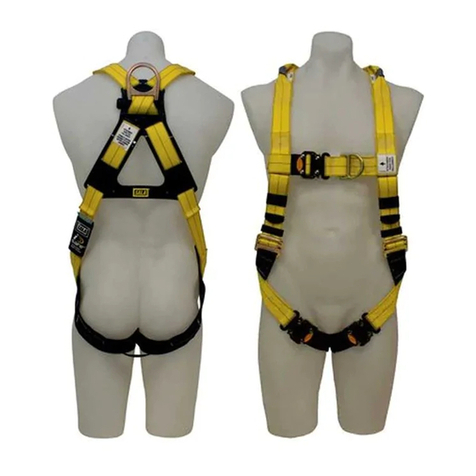
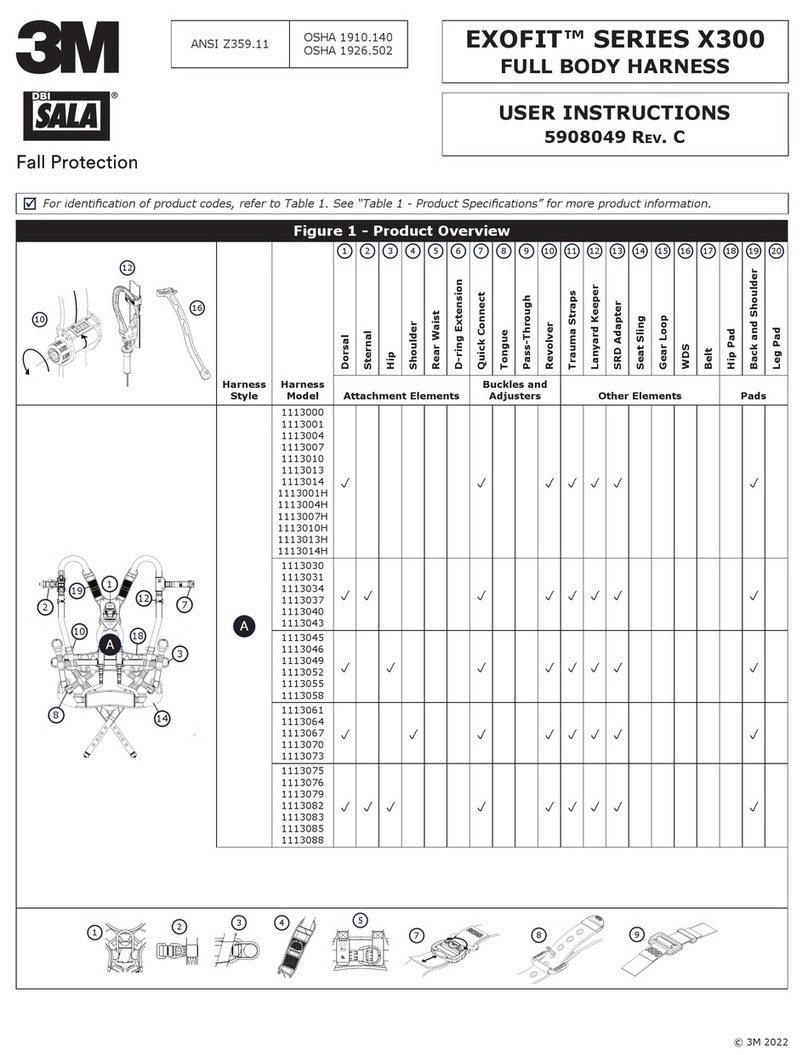
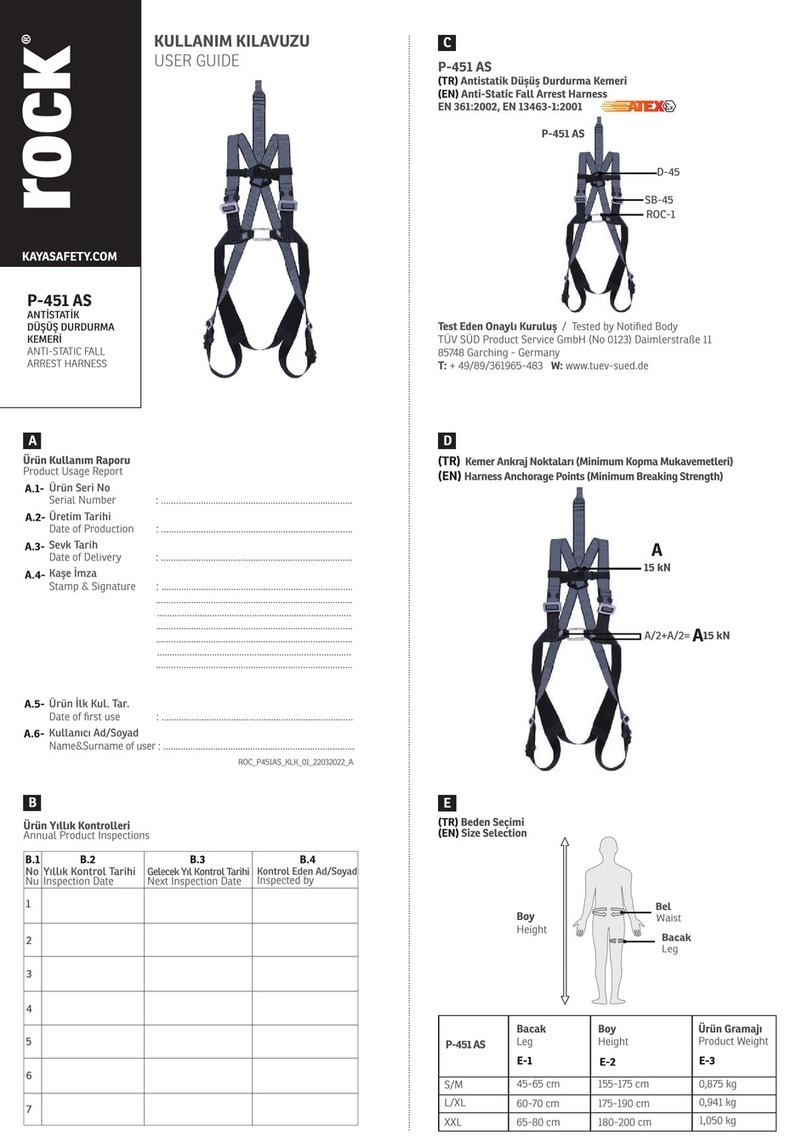
1.1 PURPOSE: Full Body Harnesses are to be used as components in Personal Fall Protection System designed to prevent
a fall or safely arrest a fall (see Figure 2). Full Body Harnesses are used in the following applications:
AFall Arrest (EN361): Personal fall arrest systems typically include a Full Body Harness and a connecting subsystem (Energy
Absorbing Lanyard, Self-Retracting Device, etc.). Maximum arresting force must not exceed 6 kN (1 349 lb). Attachment
Elements: Dorsal (feet rst with a 60 cm (24 in) maximum free fall when using a Self-Retracting Device or 1,8 m (6 ft)
maximum free fall when using an Energy Absorbing Lanyard), Sternal (feet rst with a 60 cm (24 in) maximum free fall),
Frontal (feet rst with a 60 cm (24 in) maximum free fall). Anchorage Strength: Selected anchorage must sustain loads of
15 kN (3 372 lb) or greater.
BWork Positioning (EN358): Work positioning systems typically include a Full Body Harness, positioning lanyard, and a back-
up personal fall arrest system. For work positioning applications, connect the work positioning subsystem (example: lanyard,
Y-lanyard, etc.) to the lower (hip level) side or belt mounted work positioning attachment anchorage elements (D-Rings).
Never use these connection points for fall arrest. Attachment Elements: Frontal, Hip. Anchorage Strength: Selected anchorage
must sustain loads of 4,5 kN (1 012 lb) or greater.
CClimbing (EN361): The Full Body Harness is used as a component of a climbing system to prevent the user from falling
when climbing a ladder or other climbing structure. Climbing systems typically include a Full Body Harness, vertical cable or
rail attached to the structure, and climbing sleeve. For ladder climbing applications, harnesses equipped with a frontal D-Ring
in the sternal location may be used for fall arrest on xed ladder climbing systems. Attachment Elements: Sternal. Anchorage
Strength: Structure to which the climbing system is attached must sustain the loads required by the climbing system
manufacturer’s documentation.
DRescue (EN1496, EN1497): The Full Body Harness is used as a component of a rescue system. Rescue systems are
congured depending on the type of rescue. For limited access (conned space) applications, harnesses equipped with
D-Rings on the shoulders may be used for entry and egress into conned spaces where worker prole is an issue.
Attachment Elements: Dorsal, Sternal, Frontal, Shoulder. Anchorage Strength: Selected anchorage must sustain loads of
4,5 kN (1 012 lb) or greater.
EControlled Descent (EN341): For controlled descent applications, harnesses equipped with a single sternal level D-Ring,
one or two frontal mounted D-Rings, or a pair of connectors originating below the waist (such as a seat sling) may be used for
connection to a descent or evacuation system. Attachment Elements: Dorsal Sternal, Frontal. Anchorage Strength: Selected
anchorages must sustain loads of 15 kN (3 372 lb) or greater.
FRestraint (EN354): The Full Body Harness is used as a component of a restraint system to prevent the user from reaching
a fall hazard. Restraint systems typically include a Full Body Harness and a lanyard or restraint line. Attachment Elements:
Dorsal, Sternal, Frontal, Hip. Anchorage Strength: Selected anchorage must sustain loads of 2 kN (450 lb) or greater.
1.2 STANDARDS: Harnesses included in this manual conform to the standard(s) identied on the front cover of this
instruction. If this product is resold outside the original country of destination, the re-seller must provide these
instructions in the language of the country in which the product will be used.
1.3 TRAINING: It is the responsibility of the user and the purchaser of this equipment to assure that they are familiar
with these instructions, trained in the correct care and use of, and are aware of the operating characteristics,
application limits, and the consequences of improper use of this equipment.
1.4 LIMITATIONS: Always consider the following application limitations before using this equipment:
• CAPACITY: The Full Body Harness is designed for use by persons with a combined weight (clothing, tools,
etc.) of no more than 140 kg (310 lb). Make sure all of the components in your system are rated to a capacity
appropriate to your application.
• FREE FALL: Personal fall arrest systems used with this equipment must be rigged to limit the free fall to
2 m (6,6 ft)1. Restraint systems must be rigged so that no vertical free fall is possible. Work positioning systems
must be rigged so that free fall is limited to 60 cm (24 in) or less. Personnel riding systems must be rigged so
that no vertical free fall is possible. Climbing systems must be rigged so that free fall is limited to 45 cm (18 in)
or less. Rescue systems must be rigged so that no vertical free fall is possible. See subsystem manufacturer’s
instructions for more information.
• FALL CLEARANCE: Figure 3 illustrates the components of a Fall Arrest. There must be sufcient Fall Clearance
(FC) to arrest a fall before the user strikes the ground or other obstruction. Clearance is affected by a number of
factors including: (A) Lanyard Length, (B) Lanyard Deceleration Distance or SRL Maximum Arrest Distance, (C)
Harness Stretch and D-Ring/Connector Length and Settling (typically a Safety Factor of 0,5 m (1,6 ft)). Refer
to the instructions included with your Lanyard or Self-Retracting Device for specics regarding Fall Clearance
calculation.
• SWING FALLS: Swing Falls occur when the anchorage point is not directly above the point where a fall occurs (see
Figure 4). The force of striking an object in a swing fall may cause serious injury or death. Minimize swing falls by
working as directly below the anchorage point as possible. Do not permit a swing fall if injury could occur. Swing falls
will signicantly increase the clearance required when a Self-Retracting Device or other variable length connecting
subsystem is used.
• EXTENDED SUSPENSION AND SUSPENSION TRAUMA: A Full Body Harness is not intended for use in extended
suspension applications. Extended suspension can cause Suspension Trauma. If the user is going to be suspended for
an extended length of time it is recommended that some form of seat support be used. 3M recommends a seat board,
suspension work seat, seat sling, or a boatswain chair. Contact 3M for more information on these items.
• ENVIRONMENTAL HAZARDS: Use of this equipment in areas with environmental hazards may require
additional precautions to prevent injury to the user or damage to the equipment. Hazards may include, but are
not limited to; heat, chemicals, corrosive environments, high voltage power lines, gases, moving machinery, and
sharp edges.
• HARNESSES FOR HIGH TEMPERATURE ENVIRONMENTS: Harnesses with Kevlar webbing are designed for
use in high temperature environments, with limitations: Kevlar webbing begins to char at 425 - 480 °C
(800 - 900 °F). Kevlar webbing can withstand limited contact exposure to temperatures up to 535 °C (1 000 °F).
Polyester webbing loses strength at 145 - 200 °C (300 - 400 °F). PVC coating on hardware has a melting point of
approximately 175 °C (350 °F).
1 Fall Arrest Free Falls: Free falls greater than 2 m (6,6 ft) may be permitted when users are secured to the anchorage with a connecting subsystem which
limits maximum arresting force to 6 kN (1 349 lb) and is authorized for such use (i.e., 3M Force 2™ Lanyards).