3
1) WORK AREA
a) Keep work area clean and well lit. Cluttered and dark
areas invite accidents.
b) Do not operate power tools in explosive atmospheres,
such as the presence of ammable liquids, gases or
dust. Power tools create sparks which may ignite the
dust or fumes.
c) Keep children and bystanders away while operating a
power tool. Distractions can cause you to lose control.
2) ELECTRICAL SAFETY
a) Power tool plugs must match the outlet. Never modify
the plug in any way. Do not use any adapter plugs with
earthed (grounded) power tools. Unmodied plugs and
matching outlets will reduce risk of electric shock.
b) Avoid body contact with earthed or grounded surfaces
such as pipes, radiators, ranges and refrigerators. There
is an increased risk of electric shock if your body is
earthed or grounded.
c) Do not expose power tools to rain or wet conditions.
Water entering a power tool will increase the risk of
electric shock.
d) Do not abuse the cord. Never use the cord for
carrying, pulling or unplugging the power tool. Keep
cord away from heat, oil, sharp edges or moving parts.
Damaged or entangled cords increase the risk of
electric shock.
3) PERSONAL SAFETY
Indicates Caution is required. Failure to exercise
caution and correct operating technique can result
in serious personal injury, loss of limb or death.
a) Stay alert, watch what you are doing and use common
sense when operating a power tool. Do not use a
power tool while you are tired or under the inuence
of drugs, alcohol or medication. A moment of
inattention while operating power tools may result in
serious personal injury.
b) Use safety equipment. Always wear eye protection.
Safety equipment such as dust mask, non-skid
safety shoes, hard hat, or hearing protection used for
appropriate conditions will reduce personal injuries.
If the maximum duty cycle of the attached tool is
exceeded or the tool temperature exceeds 50° C.,
then the operator should wear protective hand wear
(gloves).
Safety Information
c) Avoid accidental starting. Ensure the switch is in the
off-position before plugging in. Carrying power tools
with your nger on the switch or plugging in power
tools that have the switch on invites accidents.
d) Remove any adjusting key or wrench before turning
the power tool on. A wrench or a key left attached to a
rotating part of the power tool may result in personal
injury.
e) Do not overreach. Keep proper footing and balance at
all times. This enables better control of the power tool
in unexpected situations.
f) Dress properly. Do not wear loose clothing or jewelry.
Keep your hair, clothing and gloves away from moving
parts. Loose clothes, jewelry or long hair can be
caught in moving parts.
g) If devices are provided for the connection of dust
extraction and collection facilities, ensure these are
connected and properly used. Use of these devices
can reduce dust-related hazards.
4) POWER TOOL USE AND CARE
a) Do not force the power tool. Use the correct power
tool for your application. The correct power tool will
do the job better and safer at the rate for which it was
designed.
b) Do not use the power tool if the switch does not turn
it on and off. Any power tool that cannot be controlled
with the switch is dangerous and must be repaired.
c) This product is designed to be used in combination
with the AcraDyne iEC DC tool controller for
intermittent hand-held or xtured assembly
processes.
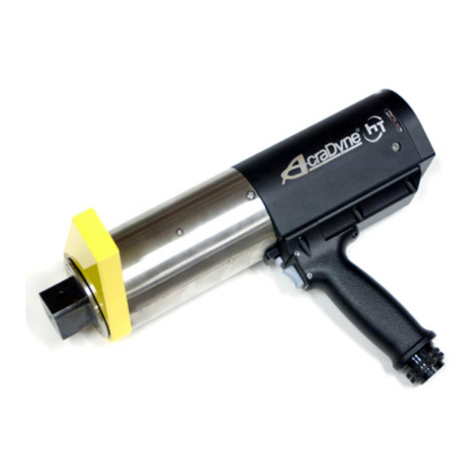
CAUTION – DO NOT USE THE ACRADYNE® HT NUTRUNNING SYSTEM WITHOUT FULLY READING THIS MANUAL AND HAVING A COMPLETE
UNDERSTANDING OF THE CORRECT USAGE OF A HIGH TORQUE DELIVERING TOOL AND ANY ASSOCIATED REACTION BARS/ACCESSORIES.
SAVE THESE INSTRUCTIONS