6
Ifthe EC-16™controller is programmed for tractioncontrol,
it contains the following outputs:
- Aconnection to theengine's electronic control module
allowstheEC-16™controller to reduce enginetorqueunder
certain circumstances.
- A traction dash light is connected to and controlled by
the EC-16™controller and serves as a means of advising
the driver of the condition of the traction control system.
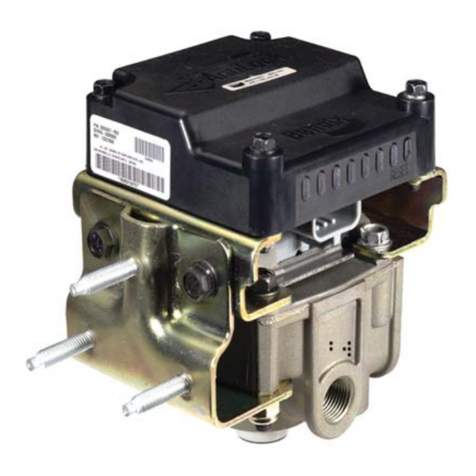
- A connection to the traction solenoid (located in the
upperportionof the antilocktractionrelayvalve—seeFigure
3)is provided via a 2pin Deutschconnector.
OPERATION - ANTILOCK
PHILOSOPHY
The Bendix®EC-16™controller antilock system uses
individualsensors, modulators andan electroniccontroller
to control the four vehicle wheel ends. By monitoring the
decelerationrate duringbraking,andsubsequentlyadjusting
the brake application pressure at each wheel, the EC-16™
controllerisabletoimprovebrakingbetweenthevehicletire
and the road surface it is on, while maintaining vehicle
stability.
Therearaxlebrakes are controlledindependently;therefore
brakeapplicationpressureat an individual wheelisadjusted
solely on the basis of its behavior on the road surface on
which it is traveling.
While each steering axle brake is under the control of an
individual modulator, the EC-16™controller does not treat
these brakes totally independently. The EC-16™controller
usesamodified individualcontrolphilosophyforthesteering
axle brakes. This is done in order to minimize "steering
wheelpull"intheeventeachwheelistravelingona different
road surface (for example, ice close to the curb and a dry
crown).EssentiallytheEC-16™controllercontrolsthebraking
forcedifferencesbetween the twobrakes.
The wheel on dry pavement is initially given less braking
force and is brought up to optimum during the stop, while
thewheeloniceattemptstomaintainoptimumbrakingduring
the entire stop.
In the case of vehicles equipped with tandem rear axles
(6x2, 6x4), the wheel speed sensors are installed at the
wheels on the axle that is most likely to lock first. A single
modulator controls both curb side brakes on the tandem,
andanother modulator controlsboth brakeson the driver's
sideofthetandem.Withthisarrangementofspeedsensors
andmodulators,both brakes on oneside of the tandemare
treated as one since they will most likely be on the same
typeof road surface.
NON ANTILOCK BRAKE APPLICATION
During normal braking, air pressure from the brake valve
entersthecontrolportofthe service relay valve. The service
relay delivers air to, and through, the antilock modulator
locatednearthe braked wheel,and into thebrake actuator.
Theservicebrakesarethusapplied.If the wheel sensors do
notdetectanimpendingwheellockup,theEC-16™controller
doesnotinitiateany corrective action and thevehiclecomes
to a stop in a normal fashion.
ANTILOCK BRAKE APPLICATION
Ifa service brake application is made andthe wheel speed
sensors detect an impending wheel lockup, the EC-16™
controller will immediately begin modification of the brake
application using the antilock modulator(s) at the affected
wheel(s). Solenoid valves contained in the modulator are
energizedanddeenergizedbytheEC-16™controllerinorder
to modify the brake application. When a solenoid coil is
energized,its shuttle moves. Depending upon the function
of the specific solenoid, it either opens or closes, thereby
causing the exhaust or re application of air pressure to the
brake actuator. The solenoids in each modulator are
controlled independently by the EC-16™controller. By
opening and closing the solenoid valves in the appropriate
modulator,theEC-16™controllerisactuallysimulatingwhat
drivers do when they "pump the brakes". It must be
remembered however that unlike the driver, the EC-16™
controller is able to "pump" each brake on the vehicle
independentlyand with far greaterspeed and accuracy.
OPERATION - TRACTION CONTROL
PHILOSOPHY
Traction control is a natural extension of antilock. Just as
antilock helps vehicle control and stability during braking,
tractioncontrolhelpsduringvehicle acceleration. The wheel
speed sensors not only detect rapid decreases in wheel
speed for antilock but also detect unreasonably high
increasesfortractioncontrol.Withtractioncontrol,aspinning
wheel is instantly detected and compared with the other
wheels on the vehicle, both front and rear. Two different
methodsareused to controlwheel spin; torque limitingand
differentialbraking.Dependinguponvehicletype, speedand
road (surface) condition, each method provides a unique
anddesirabletypeofwheelspincontrol.Ideallybothmethods
are used to control vehicle traction. While all new version
EC-16™controllers are capable of providing wheel control
antilock and traction control (utilizing both methods of
control),notallsystemswillbeconfiguredforbothmethods.
Depending upon the vehicle, either or both traction control
methods will be activated during the self configuration
procedure.