7
Normal Braking
Duringnormal braking, brake pressure is deliveredthrough
the ABS PMV and into the brake chamber. If the ECU
does not detect excessive wheel slip, it will not activate
ABS control, and the vehicle stops with normal braking.
Retarder Brake System Control
On surfaces with low traction, application of the retarder
canlead tohighlevels of wheelslipat the driveaxlewheels,
which can adversely affect vehicle stability.
To avoidthis,the EC-60™controllerswitchesoffthe retarder
as soon as a lock-up is detected at one (or more) of the
driveaxlewheels.
When the ECU is placed in the ABS off-road mode, it will
switch off the retarder only whenABS is active on a steer
axle wheel and a drive axle wheel.
Optional ABS Off-Road Mode
On some road conditions, particularly when the driving
surface is soft, the stopping distance with ABS may be
longer than without ABS. This can occur when a locked
wheel on soft ground plows up the road surface in front of
thetire, changing the rollingfrictionvalue. Althoughvehicle
stoppingdistancewitha locked wheel may be shorter than
correspondingstopping distance withABS control, vehicle
steerability and stability is reduced.
PremiumEC-60™controllers have anoptionalcontrol mode
that more effectively accommodates these soft road
conditions to shorten stopping distance while maintaining
optimal vehicle steerability and stability.
WARNING: TheABSoff-roadmodeshouldnot be used on
normal,paved road surfaces because vehicle stability and
steerability may be reduced. The flashing ABS Indicator
Lamp communicates the status of this mode to the driver.
Thevehiclemanufacturer should provide the optionalABS
off-roadfunctiononly for vehicles that operate on unpaved
surfaces or that are used in off-road applications, and is
responsiblefor insuringthatvehiclesequippedwith theABS
off-roadfunctionmeetallFMVSS-121requirementsandhave
adequateoperator indicators and instructions.
The vehicle operator activates the off-road function with a
switch on the dash panel. A flashing ABS Indicator Lamp
indicates to the driver that the ABS off-road function is
engaged. To exit the ABS off-road mode, depress and
release the switch.
All-Wheel Drive (AWD) Vehicles
AWD vehicles with an engaged interaxle differential (steer
axle to rear axle)/AWD transfer case may have negative
effects on ABS performance. Optimum ABS performance
isachieved when the lockabledifferentialsaredisengaged,
allowingindividual wheel control.
Premium EC-60™controllers can be programmed
specifically for this configuration to control the differential
lock/unlock solenoid in the AWD transfer case. When
programmed to do so, the ECU will disengage the locked
interaxle/AWD transfer case during an ABS event and
reengage it once theABS event has ended.
ATC OPERATION
ATC Functional Overview
JustasABS improves vehicle stability during braking,ATC
improves vehicle stability and traction during vehicle
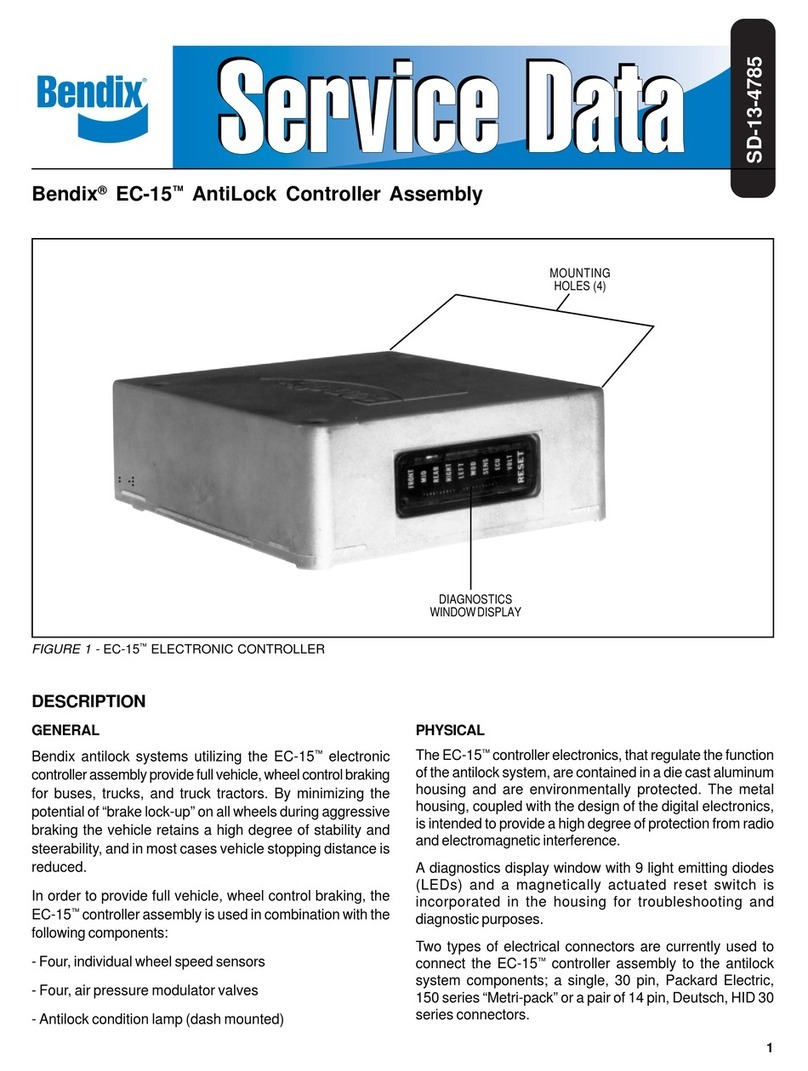
acceleration. TheEC-60™controllerATC functionusesthe
same wheel speed information and modulator control as
theABSfunction. The EC-60™controllerdetects excessive
drive wheel speed, compares the speed of the front, non-
drivenwheels, andreactsto helpbringthe wheelspinunder
control. The EC-60™controller can be configured to use
engine torque limiting and/or differential braking to control
wheel spin. For optimalATC performance, both methods
arerecommended.
ATC Lamp Operation
TheATC Lamp Illuminates:
1. During power up (e.g. when the vehicle is started) and
turns off after the self test is completed, providing no
diagnostic trouble codes are present.
2. WhenATC is disabled for any reason.
3. During anATCevent (the lampwillflashrapidly). When
ATC is no longer active, the ATC active/indicator lamp
turnsoff.
4. When the ECU is placed in theATC off-road mode (the
lamp will flash at a rate of 1.0 seconds on, 1.5 seconds
off). This notifies the vehicle operator that the off-road
mode is active.
Differential Braking
Differential braking is automatically activated when drive
wheel(s) on one side of the vehicle are spinning, which
typically occur on asphalt road surfaces with patches of
ice. The traction system will then lightly apply the brake to
thedrive wheel(s) thatarespinning. The vehicle differential
will then drive the wheels on the other side of the vehicle.
Differential braking is available at vehicle speeds up to 25
MPH.
Disabling ATC Differential Braking
ATC differential braking is disabled under the following
conditions:
1. Duringpowerup(e.g.whenthevehicleisstarted),until
the ECU detects a service brake application.
2. If the ECU receives a J1939 message indicating that
the vehicle is parked.
3. When the dynamometer test mode is active. The
dynamometertest mode isenteredusingthe diagnostic
blink code switch or by using a diagnostic tool (such
as Bendix®ACom™Diagnostics).