BLS 5250 BLS 5500), first pull down the locking ring of the inner mask
to release the inner mask, then remove the inner mask from its
housing, unthreading the edges from the inner connection MI/21 (draw
9 BLS 5150 BLS 5400; draw 7 BLS 5250 BLS 5500) Replace the
inner mask with the new one, positioning the edges of the hole in the in
the fitting groove of the MI/21, pulling down again the locking ring
MI/26, then checking the right assembling of the valve holders MI/25
equipped with the NG/26 valves
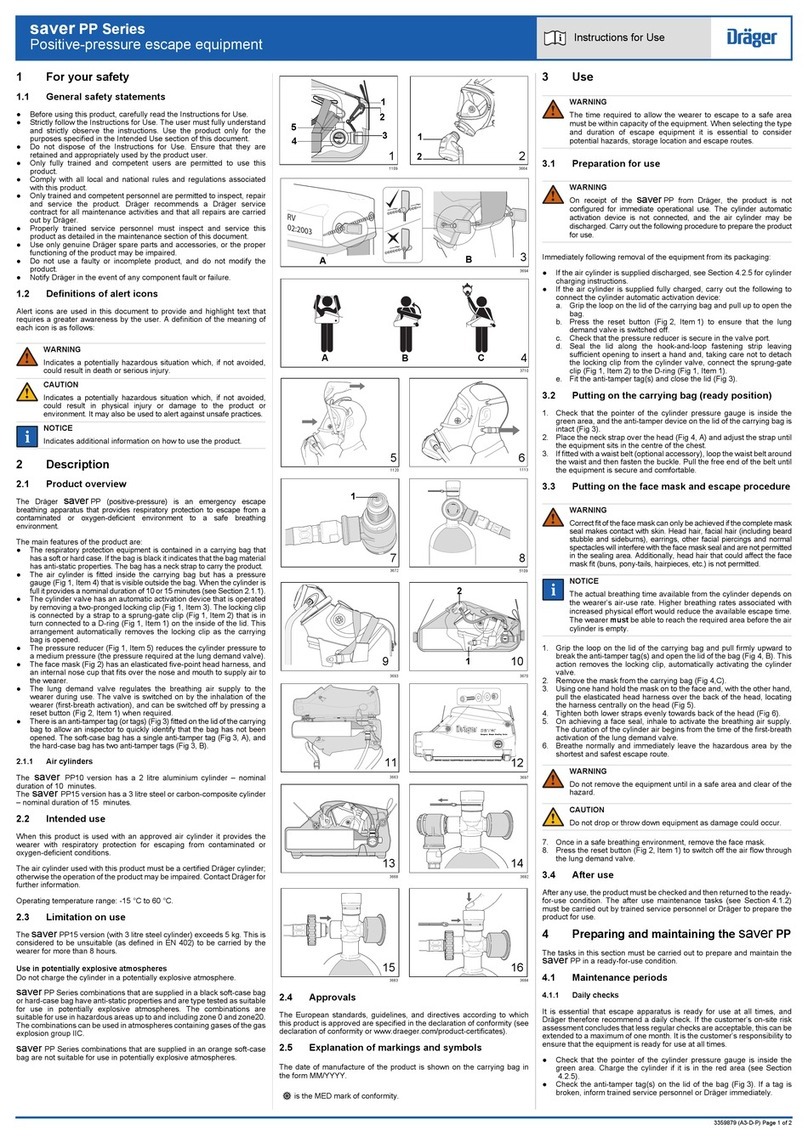
5.2.3 Replacing the inhalation valve holder and relative inhalation
valve for LS 5150 LS 5400 To replace the inhalation valve holder
MI/24 (draw 4), it is necessary to take it out from its housing on the
inner threaded connection MI/20 (draw 6), pulling it with strength
Replace the component, check the inhalation valve NG/26 (draw 5) is
in the right position and then place it again in its housing, keeping
attention to place it straight and with the valve turned into the inner of
the mask, checking that the valve surface is free to move
5.2.4 Replacing the head harness (and assembling the textile
harness, as accessory) The head harness M/8 (draw 20 BLS 5150
BLS 5400; draw 22 BLS 5250 BLS 5500) has 6 adjuster straps and is
made in rubber Replace it if there is any sign of splitting To do this,
pull the straps out through buckles MI/6 (draw 16 BLS 5150 BLS 5400;
draw 19 BLS 5250 BLS 5500) Once you have freed all of the straps,
fit the new headpiece by passing the straps through the buckles and
making sure they are fitted securely
If the textile harness is used (optional fittings, on demand, code
000773), the procedure is the same
5.2.5 Replacing the clamping band If clamping band MI/9 (draw 17
BLS 5150 BLS 5400; draw 16 BLS 5250 BLS 5500) is accidentally
broken, first remove it from the head harness M/8 (draw 20 BLS 5150
BLS 5400; draw 22 BLS 5250 BLS 5500) and from the buckles MI/6
(draw 16 BLS 5150 BLS 5400; draw 19 BLS 5250 BLS 5500), for this
operation see the previous paragraph Then use a screwdriver to
unscrew the bolt from the nut (draw 18 BLS 5150 BLS 5400; draw 21
BLS 5250 BLS 5500 and draw 19 BLS 5150 BLS 5400; draw 20 BLS
5250 BLS 5500) and open the clip When reassembling, be particularly
careful that the face seal and clamping band are centred on the visor
Do this by lining up one end with the centre mark on the face seal
before tightening the bolt
5.2.6 Replacing the exhalation valve and related o-ring This
maintenance operation requires dismantling the entire membrane
holder/exhalation membrane group MI/21 + NG/11 (draw 9 BLS 5150
BLS 5400; draw 7 BLS 5250 BLS 5500 and draw 8 BLS 5150 BLS
5400; draw 6 BLS 5250 BLS 5500), using the proper L key Before to
proceed to this replacing, it is necessary to remove the inner mask N/7
(draw 11 BLS 5150 BLS 5400: draw 15 BLS 5250 BLS 5500) from its
housing, unthreading the edges from the inner threaded connection
Afterwards taking the mask in one hand and in the other hand the key
put the key perpendicularly to the filter holder using the thin plates as a
grip Unscrew the valve holder rotating clockwise Once the membrane
holder is removed, replace the NG/11 membrane (draw 8 BLS 5150
BLS 5400; draw 6 BLS 5250 BLS 5500), inserting it in its housing hole,
using for help a drop of liquid soap on the stem of the new membrane
and replace the o-ring MI/18 (draw 7 BLS 5150, BLS 5400; draw 5
BLS 5250 BLS 5500) housing on the inner threaded connection MI/20
(draw 6 BLS 5150 BLS 5400; draw 4 BLS 5250 BLS 5500)
Reassemble the parts in the reverse order To re-set the parts, follow
the contrary procedures
5 2 6 bis Replacing the inhalation membrane for LS 5250 LS
5500 To replace the inhalation membranes NG/27 (draw 11) present
on the two lateral filter holders Mi/22 (draw 12) it is first necessary to
remove the inner mask N/7 (draw 15) from its housing, then it is
possible to extract, pulling toward oneself, the NG/27 membranes After
removing the NG/27 membranes, replace them with new ones, putting
them in the respective housing hole, keeping attention to put them in
right position and checking that all the membrane surface is free to
move Reassemble the inner mask in the reverse order As this full face
mask is designed for a low maintenance, the available spare parts are
not many (see the spare parts list) In case of damage of other
components not listed here, the respirator must be entirely replaced,
please contact BLS S r l for more information
BLS recommends carrying out the replacing operations listed at the
point 5 2 5 and 5 2 6 by BLS itself or by the authorized workshop,
recommended on request by BLS It is however necessary, at least
after the replacing of the inhalation membrane holder and relative
inhalation membrane (par 5 2 3), the replacing of the inhalation
membrane (par 5 26 bis), the replacing of the clamping band ( par
5 2 5), the replacing of the exhalation membrane and related o-ring
(par 5 2 6 ) and always after particular cleaning and disassembly
operations, carry out an efficiency test (see following par 5 2 7) If it is
not possible to carry out the efficiency test and in case of particular
breaking or replacing, it is necessary to contact BLS S r l or an
authorized workshop BLS S r l don’t take any responsibility for the bad
functioning of the mask due to replacing operations with non original
spare parts, carried out without the efficiency control or by non
authorized workshop
5.2.7 Mask efficiency test If components have been replaced and
every time the mask is reassembled after particular clearing operations,
a test for function and leak-tightness must be carried out
The test must be carried out with an appropriate device, made of an
inflatable rubber head, a connection for the facepiece, a connecting
hose, a cap to close the inhalation valve and an appropriate test device
(easily available on the market) to make and control positive and
negative pressure inside the mask (BLS can suggest, on customer’s
request, all the information about this kind of test device) If you don’t
have a test device of this kind, please contact BLS for the components
replacement and the tightness test
Leak tightness test Fit the mask onto the inflatable head and inflate it
until the mask adheres without wrinkling, gently pull the head harness
straps (for further details, see the instructions for the mask testing
apparatus) Dampen with water the contact area between the
membrane and the seat of the valve Create a depression of 10 mbar
inside the mask The depression should not decrease by more than 1
mbar in a minute If the leak is higher, partially deflate the head and
dampen with water the contact area between the bladder and the
mask; finally re-inflate the head If the pressure still decreases, check if
the valve needs to be cleaned and repeat the test
5.3 Storage It is advisable to keep new facepieces in their original
packing in a ventilated store-room, away from possible heat sources
Storage should preferably be between -10 and + 50 °C
BLS S r l however recommends to do not use the masks for more than
10 (ten) years, after that period of time BLS suggests the replace of the
mask with a new one For the transport of the masks use the
original packaging.
6 – SPARE PARTS AND ACCESSORIES
6.1 Spare parts list
Description Components Qt
Draw.
LS
5150
LS
5400
Draw.
LS
5250
LS
5500
Clamping band and
head harness
M/8 Harness straps
MI/9 Clamping band
NG/25 Screw
NG/24 Nut
MI/6 Buckles
6
1
1
1
6
20
17
19
18
16
22
16
21
20
19
Kit - Inner mask valve
holder / inhalations
valves
MI/25 inner mask
membrane
NG/26 Inner mask
valve holder
2
2
12
15
18
23
Kit – Inhalation
valve / Inhalation
valve holder
(MI/24+NG/26)
MI/24 Rubber valve
holder
NG/26 Inhalation
valve
1
1
4
5
-
-
Inhalation
membranes NG/27
kit
NG/27 Inhalation
membranes
2 - 11
5