DCN 45469
36-0151C
05NOV2020
David Knuth
Vernon Hills, IL
Proofed by: _____________________________ Date:______________
Dimensions checked:________________ Copy checked: _____________
2
The following warnings are applicable only to electrosurgical devices listed
in Appendix A:
• Prior to use of the instruments in patients who have cardiac pacemakers or other active
implants, consult the implanted device manufacturer’s instructions for use. A possible
hazard exists due to interference with the intended action of the implanted device or
damage to the implanted device. In case of doubt, qualified advice should be obtained.
• To prevent the possibility of electrical shocks or burns, do not use devices with breaks in
the insulation.
• Gas embolism may result from over-insufflation of air, inert gas prior to high-frequency
(HF) surgery or laser assist gas.
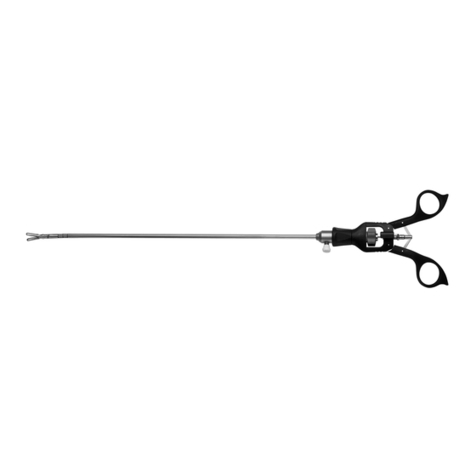
• The Snowden-Pencer Devices are monopolar devices and should only be connected to
an electrosurgical generator that is compatible with monopolar devices.
• Do not exceed the maximum rated voltage specified. Adjust the electrosurgical generator
to a setting appropriate for the maximum peak output voltage.
• A dispersive electrode, such as a grounding pad, should be used with the device
and electrosurgical generator to prevent burns/injury to the patient when using the
monopolar device. Ensure the pad is properly sized and properly placed and always
recheck the pad when patient is moved. It is recommended that the device is used with
an electrosurgical generator that contains contact quality monitoring (return electrode
monitoring) with a signal to indicate there is contact to the patient.
• When HF surgical equipment and physiological monitoring equipment are used
simultaneously on the same patient, any monitoring electrodes should be placed as
far as possible from the surgical electrodes. Needle monitoring electrodes are not
recommended. In all cases, monitoring systems incorporating HF current limiting devices
are recommended.
• Conductive fluids (e.g., blood or saline) in direct contact with an active electrode may
carry electrical current or heat, which may cause unintended burns to the patient.
• Non-flammable agents should be used for cleaning and disinfection wherever possible.
Flammable agents used for cleaning or disinfecting, or as solvents of adhesives should
be allowed to evaporate before the application of HF surgery.
• There is a risk of pooling of flammable solutions under the patient or in body
depressions such as the umbilicus, and in body cavities such as the vagina. Any fluid
pooled in these areas should be mopped up before HF surgical equipment is used.
Attention should be called to the danger of ignition of endogenous gases. Some
materials, for example cotton, wool, and gauze, when saturated with oxygen may be
ignited by sparks produced in normal use of the HF surgical equipment.
• The use of flammable anesthetics or oxidizing gases, such as nitrous oxide (N2O) and
oxygen, should be avoided if a surgical procedure is carried out in the region of the
thorax or the head unless these agents are removed.
• To reduce capacitive coupling, the device should only be activated when positioned to
deliver energy to the target tissue.
• Activating the electrosurgical unit while simultaneously utilizing the suction / irrigation
may alter the intended path of the electrical energy away from target tissue.
• Improper connections of accessories may result in inadvertent accessory activation or
other potentially hazardous conditions.
• Connect adaptors and accessories to the electrosurgical unit only when the unit is off.
Failure to do so may result in an injury or electrical shock to the patient or operating
room personnel.
• Start with the lowest possible power setting on the electrosurgical generator. To achieve
the desired cutting and coagulation, check the patient circuit and then gradually increase
the power setting.
Note: The output power selected should be as low as possible for the intended purpose.
• Do not activate the electrosurgical unit until the device has made contact with the patient.
• Interference produced by the operation of HF surgical equipment may adversely influence
the operation of other electronic equipment.
• Use of low-frequency power could result in neuromuscular stimulation.
• Failure of the electrosurgical generator may result in an unintended increase in output
power.
• No modification of this equipment is allowed.
• Ensure the diameter of the trocar is compatible with the size of the shaft/scissors
(5mm or 10mm). Failure to do so may compromise the instruments insulation.
• Extended energized periods of time without contact to target tissue will increase the
opportunity for insulation degradation.