manuals.online logo
Brands
  1. Home
  2. •
  3. Brands
  4. •
  5. Fantek
  6. •
  7. Elevator
  8. •
  9. Fantek T-103 User manual

Fantek T-103 User manual

Other manuals for T-103

1

Other Fantek Elevator manuals

Fantek T-116 User manual

Fantek

Fantek T-116 User manual

Fantek T-106 User manual

Fantek

Fantek T-106 User manual

Fantek T-104 User manual

Fantek

Fantek T-104 User manual

Fantek T-105 User manual

Fantek

Fantek T-105 User manual

Popular Elevator manuals by other brands

OMS Hypodrive EC 2-25 Lift installation instructions

OMS

OMS Hypodrive EC 2-25 Lift installation instructions

York M36 manual

York

York M36 manual

Cambridge Elevating JOURNEY LU installation manual

Cambridge Elevating

Cambridge Elevating JOURNEY LU installation manual

GSI Group X Series Installation Manual - Original Instructions

GSI Group

GSI Group X Series Installation Manual - Original Instructions

epic power P2S Series installation guide

epic power

epic power P2S Series installation guide

Kongskilde CFG 20 Instruction manual / spare parts list

Kongskilde

Kongskilde CFG 20 Instruction manual / spare parts list

Savaria Orion Planning guide

Savaria

Savaria Orion Planning guide

Savaria Telecab17 owner's manual

Savaria

Savaria Telecab17 owner's manual

Savaria Telecab owner's manual

Savaria

Savaria Telecab owner's manual

Forum SBE-1250 operating instructions

Forum

Forum SBE-1250 operating instructions

WFA GOlfinho SPORTS PANDAPOOL Technical sheet

WFA

WFA GOlfinho SPORTS PANDAPOOL Technical sheet

OLEO LB Series installation guide

OLEO

OLEO LB Series installation guide

Snorkel A46JRT Operator's manual

Snorkel

Snorkel A46JRT Operator's manual

Kone MX10 Maintenance procedures

Kone

Kone MX10 Maintenance procedures

Avanti OCTOPUS XL120 user manual

Avanti

Avanti OCTOPUS XL120 user manual

National Wheel-O-Vator Destiny owner's manual

National Wheel-O-Vator

National Wheel-O-Vator Destiny owner's manual

ZHONGTIAN TDTG36/18 Operation manual

ZHONGTIAN

ZHONGTIAN TDTG36/18 Operation manual

Savaria Vuelift Mini owner's manual

Savaria

Savaria Vuelift Mini owner's manual

manuals.online logo
manuals.online logoBrands
  • About & Mission
  • Contact us
  • Privacy Policy
  • Terms and Conditions

Copyright 2025 Manuals.Online. All Rights Reserved.

1.- Introduction.
Dear customer, in order to make reliable operating with our T-103 lifting tower we’ve
edited this operating manual. Please read it carefully before starts using the tower.
All our products have been submitted to more stringent proofs and controls during the
manufacturing process.
In order to maintain the guarantee of function and safety, original parts of the
manufacturer’s design must be used. The guarantee will be unabled if parts different
than the manufacturer ones are used to repair or modify the product in any other way.
We reserve the right to modify design and performance without prior notice when
contacting us with queries or ordering spare parts. In these cases we need the model
type, year of manufacture, and serial number.
2.- Technical Information.
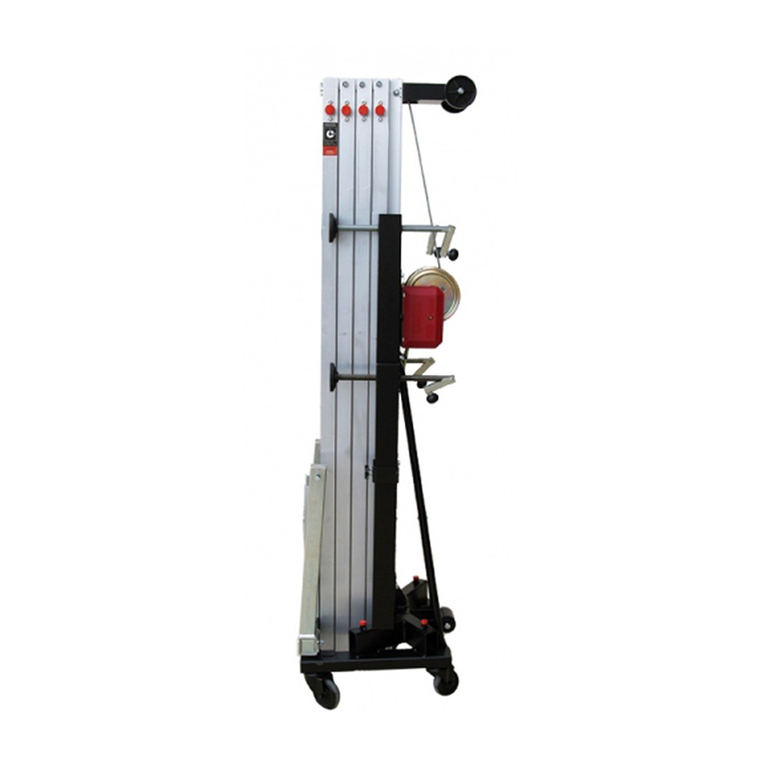
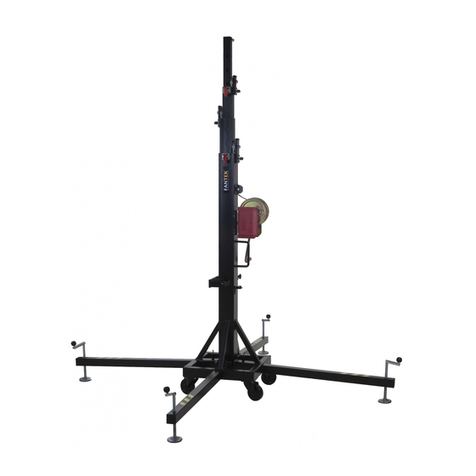
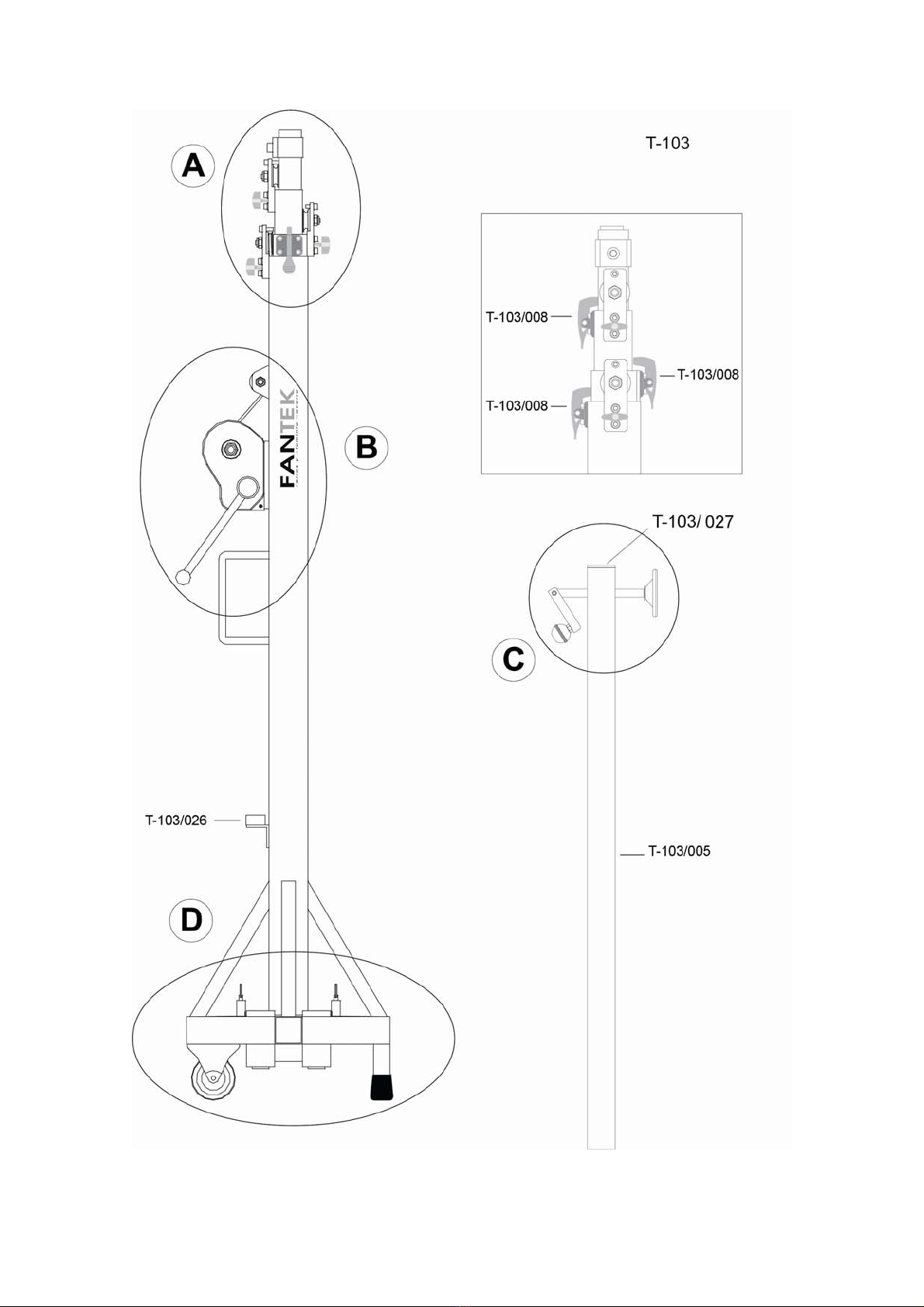
Lifting tower T-103. This tower is designed to lift loads vertically up to different heights as
a support of lighting sets.
2.1.- Max. load: 150 kg.
2.2.- Min. load: 25 kg.
2.3.- Max. height: 5,3 m.
2.4.- Min. height: 1,70 m.
2.5.- Base area: 2 x 2 m.
2.6.- Folded base area: 0,37 x 0,37 m.
2.7.- Weight: 40 kg.
2.8.- Winch: 350 kg. maximum load winch with automatic brake to stop the load.
Certified in Düsseldorf according to DIN 15020 and VBG 8, with the number 93309.
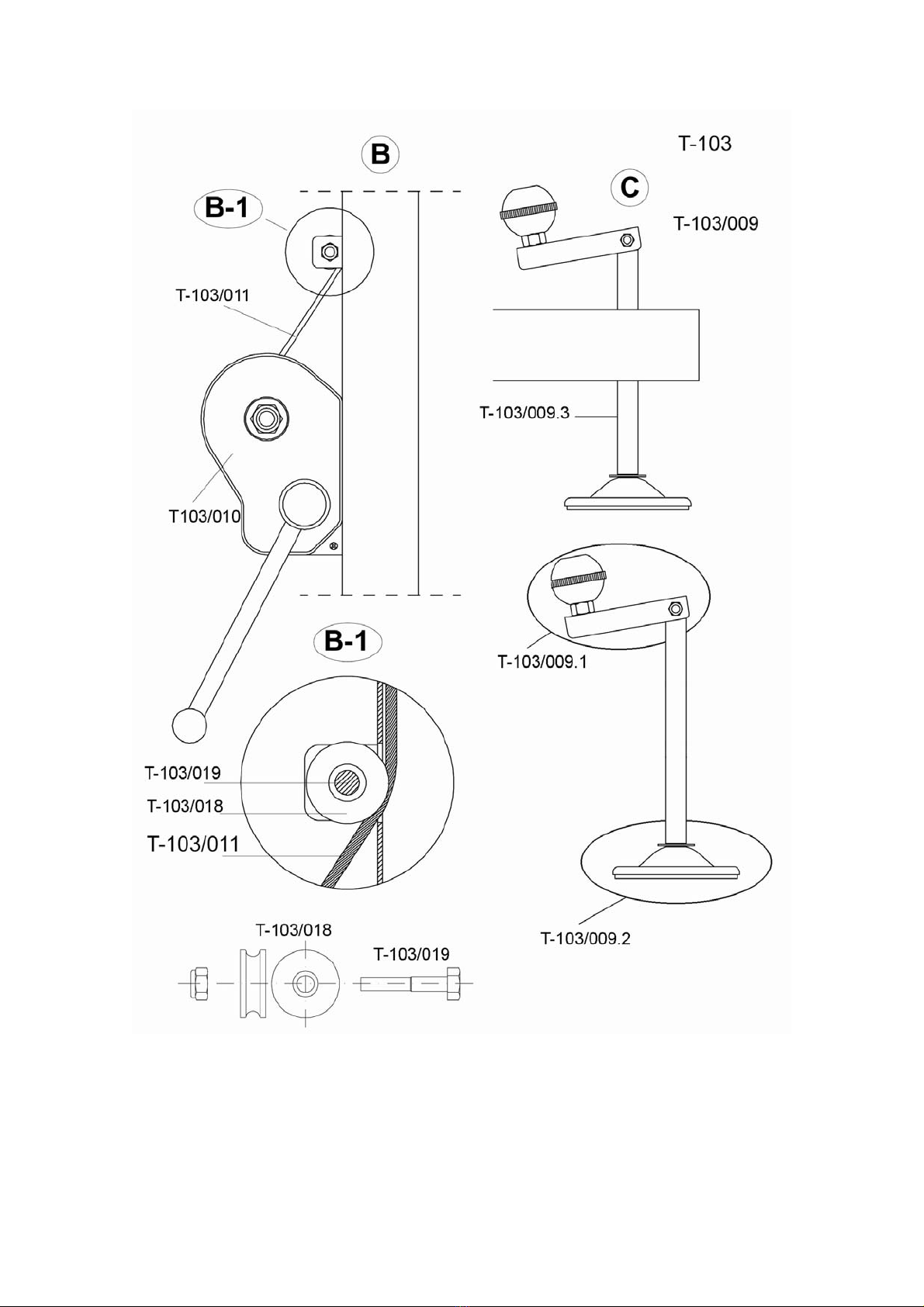
2.9.- Cable: Steel DIN 3060. Quality 160 kg/mm2. Twisting – resistant. 4 mm. cable
diameter
2.10.- Construction material: Steel profiles DIN 2394.
2.11.- Four telescopic profiles system operated by steel cable and guided by
channelled steel pulleys with ball bearings.
2.12.- Profiles fixing to the desired height by safety steel ACC/12 catches.
2.13.- Adjustable stabilizing disc feet in the legs with rubber non slip supports.
2.14.- Anchor of the legs by safety catches.
2.15.- Bubble level to adjust the tower verticality.
2.16.- Antirust protection and electrolitic cadmiated.
2.17.- Wheels for the vertical transport of the tower to it’s working location when folded.
3.- Safety precautions.
3.1.- Place the tower only on solid and levelled surfaces.
3.2.- Verify that the legs are correctly inserted and fastened.
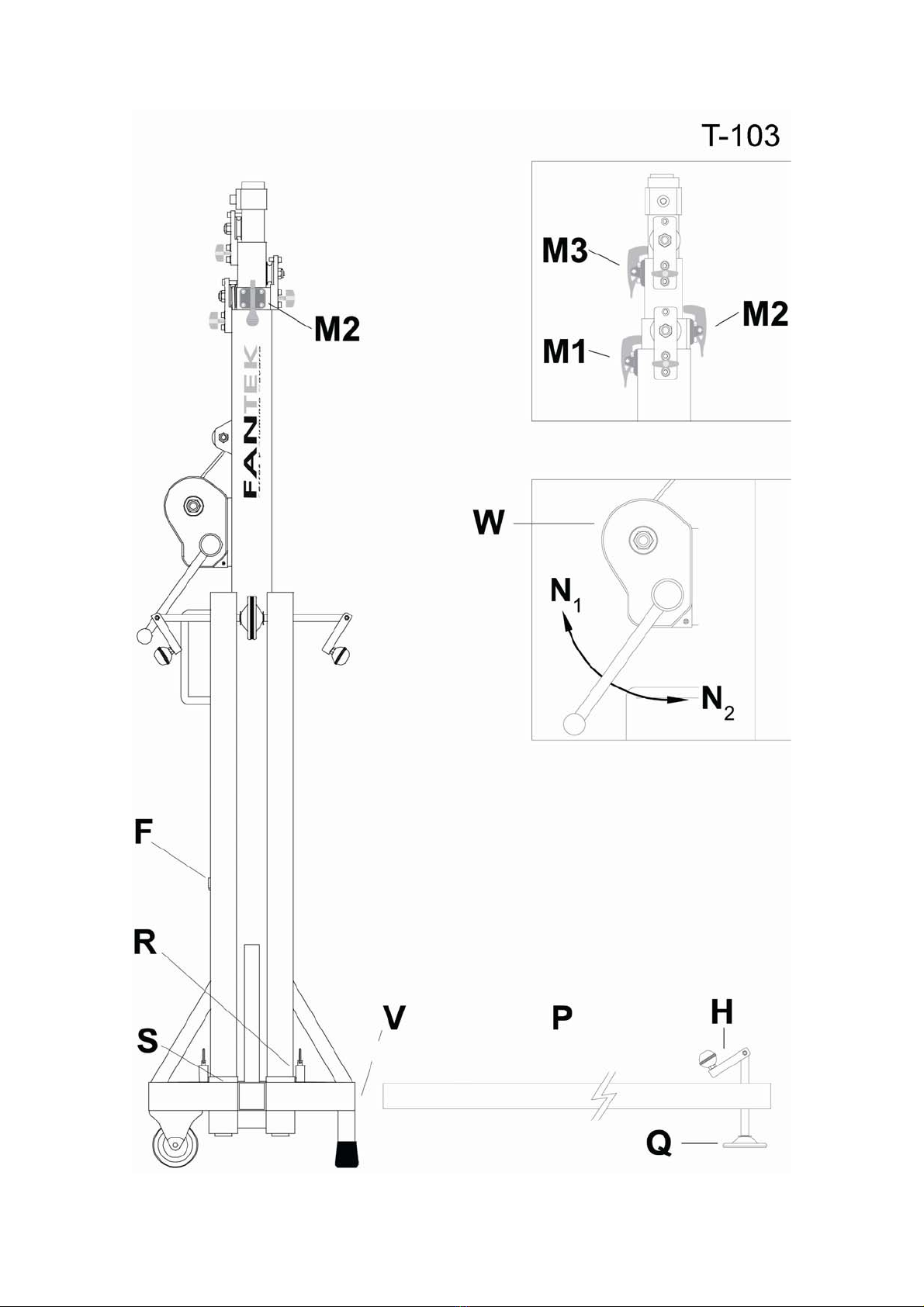
3.3.- Verify that the tower is in a vertical position by means of the bubble level (F)
placed in the base profil. Adjust, if necessary, with the plate support (Q), rotating the
hand crank (H).
3.4.- Verify the tower is in vertical position and is blocked in the working position by
means of the safety catches (M1, M2, M3).
3.5 Fix the adjustment handles while the profils are being lifting.
3.6.- If you use the tower open air, you have to place it on a secure surface and protect
the tower against the wind.
3.7.- Do not use stairways neither over the tower nor leaned in it.
3.8.- Be careful with cables, prominent objects, etc. placed above the tower.
3.9.- Do not stay under the load.
3.10.- Do not move the tower when it is lifted with load.
3.11.- Before you use the tower the first time verify the cable, this must be free of cuts
and fraying. Do not use inappropriate cables.
3.12.- Never dismount the winch hand crank (W) if the tower is loaded.
3.13 The minimum load required for a perfect braking function is 25 kg. The brake will
not function without this minimum load.
3.14.- Do not apply oil or grease to the winch brake mechanism.
3.15.- Not approved to lift people.
3.16.- For the transport, download all the sections and blockade them with their safety
catches.
4.- Operating.
4.1.- In order to place the tower in their working position, put the tower on a hard and
levelled surface.
4.2.- Get on the legs (P) of their support for the transport (S) and insert them in their
working lodging (V) verifying that they are tightly fastened by the safety catches (R).
4.3.- Adjust the vertical position of the tower by means of the plate support (Q) rotating
the hand crank (H) in the necessary direction to manage the bubble level (F) to the
centre.
4.4.-Give up the adjustment handle of the bar number 3,put the load on the top of the
tower using the suitable support, in order to make work the weight only in the vertical
direction. The minimum load must be 25 kg.The tower will remain blocked automatically
in any position by the retention system.
4.5.- Elevation:
Rotate the winch hand cranck in a clockwise (N1) lifting the tower until the desired
position,and getting completely out the first profile.Check the automatics catches
(M1,M2,M3) are being nailed,fixing automatically the profils.The safety catches must
always remain nailed when the elevation is finished.This is obtained decreasing a few
centimeters the load height once in the desired position.While you are lifting the tower
you must fix the adjustment handles before of giving up the following profile.
4.6.- Descending:
Let´S give up the adjustment handle of the last profile that has been lifted.As following
unblock the security catch (M1).In working position the weight of the load avoid to
unblock the catches,for unblocking the security catches you must elevate a few
centimeters the load by using the winch.Once the catch(M1) is unblocked, rotate the
winch hand cranck in counterwise (N2) until the profile 1 is completely folded, then fix
the profile with the adjustment handle to have it ready for transport.Get free the handle
of the profile number 2 and give up the catch(M2), continue lowering the load until the
second profile gets completely folded down to its minimum height,press the handle of
this profile.Repeat the operation with the profile number 3.
The tower can be left in any intermediate needed position as in lifting.
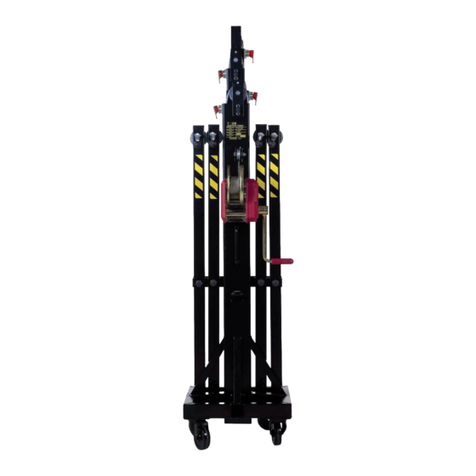
4.7.- For the tower transport is necessary to fold the tower lowering completely all the
profiles, blockading them with the safety catchs (M1,M2). Get out the legs lifting the
blockade on the catches and put them in their transport lodging (S).
5.- Maintenance.
5.1.- The cables get spoiled, because of this all cables have to be regularly checked.
Faulty cables must be replaced immediately. Do not use the lifting tower with faulty
cables. It is dangerous.
Only use cables DIN 3060.
5.2.- The lifting tower has been lubricated in the manufacturing process. It is
nevertheless recommended apply oil regularly to the gear drive, the bearing bushes
on the drive shaft, and to the drum hub, the thread of the handle and the profiles of
the tower.
ATTENTION:
Do not apply oil or grease to the brake mechanism.
The brake discs have been pregreased with an special warmth and pressure resistant
grease. Do not use other greases or this will affect to the winch brake performance.
5.3.- The lifting tower T-103 must be inspected by specialized technicians annually at
least.