10
ABOUT NORMAL BODY
TEMPERATURE AND
FEVER
Body temperature can vary from person to
person. It also varies on different parts of the
body and time of day. The following table shows
the statistics of normal ranges from different body
parts. Please keep in mind that temperatures
measured from different body parts, even at the
same time, should not be directly compared.
Fever indicates that the body temperature is
higher than normal. This symptom may be caused
by infection, overdressing or immunization. Some
people may not experience fever even when
they are ill. These include, but are not limited
to, infants younger than 3 months old, persons
with compromised immune systems, persons
taking antibiotics, steroids or antipyretics (aspirin,
ibuprofen, acetaminophen), or persons with
certain chronic illnesses. Please consult your
physician when you feel ill even if you do not
have a fever.
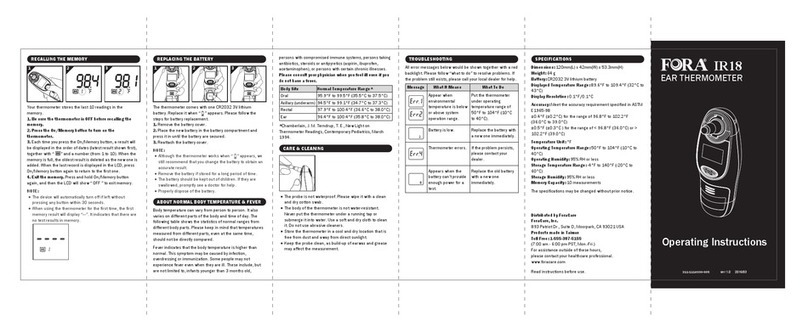
Body Site Normal Temperature Range*
Oral 95.9°F to 99.5°F (35.5°C to 37.5°C)
Axillary (underarm) 94.5°F to 99.1°F (34.7°C to 37.3°C)
Rectal 97.9°F to 100.4°F (36.6°C to 38.0°C)
Ear 96.4°F to 100.4°F (35.8°C to 38.0°C)
*Chamberlain, J. M. Terndrup, T. E., New Light on Thermometer
Readings, Contemporary Pediatrics, March 1994.
MAINTENANCE
Replacing the Battery
132
The thermometer comes with two 1.5V AAA
alkaline batteries. Replace them when “ ”
appears. Please follow the steps for battery
replacement.
1. Remove the battery cover and remove the
used batteries.
2. Place the new batteries in the battery
compartment and press it in until the batteries are
secured.
3. Reattach the battery cover.
NOTE:
• Although the thermometer works when “ ” appears, we still
recommend that you change the batteries to obtain an
accurate result.
• Remove the batteries if stored for a long period of time.
• The batteries should be kept out of the reach of children. If
they are swallowed, promptly see a doctor for help.
• Properly dispose of the batteries.