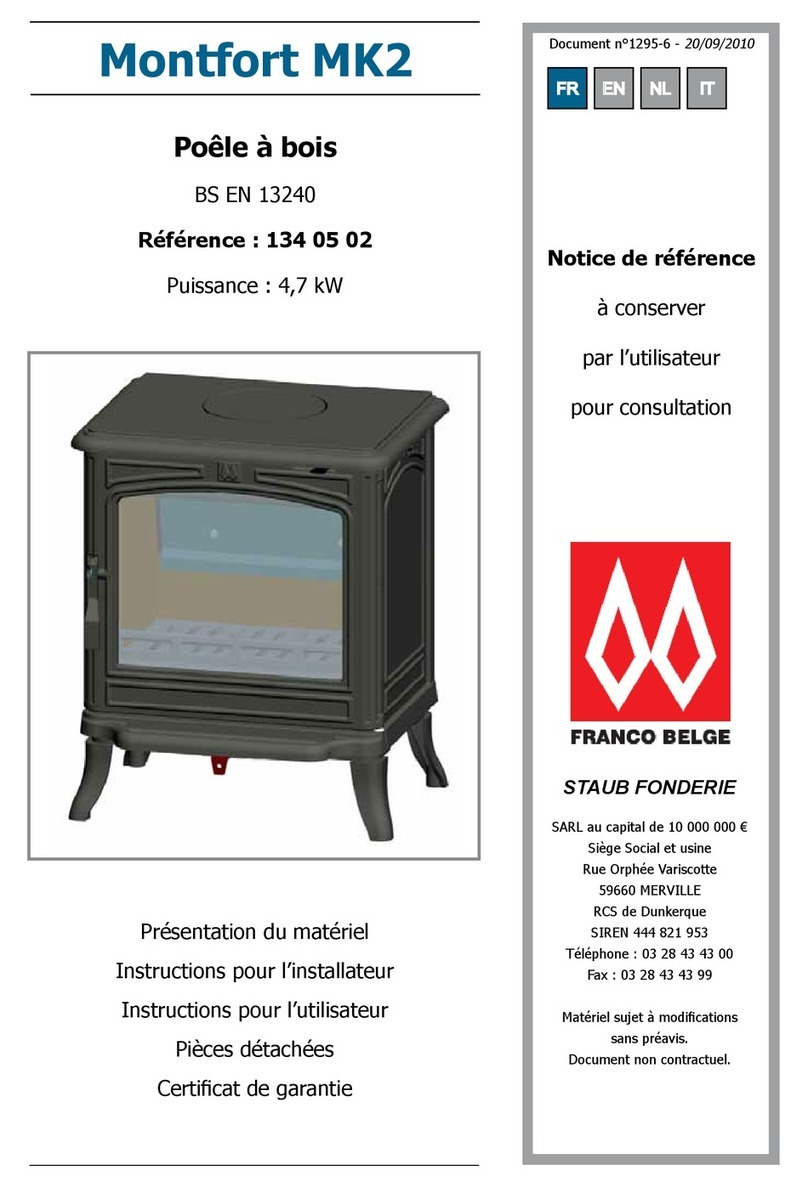
Notice de référence "1300" 9
Montfort MK2 EA - 1340502
3.2. Instructions for use with wood
(Figure 6)
3.2.1. Lighting
• Slide the secondary air inlet (# B1) to the right Open
the primary air inlet (# C1) during 10 minutes.
• Lay relighters or rolled up newspapers on the grate
with a reasonable quantity, if necessary, of dry kindling
wood.
• Light the newspaper or relighters using a long taper
and push the door to against the latch without closing
it.
After a few minutes, when the ames from the kindling
are reducing, add two small logs (half logs) and left
the door ajar again.
Wait a few minutes for add a full load, and again left
the door ajar until the load is burning well.
Close the door and the primary air inlet (#C2).
• The burning rate can now be lowered by moving the
top air control to the left. For a nominal output, use
the stove with the secondary air at about 80% open.
3.2.2. Re-fuelling
• Open the glass door and add logs.
- Open the primary and secondary air settings fully for
a few minutes in order to establish a good re before
closing the promary air and positioning the secondary
air slider to the desired setting.
3.3. Instructions for use with
smokeless fuels
3.3.1. Lighting
(Figure 6)
• Slide the secondary air inlet (# B1) to the right. Open
the primary air inlet (# C1).
• Lay relighters or rolled up newspapers on the grate
with a reasonable quantity, if necessary, of dry kindling
wood. Place a small quantity of solid fuel on top.
• Light the newspaper or relighters using a long taper
and close the door.
• When the re is burning ercely, add further fuel.
• When the stove body is hot, close the top air control
by sliding to the left.
• The burning rate can now be adjusted by sliding
primary air control.
3.3.2. Re-fuelling
- Open the primary air control (#C1).
- Open the glass door and add fuel.
- Leave the primary air control open for a few minutes
to allow the initial volatiles in the fuel to burn.
- Adjust the primary air unlet to the desired position.
3.4. Cleaning
It is essential to keep the grate free from a heavy build
up of ashes.
REMEMBER TO BURN SOLID FUEL CORRECTLY, AlR
SHOULD BE ALLOWED TO FLOW FROM THE ASH PIT
AREA THROUGH THE GRATE AND THROUGH THE
FUEL. IF THE GRATE OR ASH PAN ARE CONGESTED,
THE PERFOMANCE WILL BE EFFECTED.
If burning solid fuel, always empty the ash pan at least
once a day or whenever it is full of ashes. Never allow
the ashpan to overll allowing ash to be in contact with
the underside of the grate. If this condition is allowed,
the grate will wear out pre-maturely.
3.5. Maintenance of the Chimney
Very important : In order to avoid any incident
(chimney re, etc...), maintenance tasks must be
carried out regularly. If the appliance is regularly used,
the chimney should be swept several times per year,
together with the stovepipe connection section.
If the chimney catches re, you must cut off
the ue draught, close the doors and windows,
hatches and keys and call the Fire Brigade
without delay.
DO NOT OPEN THE DOOR OF THE APPLIANCE
(OR AIR INLET) UNDER ANY CIRCUMSTANCES
Chimney condition should be checked at least once per
year by a professional engineer.
3.6. Maintenance of the stove
• The appliance must be cleaned regularly, together
with the connecting pipe and the ue pipe.
• Remove all deposits from the combustion chamber
and clean the grate area.
• The glass should be cleaned with a solft cloth or
kitchen paper dampened with a mixfure of water and
vinegar or general household glass cleaning spray.
Only clean the glass when the stove is cold and never
use abrasive cleaners or cleaning pads as This will
scratch the ceramic glass.
• The “vitroceramic” glass will resists to temperatures
of up to 750 C. Should the glass break due to misuse,
it must be replaced by the manufacturers own product.