-The flue must be well insulated. If the flue inner wall
surfaces are cold, a good thermal draw is impossible
causing condensation problems (tar formation etc) to
occur.
-The flue must be watertight.
-The flue must not be shared with other appliances.
-The chimney must have a constant cross section.
-When the cross-section of the chimney is too large, it
has difficulties in obtaining a good draught.
-The chimney must be at least 4.5 m (15 ft) high and be
at 40 cm above the ridge of the roof and 8 meters away
from any construction.
-In case of a flat roof or when the roof gradient is lower
than 15°, the stack must be 1,2 m (4 feet) high at least.
-The capping must not restrain the draught.
-If the chimney has any down draught tendency, due to
its position in relation to nearby obstacles, then an
anti-down draught cowl must be installed on the
chimney or the chimney height must be increased.
-If the chimney draught is excessive or irregular, a
draught stabilizer (barometric damper) must be
installed to the connector pipe it must be visible and
accessible.
Flue non-existent :
-The appliance must not support the weight of the flue.
-It must be distant from any combustible material
(walls, cross members)
-It must permit an easy sweeping.
2.4 Mounting the flue collar
The stove is supplied with a connection flue spigot with
an inner diameter of 125 mm and an outer diameter of
139 mm.
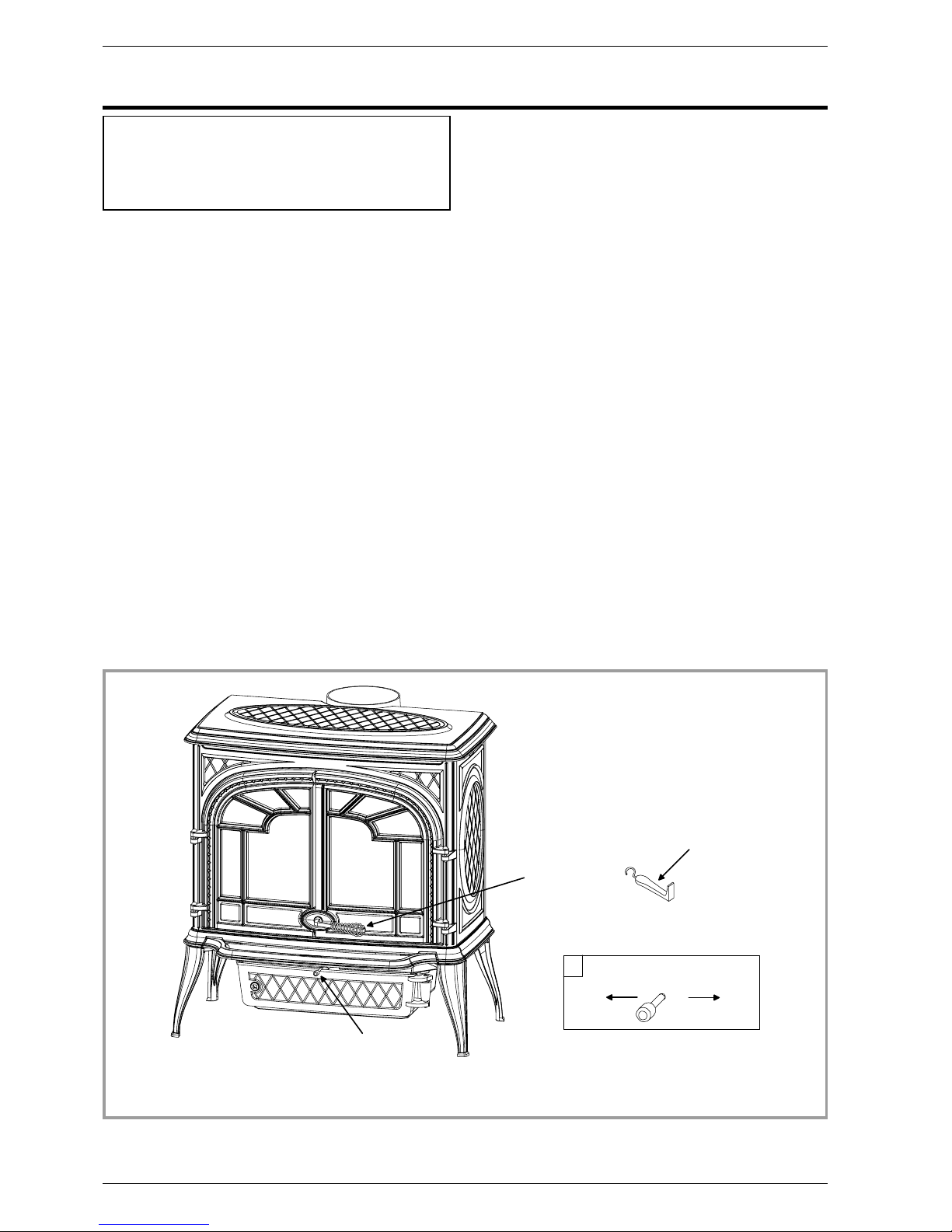
Figure 3
The same smoke outlet can be used to install a top or
rear flue. All you have to do is remove the 2 screws and
turn the adapter 180 degrees.
Ensure that the seal is fitted correctly.
2.5 Chimney connector
-The connection to flue must be carried out according
to local building regulations.
-The appliance must be installed as close as possible
to the chimney.
-The connector pipe must be approved for installation
with combustion products (either 24 ga. Black painted
or blued steel or 316 grade 20 ga. Stainless steel or
1 mm vitreous enamelled steel).
-Pipe diameter must not be less than the appliance
spigot diameter. If there is no other solution, the
reduction can not be more than one diameter lower
than the flue spigot and be situated as distant as
possible from the flue connection of the appliance.
-The connection can be either vertical or horizontal. For
horizontal connections, avoid right angle bends.
-The join between the connection pipe and the
stovepipe, and the flue, must be leak tight.
-For the premises equipped with a mechanical
controlled ventilation, the airtightness has to prevent
the exhauster drawing out the smokes from the
exhaust gas pipe.
The connection pipe and any draught stabiliser must
have access for cleaning.
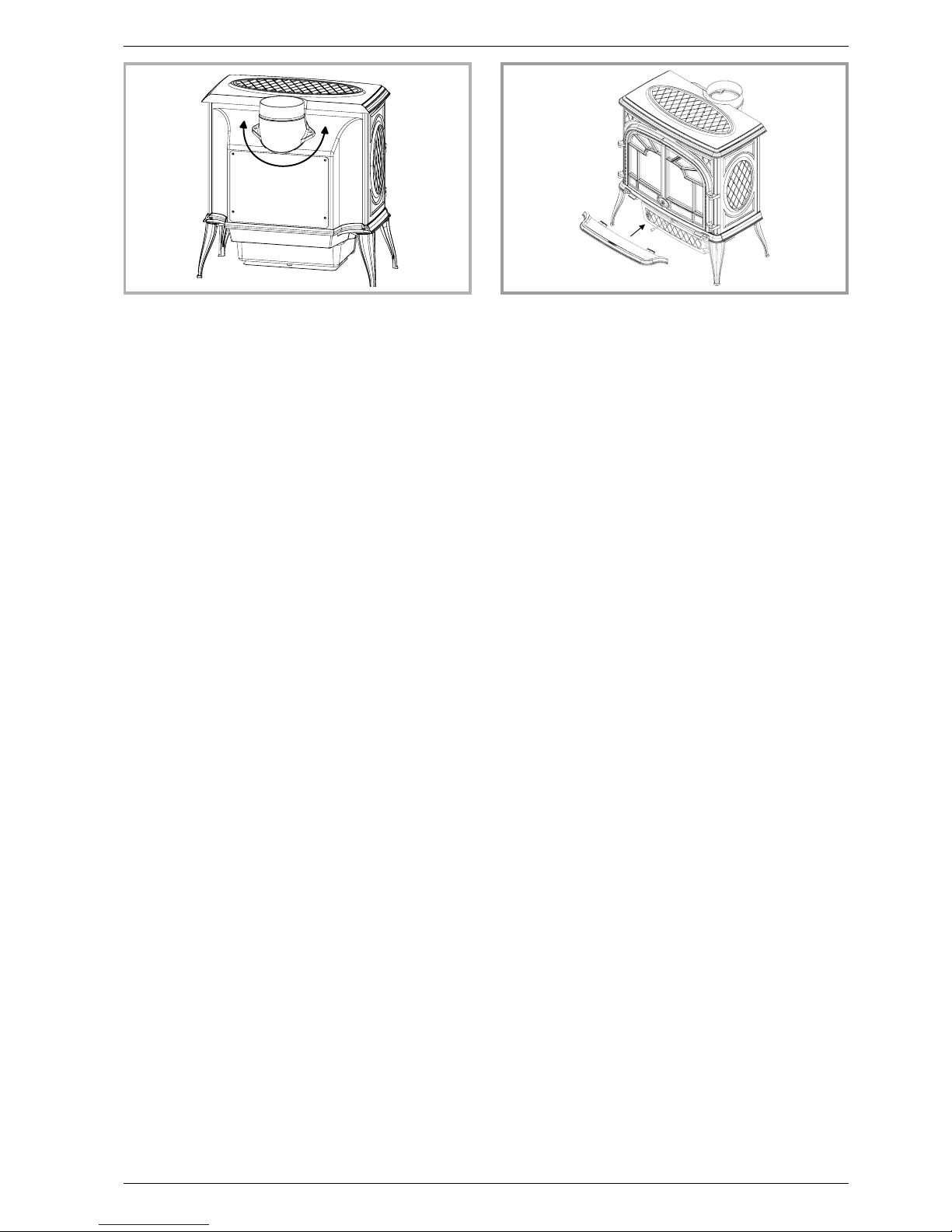
2.6 Mounting the tray
Figure 4
To avoid damage during transport, the tray has been
stored behind the main door.
Centre the tray on tab “A” and lower into place.
2.7 Pre-utilisation check
-Check that the seals of the smoke-line are in good
condition. Check that the door closes correctly. Check
that the glass is not damaged. Check that the smoke
passages are not obstructed by packaging or
removable parts. Check that all removable parts are
correctly installed.
Note : if it acts of a ceramics braid, it is consumable and
thus brought to be changed by the user.
2.8 Maintenance of the Chimney
Very important ! In order to avoid any incident
(chimney fire, etc...), maintenance tasks must be
carried out regularly.
If the appliance is regularly used, the chimney should
be swept several times per year, together with the
stovepipe connection section.
Chimney condition should be checked at least once
per year by a professional engineer.
Technical manual “1146” 5
“ARDENNES” - model 134 13 15 Installation instructions
1 8 0 °
Figure 3 - Mounting the flue collar
)
Figure 4 - Mounting the tray