manuals.online logo
Brands
  1. Home
  2. •
  3. Brands
  4. •
  5. HoMedics
  6. •
  7. Blood Pressure Monitor
  8. •
  9. HoMedics BPW-1000-EU User manual

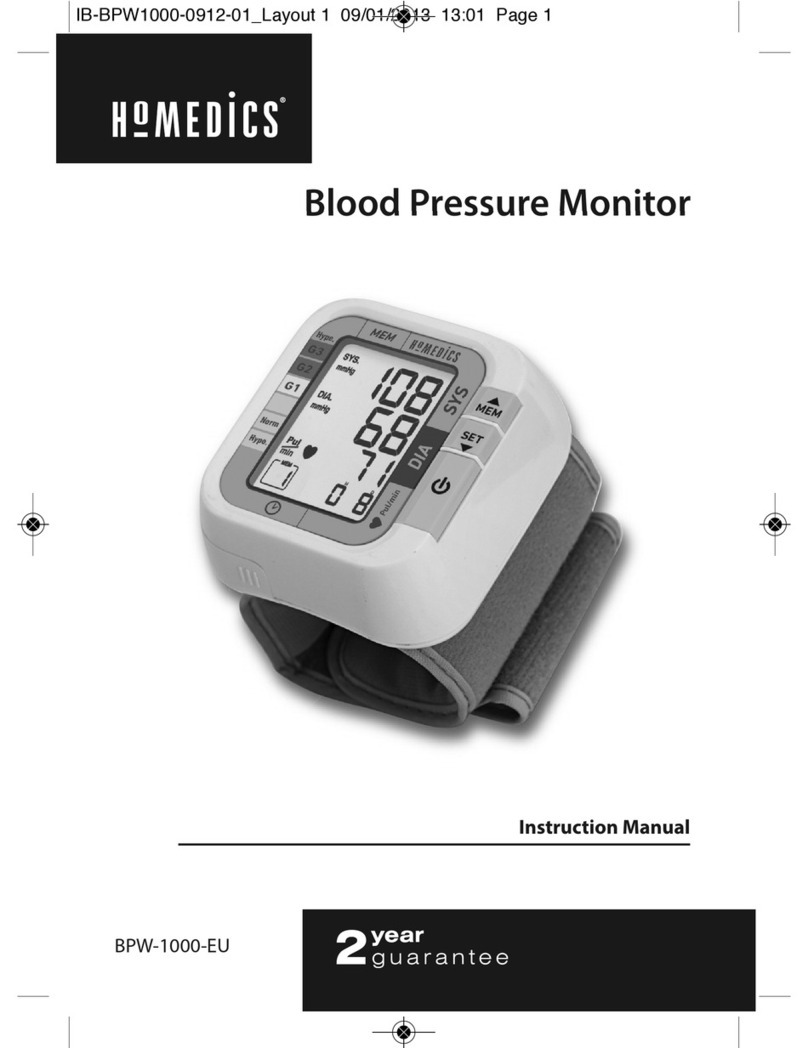
HoMedics BPW-1000-EU User manual

Other manuals for BPW-1000-EU

3

Other HoMedics Blood Pressure Monitor manuals

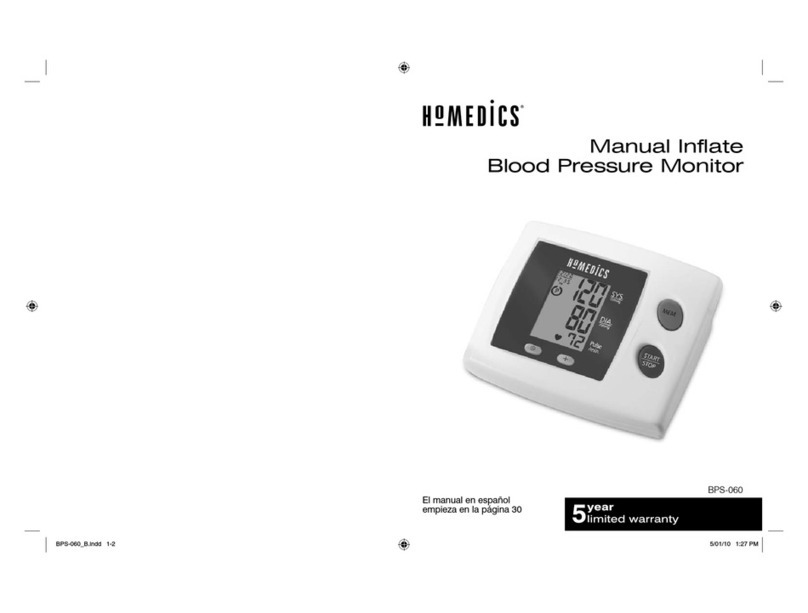
HoMedics BPA-060 User manual

HoMedics

HoMedics BPA-060 User manual

HoMedics BPA-040 User manual

HoMedics

HoMedics BPA-040 User manual

HoMedics BPW-1000-EU User manual

HoMedics

HoMedics BPW-1000-EU User manual

HoMedics THERA-P BPA-200 User manual

HoMedics

HoMedics THERA-P BPA-200 User manual

HoMedics HL158VA User manual

HoMedics

HoMedics HL158VA User manual

HoMedics BPA-060 User manual

HoMedics

HoMedics BPA-060 User manual

HoMedics BPW-1000-EU User manual

HoMedics

HoMedics BPW-1000-EU User manual

HoMedics Walgreens Premium Arm WGNBPA-960BT User manual

HoMedics

HoMedics Walgreens Premium Arm WGNBPA-960BT User manual

HoMedics CareOne AHBPA-060 User manual

HoMedics

HoMedics CareOne AHBPA-060 User manual

HoMedics BPA-945 User manual

HoMedics

HoMedics BPA-945 User manual

HoMedics BPA-110 User manual

HoMedics

HoMedics BPA-110 User manual

HoMedics BPA-300 User manual

HoMedics

HoMedics BPA-300 User manual

HoMedics BPA-110 User manual

HoMedics

HoMedics BPA-110 User manual

HoMedics BPW-O200 User manual

HoMedics

HoMedics BPW-O200 User manual

HoMedics Walgreens 518728 User manual

HoMedics

HoMedics Walgreens 518728 User manual

HoMedics BPA-200-EU User manual

HoMedics

HoMedics BPA-200-EU User manual

HoMedics THERA-P BPW-200 User manual

HoMedics

HoMedics THERA-P BPW-200 User manual

HoMedics BPA-945 User manual

HoMedics

HoMedics BPA-945 User manual

HoMedics BPW-040 User manual

HoMedics

HoMedics BPW-040 User manual

HoMedics BPA-960BT User manual

HoMedics

HoMedics BPA-960BT User manual

HoMedics MiBody 360 User manual

HoMedics

HoMedics MiBody 360 User manual

HoMedics BPW-710-CA Instruction Manual

HoMedics

HoMedics BPW-710-CA Instruction Manual

HoMedics BPA-060-DDM User manual

HoMedics

HoMedics BPA-060-DDM User manual

HoMedics BPA-110 User manual

HoMedics

HoMedics BPA-110 User manual

Popular Blood Pressure Monitor manuals by other brands

Panasonic EW3036 null

Panasonic

Panasonic EW3036 null

Microlife BP 3AS1-2 null

Microlife

Microlife BP 3AS1-2 null

Little Doctor LD7 instruction manual

Little Doctor

Little Doctor LD7 instruction manual

Microlife WatchBP Office Targe instruction manual

Microlife

Microlife WatchBP Office Targe instruction manual

Omron M6W Information sheet

Omron

Omron M6W Information sheet

Mx Onda MX-CP2395 instruction manual

Mx Onda

Mx Onda MX-CP2395 instruction manual

Braun VitalScan 1 manual

Braun

Braun VitalScan 1 manual

Little Doctor LD-91 instruction manual

Little Doctor

Little Doctor LD-91 instruction manual

Sanitas SBM 09 Instructions for use

Sanitas

Sanitas SBM 09 Instructions for use

A&D LifeSource UB-328 instruction manual

A&D

A&D LifeSource UB-328 instruction manual

König Electronic HC-BLDPRESS200 User instruction manual

König Electronic

König Electronic HC-BLDPRESS200 User instruction manual

Leicke Sharon user manual

Leicke

Leicke Sharon user manual

Omron M6 Comfort instruction manual

Omron

Omron M6 Comfort instruction manual

3B SCIENTIFIC U11395 instruction sheet

3B SCIENTIFIC

3B SCIENTIFIC U11395 instruction sheet

Soehnle SYSTO MONITOR 100 Instructions for use

Soehnle

Soehnle SYSTO MONITOR 100 Instructions for use

Nasco Healthcare Simulaids Life/form LF01095U USER HELP GUIDE

Nasco Healthcare

Nasco Healthcare Simulaids Life/form LF01095U USER HELP GUIDE

Microlife WatchBP office instruction manual

Microlife

Microlife WatchBP office instruction manual

ForaCare FORA P30 Plus owner's manual

ForaCare

ForaCare FORA P30 Plus owner's manual

manuals.online logo
manuals.online logoBrands
  • About & Mission
  • Contact us
  • Privacy Policy
  • Terms and Conditions

Copyright 2025 Manuals.Online. All Rights Reserved.

GB
Instruction Manual
BPW-1000-EU
Blood Pressure Monitor
IB-BPW1000-0912-01_Layout 1 09/01/2013 13:01 Page 1
2
GB
HOMEDICS BLOOD PRESSURE MONITOR
Before use
Before the blood pressure monitor is taken into use a number of basic steps should be
observed. Please read this manual thoroughly before the blood pressure monitor is used
for the first time and keep the manual for future use.
The blood pressure monitor is intended for home use only. Any measurement is solely
for your information and can under no circumstances replace a visit to the doctor. The
blood pressure measurements should always be assessed by a qualified person (a
doctor, nurse or similar) who is familiar with the user’s general medical condition. By
regular use and by keeping a record of the results, this person can be kept well informed
about developments in the user’s blood pressure. Measurements must never be
interpreted by the user with the aim of changing levels in the use of medicine as
prescribed by a doctor, but the doctor’s instructions must be followed AT ALL TIMES.
Use of appropriate cuff size is crucial to correct measurement. Follow the instructions
presented in this manual and printed on the cuff to ensure that the correct cuff size is
used.
The blood pressure monitor is not suited for users who suffer from arrhythmia (heart
rhythm disturbances) and errors may occur in the measurement results if the user has
suffered a stroke, suffers from cardiovascular diseases, has a very low blood pressure, or
suffers from other symptoms such as circulatory diseases (diabetes, kidney diseases,
arterial sclerosis (deposits in the arteries), or poor peripheral blood circulation (e.g. in
hands and feet).
Electromagnetic disturbances: The device contains sensitive electronic components.
Keep it clear of strong electric or electromagnetic fields in the immediate surroundings
(e.g. mobile telephones, microwave ovens) as these may temporarily reduce
measurement accuracy.
Use the blood pressure monitor only for its original purpose.
The device is intended for measurement of blood pressure and pulse with adult persons.
Do not apply the monitor to infants nor to persons who cannot express their permission.
The device must not be operated by children.
The blood pressure monitor functions in accordance with the oscillometric
measurement principle. These blood pressure changes are measured in the cuff on the
basis of the arm pulse and are converted into a numerical value of the current blood
pressure. Simultaneously, the number of pulse beats are registered and calculated as
number of pulse beats per minute.
There are two kinds of discernible blood pressures. Both are expressed in mmHg
(millimetres on the mercury column): The systolic and the diastolic. The systolic (‘the
high blood pressure’) states the pressure when the heart chambers contract to send
blood through your body, and the diastolic (‘the low blood pressure’) states the pressure
when the heart is at ease and filling with blood before the next muscle contraction. The

IB-BPW1000-0912-01_Layout 1 09/01/2013 13:01 Page 2
3
GB
connection between values (mmHg) is expressed as e.g. 130 over 85 which means that
the systolic pressure is 130 and the diastolic pressure is 85.
Why is it important to keep an eye on your blood pressure?
Many of today’s most common diseases are connected to hypertension , also referred to
as ‘high blood pressure’. Hypertension is closely connected to cardiovascular diseases,
and for people in the danger zone the blood pressure provides an important tool to
keep an eye on the development.
What are systolic pressure and
diastolic pressure?
When ventricles contract and pump
blood out of the heart, blood pressure
reaches its maximum value, the highest
pressure in the cycle is known as systolic
pressure. When the heart relaxes
between heartbeats, the lowest blood
pressure is diastolic pressure.
What is the standard blood
pressure classification?
Below illustrates the blood pressure
classification mode by World Health
Organization (WHO) and International
Society of Hypertension(ISH) in 1999.
Systolic Diastolic
artery
press relax
vein
blood discharging blood entering
SYS <120 120~129 130~139 140~159 160~179 >180
D A <80 80~84 85~89 90~99 100~109 >110
Level
Blood
Pressure
(mmHg)
ptimal Normal High-normal Mild Moderate Severe
CAUTI N
Only a physician/ P can tell you your normal blood pressure range and the point at
which you are at risk. Consult your physician to obtain these values. If the
measurements taken with this product fall outside the range, consult your physician/ P.
Hypo Norm. Norm. G1 G2
G3
IB-BPW1000-0912-01_Layout 1 09/01/2013 13:01 Page 3
4
GB
SAFETY INFORMATION
Caution: consult accompanying
documents Type B applied part
CE mark: conforms to essential
requirements of the Medical Device
Directive 93/42/EEC.
Disposal: do not dispose of this
product as unsorted municipal waste.
Collection of such waste separately
for special treatment is necessary.
Manufacturer
Direct current
Specifies serial number
CAUTI N
• This device is intended for adult use only.
• This device is intended for non-invasive measuring and monitoring of arterial blood
pressure. It is not intended for use on extremities other than the wrist or for functions
other than obtaining a blood pressure measurement.
• Do not confuse self-monitoring with self-diagnosis. This unit allows you to monitor
your blood pressure. Do not begin or end medical treatment based solely on the
readings from this unit. Always consult your physician first.
• If you are taking medication, consult your physician to determine the most appropriate
time to measure your blood pressure. Never change a prescribed medication without
consulting your physician.
• This unit is not suitable for continuous monitoring during medical emergencies or
operations.
• If the wrist cuff pressure exceeds 40 kPa (300 mmHg), the unit will automatically
deflate. Should the wrist cuff not deflate when pressures exceeds 40 kPa (300 mmHg),
detach the wrist cuff from the wrist and press the “ ” button to stop inflation.
• To avoid measurement errors, carefully read this manual before using the product.
• The equipment is not AP/AP equipment and not suitable for use in the presence of a
flammable anesthetic mixture with air or with oxygen or nitrous oxide.
• The operator shall not touch the battery and the patient simultaneously.
• The user must check that the equipment functions safely and see that it is in proper
working condition before being used.
IB-BPW1000-0912-01_Layout 1 09/01/2013 13:01 Page 4
GB
5
LCD display signal
MEM
Pul/min SYSDIA
G3
G2
G1
Norm
Hypo.
Hype.
Symbol Description Explanation
Systolic blood pressure High pressure result
Diastolic blood pressure Low pressure result
BPM
Pulse/minute; heartbeats/minute
Memory If “M” shows, the displayed measurement values
is from the memory.
Movement error symbol Movement will result in inaccurate reading
Low battery
Batteries are low and need to be replaced
kPa Measurement unit of the blood pressure
(1kPa = 7.5mmHg)
mmHg Measurement unit the blood pressure
(1mmHg = 0.133kPa)
Deflating CUFF is deflating
Time (hour:minute) Current time
rade
The grade of the blood pressure
IB-BPW1000-0912-01_Layout 1 09/01/2013 13:01 Page 5
6
GB
MONITOR COMPONENTS
LCD DISPLAY
RADE
TIME
MEM/UP TOUCH KEY
BATTERY
COMPARTMENT
CUFF
SYSTOLIC
SET/DOWN TOUCH KEY
DIASTOLIC
START/STOP
PULSE RATE
Inserting and Changing Batteries
1. Slide off the battery cover.
2. Install the batteries by matching the correct
polarity, as shown. Always use the correct
battery type.
3. Replace the cover.
Replace the batteries whenever the below happens
• The shows
• The display dims
• The display does not light up
CAUTI N
Remove batteries if the device is not likely to be used for some time.
IB-BPW1000-0912-01_Layout 1 09/01/2013 13:01 Page 6
GB
7
SETTIN DATE, TIME AND MEASUREMENT UNIT
It is important to set the clock before using your blood pressure monitor, so that a time
stamp can be assigned to each record that is stored in the memory. (year: 2000–2050,
time: 24 H)
1. When the unit is off, hold “SET” for 3 seconds to
enter for mode for changing the date, time and
measurement unit.
2. Press the “MEM” to change the [YEAR].
3. When you get the correct year, press “SET” and it
will turn to the next step automatically.
4. Repeat steps 2 and 3 to set the [MONTH] and [DAY].
5. Repeat steps 2 and 3 to set the set the [HOUR] and
[MINUTE].
6. Repeat steps 2 and 3 to set the [UNIT].
7. The "Year, Month, Date, Hour, Minute, Unit" will show once again and then turn off
automatically.
IB-BPW1000-0912-01_Layout 1 09/01/2013 13:01 Page 7
8
GB
HOW TO USE THE BLOOD PRESSURE DEVICE
Applying the cuff
1. Remove all watches, jewellery, etc. prior to
attaching the wrist monitor. Clothing
sleeves should be rolled up and the cuff
should be wrapped on bare skin for correct
measurements.
2. Apply cuff to left wrist with palm facing up
see Fig. A.
3. Make sure the edge of the cuff is about 1
cm from the palm see Fig. B.
4. In order to ensure accurate measurements,
fasten the velcro strap securely around
your wrist so there is no extra space
between the cuff and the wrist see Fig. C.
If the cuff is not wrapped tight enough, the
measurement values may be false.
5. If your doctor has diagnosed you with poor
circulation on your left arm, carefully place
the cuff around your right wrist see Fig. D.
Fig. A
Fig. B
Fig. C
Fig. D
IB-BPW1000-0912-01_Layout 1 09/01/2013 13:01 Page 8
GB
9
(X)
Correct Measuring Posture
1. Place your elbow on a table so that the
cuff is at the same level as your heart see
Fig. E.
NOTE: Your heart is located slightly below
your armpit a bit to the left of the middle
of your chest. Relax your entire body,
especially the area between your elbow
and fingers.
2. If the cuff is not at the same level as your
heart or if you can not keep your arm
completely still throughout the reading,
use a soft object such as a folded towel to
support your arm see Fig. F. Do not allow
hard objects to come in contact with the
wrist cuff.
3. Turn your palm upwards.
4. Sit upright in a chair, and take 5-6 deep
breaths.
Avoid leaning back while the
measurement is being taken see Fig. .
Fig. E
Fig. F
Fig.
IB-BPW1000-0912-01_Layout 1 09/01/2013 13:01 Page 9
10
GB
Important notes regarding your blood pressure measurement
• Take your reading in a comfortable environment as measurements can be aected by
hot or cold temperatures. Take your blood pressure at normal body temperature.
• Do not move or talk during measurement as this can elevate readings.
• Do not move or cross legs during measurement. Keep feet at on oor.
• Do not touch cu or monitor during measurement procedure.
• t is suggested that you take your measurements at the same time each day and use
the same arm for consistency.
• Users should wait a minimum of 5 minutes before taking additional measurements.
More time may be necessary depending upon your physiology.
• The measurement results that users receive are for reference only. f users have any
blood pressure concerns, please consult your doctor.
• Once ination reaches 300 mmHg, the unit will deate automatically for safety reasons.
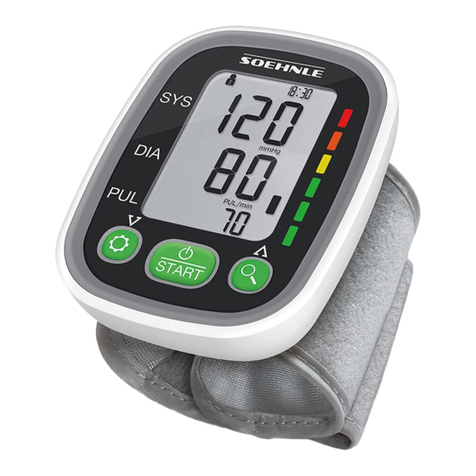
• This product is not suitable for people with arrhythmias.
• This device may have diculty determining the proper blood pressure for users with
diabetes, poor circulation of blood, kidney problems, or for users who have suered a
stroke.
• Position the monitor at the same level as your heart during measurement to ensure
accurate readings.
• Blood pressure changes with every heartbeat and is in constant uctuation throughout
the day.
• Blood pressure measurement can be aected by the position of the user, his or her
physiologic condition and other factors. For greatest accuracy, wait 1 hour after
exercising, bathing, eating, drinking beverages with alcohol or caeine, or smoking to
measure blood pressure.
• Before measurement, it is suggested that you sit quietly for 15 minutes as
measurements taken during a relaxed state will have greater accuracy. You should not
be physically tired or exhausted while taking a measurement.
• During the measurement, do not talk or move your arm or hand muscles.
IB-BPW1000-0912-01_Layout 1 09/01/2013 13:01 Page 10