10
5. Operation
The
LED
jumper is used to control the LED indication without interfering with the detector. Jumper in the
ON
position (pins
1 and 2), LED on, jumper in the
OFF
position (pins 2 and 3), LED off. Factory default:
LED on
.
The
P. Count
jumper controls the sensitivity of the infrared and microwave to trigger the alarm. With the jumper in position
1P
, the sensor provides maximum sensitivity (pins 7 and 8). With the jumper in position
4P
, the sensor provides appropriate
detection for environments with a high incidence of EMI and RFI interferences (pins 1 and 2), with greater immunity to false
triggering. The 2P and 3P positions are intermediate settings. Factory default:
3P jumper
.
The
Relay
jumper controls the state of the relay contact. With the jumper in the
NC
position (pins 1 and 2), the contact
is Normally Closed. With the jumper in the
NA
position (pins 2 and 3), the contact is Normally Open. Factory default:
NF
(Normally closed)
The microwave adjustment potentiometer determines the microwave detection range. Adjust it according to the needs of
the environment. Level
1
minimum sensitivity, level
5
maximum sensitivity. Factory default:
maximum sensitivity (level 5)
.
6. Test
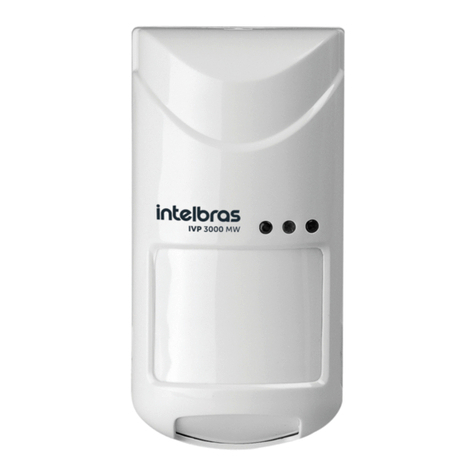
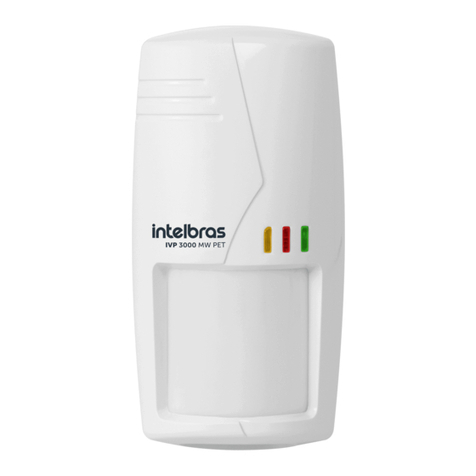
When powered on, all LEDs will ash constantly, indicating that the sensor has activated the self-test. After 60 seconds, all LEDs
will go out and the sensor will enter operating mode.
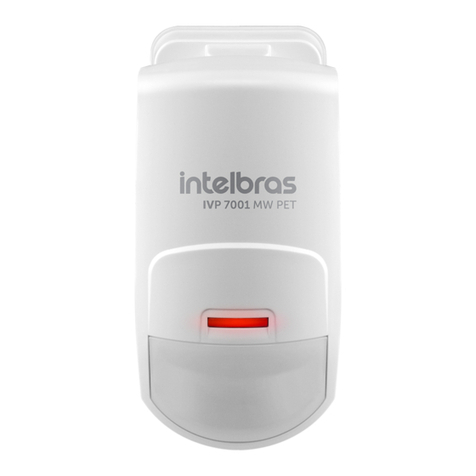
Perform the walk test, with movements transverse to the sensor’s detection rays, observing the LED indications.
» Green
LED
:infrared activation.
» Yellow
LED
:microwave activation.
»
Blue
LED: alarm activation (infrared + microwave).
LED
Jumper
Position Condition
ON LED on.
OFF LED off
P. Count
Jumper
Position Condition
1P Maximum sensitivity
2P - 3P Intermediate sensitivity
4P minimum sensitivity (EMI and RFI)
Greater immunity to false triggering
Relay
Jumper
Position Condition
NF Normally closed
NA Normally Open
Microwaves
Position Condition
Min. Minimum detection range
Max. Maximum detection range