1INTRODUCTION
6
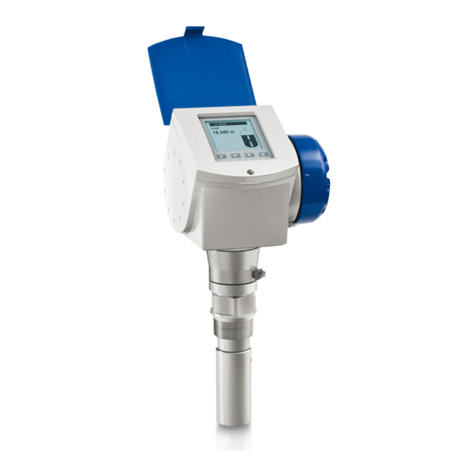
OPTIWAVE 5200 C
www.krohne.com 02/2013 - 4001906202 - AD SIL OPTIWAVE 5200 R02 en
1.5 Terms and definitions
DCDDiagnostic Coverage of dangerous failures
Firmware Software embedded in the device.
FIT Failure In Time (1×10⁻⁹ failures per hour)
FMCW Frequency-Modulated Continous-Wave. The measuring principle. For more
data, refer to “Technical Data”in the handbook (document [N1]).
FMEDA Failure Modes, Effects and Diagnostics Analysis
HFT Hardware Fault Tolerance
High demand or
continuous mode Where the frequency of demands for operation made on a safety-related system
is greater than one time per year
I/O Input / output
λDD Rate for dangerous detected failure
λDU Rate for dangerous undetected failure
λSD Rate for safe detected failure
λSU Rate for safe undetected failure
Low demand mode Where the frequency of demands for operation made on a safety-related system
is no greater than one time per year
MTBF Mean Time Between Failures
MTTF Mean Time To Failure
MTTR Mean Time To Recovery
PFDAVG Average Probability of Failure on Demand
PFH Probability of a dangerous Failure per Hour
SFF Safe Failure Fraction
SIL Safety Integrity Level
SIS Safety Integrated System
TBF Tank bottom following. A device measurement mode. For more data, refer to
“Technical Data”in the handbook (document [N1]).
Type A system "Non-complex" system (all failure modes are well defined). For more data, refer
to subsection 7.4.3.1.2 of IEC 61508-2.
Type B system "Complex" system (all failure modes are not well defined). For more data, refer
to subsection 7.4.3.1.2 of IEC 61508-2.
T[Proof] Proof Test Interval
T[Repair] Time to Repair
T[Test] Internal Diagnostics Test Interval
1oo1 1 out of 1 channel architecture (single architecture performs the safety function)
1oo1D 1 out of 1 channel architecture with diagnostics