3
!
Rules For Safe Operation (1)
Warning
To avoid possible electric shock or personal
injury, and to avoid possible damage to the Meter
or to the equipment under test, adhere to the
following rules :
n Before using the Meter inspect the case. Do not
use the Meter if it is damaged or the case (or part
of the case) is removed. Look for cracks or
missing plastic. Pay attention to the insulation
around the connectors and Clamps.
n Inspect the test leads for damaged insulation or
exposed metal. Check the test leads for Continuity.
Replace damaged test leads with identical
electrical Specifications before using the Meter.
n Do not apply more than the rated voltage, as
marked on the Meter, between the terminals or
between any terminal and grounding.
n The rotary switch should be placed in the right
position and no any changeover of range shall be
made while measurement is conducted to
prevent damage of the Meter.
n When measurement is taken at an effective
voltage over 60V in DC or 30V rms in AC, special
care should be taken for there is danger of
electric shock.
n Use the proper terminals, function, and range for
your measurements.
n Do not use or store the Meter in an environment
of high temperature, humidity, explosive,
inflammable and strong magnetic field. The
performance of the Meter may deteriorate after
the meter is dampened.
n When using the test leads, keep your fingers
behind the finger guards.
4
- +
Rules For Safe Operation (2)
n Disconnect circuit power and discharge all high
-voltage capacitors before testing resistance,
continuity, diodes, or current.
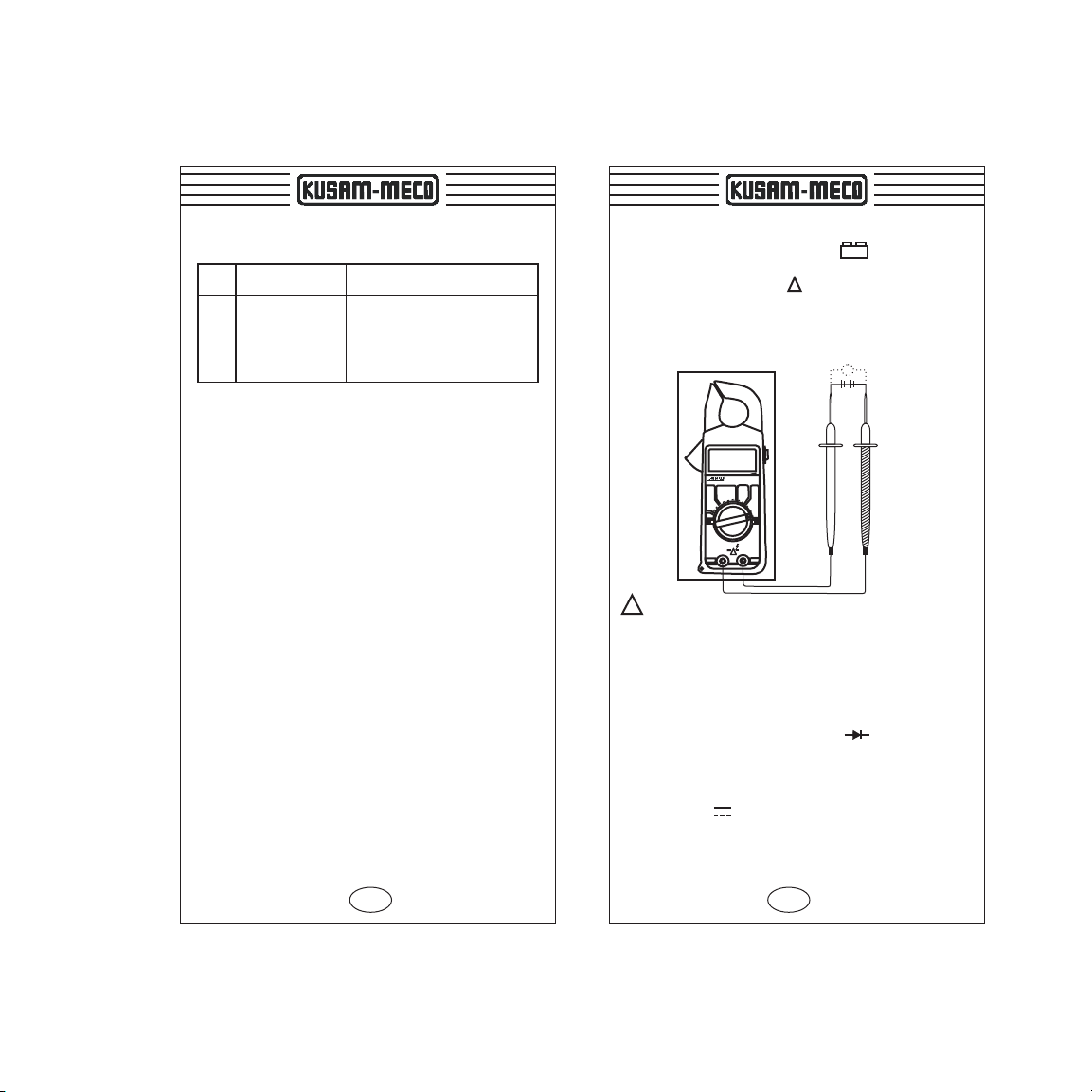
n Replace the battery as soon as the battery
indicator appears. With a low battery, the
Meter might produce false readings that can lead
to electric shock and personal injury.
n Turn the Meter power off when it is not in use and
take out the battery when not using for a long
time.
n Constantly check the battery as it may leak when
it has not been used for some time, replace the
battery as soon as leaking appears. A leaking
battery will damage the Meter.