manuals.online logo
Brands
  1. Home
  2. •
  3. Brands
  4. •
  5. Monacor
  6. •
  7. Media Converter
  8. •
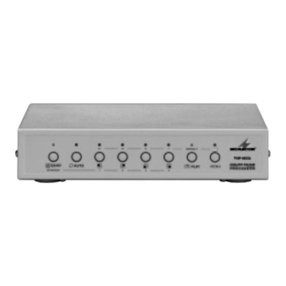
  9. Monacor TVSP-410 User manual

Monacor TVSP-410 User manual

This manual suits for next models

1

Other Monacor Media Converter manuals

Monacor SW-2412/5 User manual

Monacor

Monacor SW-2412/5 User manual

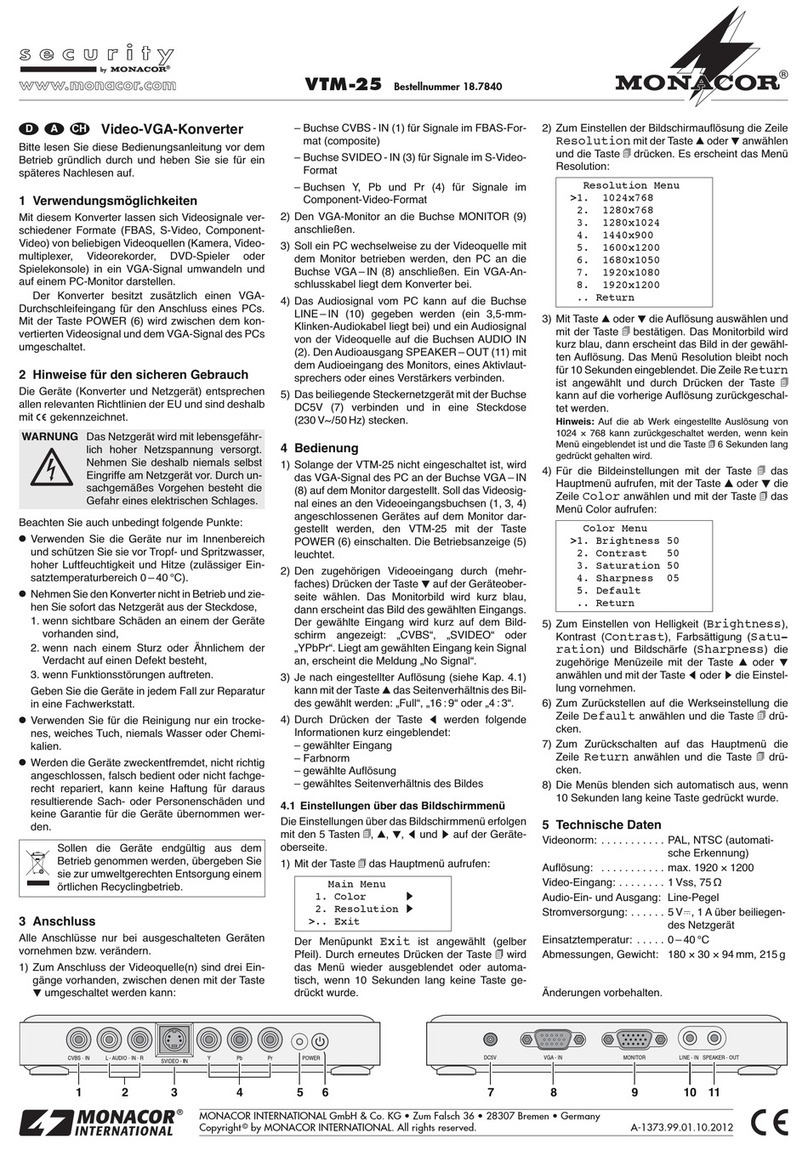
Monacor VTM-25 User manual

Monacor

Monacor VTM-25 User manual

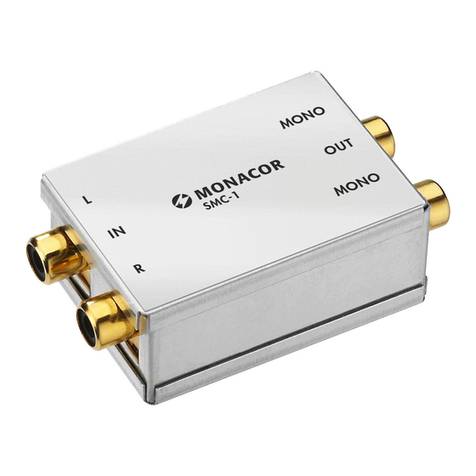
Monacor SMC-1 User manual

Monacor

Monacor SMC-1 User manual

Monacor IMG Stageline LSP-102 User manual

Monacor

Monacor IMG Stageline LSP-102 User manual

Monacor MPS-1 User manual

Monacor

Monacor MPS-1 User manual

Monacor VTM-14 User manual

Monacor

Monacor VTM-14 User manual

Monacor HDSDI-100CON User manual

Monacor

Monacor HDSDI-100CON User manual

Monacor HDRCA-100CON User manual

Monacor

Monacor HDRCA-100CON User manual

Monacor TVSP-42COL User manual

Monacor

Monacor TVSP-42COL User manual

Monacor HDDIST-104 User manual

Monacor

Monacor HDDIST-104 User manual

Monacor SR-103DMX User manual

Monacor

Monacor SR-103DMX User manual

Monacor DTRA-2 User manual

Monacor

Monacor DTRA-2 User manual

Monacor HDAHD-100 CON User manual

Monacor

Monacor HDAHD-100 CON User manual

Monacor CPA-1005 USB User manual

Monacor

Monacor CPA-1005 USB User manual

Monacor PA-24AD User manual

Monacor

Monacor PA-24AD User manual

Monacor USB-10AV User manual

Monacor

Monacor USB-10AV User manual

Monacor Security USB-20AV User manual

Monacor

Monacor Security USB-20AV User manual

Monacor TD-204 User manual

Monacor

Monacor TD-204 User manual

Monacor IMG STAGE LINE LSP-102 User manual

Monacor

Monacor IMG STAGE LINE LSP-102 User manual

Monacor IMG STAGELINE LSP-102 User manual

Monacor

Monacor IMG STAGELINE LSP-102 User manual

Monacor SMC-1 User manual

Monacor

Monacor SMC-1 User manual

Monacor VTM-10 User manual

Monacor

Monacor VTM-10 User manual

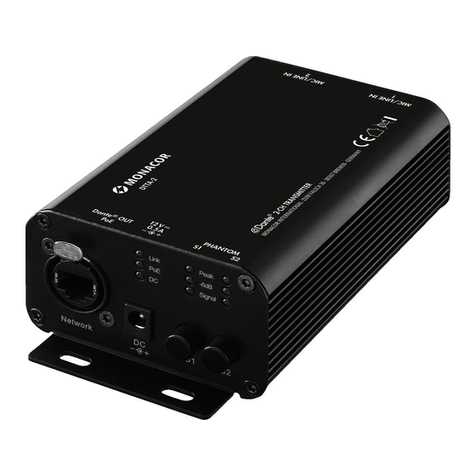
Monacor DTTA-2 User manual

Monacor

Monacor DTTA-2 User manual

Monacor HDTVI-100 CON User manual

Monacor

Monacor HDTVI-100 CON User manual

Popular Media Converter manuals by other brands

TR-Electronic CMS582M-4096/4096 IOL DMS 14H7 KRF Assembly instructions

TR-Electronic

TR-Electronic CMS582M-4096/4096 IOL DMS 14H7 KRF Assembly instructions

Korenix JetCon 2301S user manual

Korenix

Korenix JetCon 2301S user manual

StarTech.com ET91000LCOAM manual

StarTech.com

StarTech.com ET91000LCOAM manual

Alesis AI-3 Reference manual

Alesis

Alesis AI-3 Reference manual

Caton Vpro 5100 user guide

Caton

Caton Vpro 5100 user guide

Cypress CSC-5500 Operation manual

Cypress

Cypress CSC-5500 Operation manual

H&B TX-100 Installation and instruction manual

H&B

H&B TX-100 Installation and instruction manual

Bolin Technology D Series user manual

Bolin Technology

Bolin Technology D Series user manual

IFM Electronic Efector 400 RN30 Series Device manual

IFM Electronic

IFM Electronic Efector 400 RN30 Series Device manual

GRASS VALLEY KUDOSPRO ULC2000 user manual

GRASS VALLEY

GRASS VALLEY KUDOSPRO ULC2000 user manual

Linear Technology DC1523A Demo Manual

Linear Technology

Linear Technology DC1523A Demo Manual

Lika ROTAPULS I28 Series quick start guide

Lika

Lika ROTAPULS I28 Series quick start guide

Weidmuller IE-MC-VL Series Hardware installation guide

Weidmuller

Weidmuller IE-MC-VL Series Hardware installation guide

Optical Systems Design OSD2139 Series Operator's manual

Optical Systems Design

Optical Systems Design OSD2139 Series Operator's manual

Tema Telecomunicazioni AD615/S product manual

Tema Telecomunicazioni

Tema Telecomunicazioni AD615/S product manual

KTI Networks KGC-352 Series installation guide

KTI Networks

KTI Networks KGC-352 Series installation guide

Gira 0588 Series operating instructions

Gira

Gira 0588 Series operating instructions

Lika SFA-5000-FD user guide

Lika

Lika SFA-5000-FD user guide

manuals.online logo
manuals.online logoBrands
  • About & Mission
  • Contact us
  • Privacy Policy
  • Terms and Conditions

Copyright 2025 Manuals.Online. All Rights Reserved.

Bedienungsanleitung
Instruction Manual
Mode d’emploi
Istruzioni per l’uso
Gebruiksaanwijzing
Handleiding
Manual de instrucciones
Manual de instruções
Brugsanvisning
Bruksanvisning
Käyttöohje
®
TVSP-410
Best.-Nr. 19.1250
S/W-Video-Quad-Prozessor
B/W Video Quad Processor
2
Bevor Sie einschalten ...
Wir wünschen Ihnen viel Spaß mit Ihrem
neuen MONACOR Gerät. Dabei soll Ihnen
diese Bedienungsanleitung helfen, alle
Funktionsmöglichkeiten kennenzulernen.
Die Beachtung der Anleitung vermeidet
außerdem Fehlbedienungen und schützt
Sie und Ihr Gerät vor eventuellen Schä-
den durch unsachgemäßen Gebrauch.
Den deutschen Text finden Sie auf den
Seiten 4
-
7.
Before you switch on ...
We wish you much pleasure with your new
MONACOR unit. With these operating in-
structions you will be able to get to know
all functions of the unit. By following these
instructions false operations will be avoid-
ed, and possible damage to you and your
unit due to improper use will be prevented.
You will find the English text on the pages
4
-
7.
Prima di accendere ...
Vi auguriamo buon divertimento con il Vo-
stro nuovo apparecchio MONACOR. Le
istruzioni per l’uso Vi possono aiutare a
conoscere tutte le possibili funzioni. E ris-
pettando quanto spiegato nelle istruzioni,
evitate di commettere degli errori, e così
proteggete Voi stessi, ma anche l’appa-
recchio, da eventuali rischi per uso impro-
prio.
Il testo italiano lo potete trovare alle pa-
gine 8–11.
Avant toute mise en service ...
Nous vous remercions d’avoir choisi un
appareil MONACOR et vous souhaitons
beaucoup de plaisir à l’utiliser. Cette no-
tice a pour objectif de vous aider à mieux
connaître les multiples facettes de l’ap-
pareil et à vous éviter toute mauvaise ma-
nipulation.
La version française se trouve pages
8–11.
Voordat u inschakelt ...
Wij wensen u veel plezier met uw nieuw
toestel van MONACOR. Met behulp van
bijgaande gebruiksaanwijzing kunt u alle
functiemogelijkheden leren kennen. Door
deze instructies op te volgen zal een
slechte werking vermeden worden, en zal
een eventueel letsel aan uzelf en schade
aan uw toestel tengevolge van onzorgvul-
dig gebruik worden voorkomen.
U vindt de nederlandstalige tekst op de
pagina’s 22–30.
Antes de pôr em funcionamento ...
Agradecemos-lhe por ter escolhido um
aparelho MONACOR. Com estas in-
struções ficará habilitado a conhecer e uti-
lizar todas as funções desta unidade. Se-
guindo-as, evita possíveis manipulações
defeituosas.
A versão em idioma português pode ser
encontrada nas páginas 31–39.
Antes de cualquier instalación
Tenemos de agradecerle el haber adqui-
rido un equipo MONACOR y le deseamos
un agradable uso. Este manual quiere
ayudarle a conocer las multiples facetas
de este equipo y evitar cualquier uso ina-
decuado.
La versión española se encuentra en las
páginas 22–30.
D
A
CH
GB
NL
B
F
B
CH
E
I
P
Inden De tænder for apparatet ...
Vi ønsker Dem god fornøjelse med Deres
nye MONACOR apparat. Denne brugsan-
visning giver mulighed for at lære alle ap-
paratets funktioner at kende. Følg vejled-
ningen for at undgå forkert betjening og for
at beskytte Dem og Deres apparat mod
skade på grund af forkert brug.
Den danske tekst finder De på side 31–39.
Förskrift
Vi önskar dig mycket nöje med din nya
TVSP-410. Om du först läser instruktio-
nerna kommer du att få glädje av enheten
under lång tid. Kunskap om alla funktioner
kan bespara dig mycket besvär med en-
heten i framtiden.
Du finner den svenska texten på sidan
40–49.
Ennen virran kytkemistä ...
Toivomme, että uusi MONACOR-laitteesi
tuo sinulle paljon iloa ja hyötyä. Tämä
käyttöohje esittää sinulle kaikki uuden lait-
teesi toiminnot. Seuraamalla sitä vältät vir-
hetoiminnot ja niistä johtuvat mahdolliset
vahingot sinulle tai laitteellesi.
Löydät suomenkieliset käyttöohjeet sivuil-
ta 40–49.
DK
S
FIN
®
Lock Buzzer Sequ. Freeze
Power
B/W Quad
Processor
®
3
➀
V4 V3 V2 V1
OUT
IN
Live
Quad
G1G2G3G4
POWER
5
4
3
2
1
0
9
8
7
6
Dwell 5
4
3
2
1
0
9
8
7
6
alarm
Duration
Remote
or RS-232
alarm indc/ac 24 V
11 12 13 14 15 16 17 18
123456
➁
➂
2
78 9 10
Freeze
Sequ.
Alarm
Reset
Buzzer
Lock
Remote
Control
3
4
19
5
6
alarm
51
96
Sensor 1
Sensor 2
Sensor 3
Sensor 4
Alarm Reset
Alarm
Contacts
COM.
NO
NC
➄➃
Remote / RS-232
12345
6789
1Masse/Ground
2RX Dateneingang/Data Input
3TX Datenausgang/Data Output
4frei/nc
5frei/nc
6+5V
7+5V
8Masse/Ground
9Masse/Ground
Anschlußbelegung Sub-D-Steckerleiste (7)
Pin connection sub D plug (7)
Anschlußbelegung Sub-D-Buchse (13)
Pin connection sub D jack (13)
alarm
51
96
Record Start Stop
Videorecorder
automatischer Aufnahmestart eines Videorecorders über Sub-D-Buchse (13)
automatic record start of a video recorder via sub D plug (13)
➅
Bitte klappen Sie die Seite 3 heraus. Sie sehen
dann immer die beschriebenen Bedienelemente
und Anschlüsse.
Inhalt Seite
1 Hinweise für den sicheren Gebrauch . . . . 4
2 Übersicht der Bedienelemente und
Anschlüsse . . . . . . . . . . . . . . . . . . . . . . . . . 4
3 Anwendungsmöglichkeiten . . . . . . . . . . . 5
4 Gerät anschließen . . . . . . . . . . . . . . . . . . . 5
4.1 Kameras . . . . . . . . . . . . . . . . . . . . . . . . . . . . 5
4.2 Monitor und Videorecorder . . . . . . . . . . . . . 5
4.3 Alarmsensoren und Alarmausgang . . . . . . . 5
4.4 Fernbedienung . . . . . . . . . . . . . . . . . . . . . . . 5
4.5 Computer . . . . . . . . . . . . . . . . . . . . . . . . . . . 5
4.6 Stromversorgung . . . . . . . . . . . . . . . . . . . . . 6
5 Bedienung . . . . . . . . . . . . . . . . . . . . . . . . . 6
5.1 Einschalten . . . . . . . . . . . . . . . . . . . . . . . . . 6
5.2 Betriebsmodus wählen . . . . . . . . . . . . . . . . . 6
5.3 Alarmdauer einstellen . . . . . . . . . . . . . . . . . 6
5.4 Bedientasten sperren . . . . . . . . . . . . . . . . . . 6
6 Alarmmeldungen . . . . . . . . . . . . . . . . . . . . 7
6.1 Unterbrechung des Kamerasignals . . . . . . . 7
6.2 Alarmauslösung durch einen Sensor . . . . . . 7
7 Technische Daten . . . . . . . . . . . . . . . . . . . 7
1 Hinweise für den sicheren Gebrauch
Dieses Gerät entspricht den EU-Richtlinien Nr.
89/336/EWG für elektromagnetische Verträglichkeit
und Nr.73/23/EWG für Niederspannungsgeräte.
Der Steckertrafo wird mit lebensgefährlicher Netz-
spannung (230 V~) versorgt. Nehmen Sie deshalb
niemals selbst Eingriffe im Gerät vor. Durch un-
sachgemäßes Vorgehen besteht die Gefahr eines
elektrischen Schlages. Außerdem erlischt beim
Öffnen des Gerätes jeglicher Garantieanspruch.
Beachten Sie für den Betrieb auch unbedingt die fol-
genden Punkte:
•Das Gerät ist nur zur Verwendung in Räumen ge-
eignet.
•Schützen Sie das Gerät vor Feuchtigkeit und Hitze
(zulässiger Einsatztemperaturbereich 0–40°C).
•Die in dem Gerät entstehende Wärme muß durch
Luftzirkulation abgegeben werden. Darum dürfen
die Lüftungslöcher des Gehäuses nicht mit irgend-
welchen Gegenständen abgedeckt werden.
•Auch wenn das Gerät ausgeschaltet ist, hat der
Steckertrafo einen geringen Stromverbrauch.
•Den Steckertrafo nicht in die Steckdose stecken,
wenn:
1. sichtbare Schäden am Gerät vorhanden sind,
2. nach einem Sturz oder ähnlichem der Verdacht
auf einen Defekt besteht,
3. Funktionsstörungen auftreten.
Das Gerät in jedem Fall zur Reparatur in eine
Fachwerkstatt geben.
•Wird das Gerät zweckentfremdet, falsch bedient
nicht richtig angeschlossen oder nicht fachgerecht
repariert, kann für eventuelle Schäden keine Haf-
tung übernommen werden.
•Für die Reinigung nur ein trockenes Staubtuch ver-
wenden, auf keinen Fall Chemikalien oder Wasser.
2 Übersicht der Bedienelemente und
Anschlüsse
2.1 Frontseite (Abb. 1)
1Betriebsanzeige POWER
2Taste LOCK zum Sperren der Bedientasten (2
-
6)
gegen Manipulation. Zum Sperren die Taste LOCK
2Sekunden gedrückt halten. Zum Entsperren die
Taste LOCK erneut 2Sekunden gedrückt halten.
3Taste BUZZER zum Ein- undAusschalten des in-
tegrierten akustischen Alarmgebers sowie zum
Ausschalten eines Alarms
4Taste SEQU. zum Ein- und Ausschalten des Um-
schaltbetriebs
Please unfold page 3. Then you can always see
the operating elements and connections de-
scribed.
Table of Contents Page
1 Safety Notes . . . . . . . . . . . . . . . . . . . . . . . . 4
2 Operating Elements and Connections . . . 4
3 Applications . . . . . . . . . . . . . . . . . . . . . . . . 5
4 Connecting the Unit . . . . . . . . . . . . . . . . . . 5
4.1 Cameras . . . . . . . . . . . . . . . . . . . . . . . . . . . 5
4.2 Monitor and Video Recorder . . . . . . . . . . . . 5
4.3 Alarm Sensors and Alarm Output . . . . . . . . 5
4.4 Remote Control . . . . . . . . . . . . . . . . . . . . . . 5
4.5 Computer . . . . . . . . . . . . . . . . . . . . . . . . . . . 5
4.6 Power Supply . . . . . . . . . . . . . . . . . . . . . . . . 6
5 Operation . . . . . . . . . . . . . . . . . . . . . . . . . . 6
5.1 Switching on . . . . . . . . . . . . . . . . . . . . . . . . . 6
5.2 Selecting the Operation Mode . . . . . . . . . . . 6
5.3 Setting the Alarm Duration . . . . . . . . . . . . . . 6
5.4 Locking the Operating Buttons . . . . . . . . . . . 6
6 Alarm Messages . . . . . . . . . . . . . . . . . . . . . 7
6.1 Interruption of the Camera Signal . . . . . . . . 7
6.2 Alarm Activation via a Sensor . . . . . . . . . . . 7
7 Specifications . . . . . . . . . . . . . . . . . . . . . . . 7
1 Safety Notes
This appliance corresponds to the EC Directives No.
89/336/EWG for electromagnetic compatibility and
No. 73/23/EWG for low-voltage appliances.
The plug-in transformer uses lethally high voltage
(230V~). To prevent a shock hazard, do not open
the cabinet. Leave servicing to authorized skilled
personnel only. Besides, any guarantee claim ex-
pires if the unit has been opened.
For the operation also watch in any case the follow-
ing items:
•The unit is only suitable for indoor use.
•Avoid excessively warm locations (permisseble
operating temperature range 0–40°C) for the unit
or high humidity.
•The heat being generated in the unit has to be re-
moved via air circulation. Thus, the circulation
vents of the unit must not be covered at any time.
•The plug-in transformer has a small power con-
sumption even if the unit is switched off.
•Do not plug the transformer into the mains socket,
if:
1. damage at the unit can be seen,
2. a defect might have occured after a drop or sim-
ilar accident,
3. there are malfunctions.
The unit must in any case be repaired by author-
ized skilled personnel.
•If the unit is used for purposes other than originally
intended, if it is operated in the wrong way or not
repaired by authorized skilled personnel, there is
no liability for possible damage.
•Use a dry dust cloth only for cleaning, by no means
chemicals or water.
2 Operating Elements and Connections
2.1 Front Panel (fig. 1)
1POWER LED
2LOCK button for locking the operating buttons
(2
-
6) against manipulation. Press the LOCK but-
ton for 2 seconds in order to activate the locking
function. Press the LOCK button again for 2sec-
onds to disable it.
3BUZZER button to switch the integrated acoustic
alarm device on and off as well as to switch an
alarm off
4SEQU. button for switching the changeover oper-
ation on and off
4
GB
D
A
CH
5button for switching between full screen and
quad splitting operation
6Buttons for switching on the corresponding cam-
era picture during the changeover operation
resp. for “freezing” and “return to normal” the cor-
responding picture during the quad operation
2.2 Rear Panel (fig. 2)
79-pole sub D connector for connecting the re-
mote control TVSP-412RM or a computer
(RS-232 interface)
Caution! When connecting a computer, the pins
6
-
9 (fig. 4) at the connection cable of the com-
puter must not be used since they carry the oper-
ating voltage resp. ground for the remote control
TVSP-412RM.
8On/Off switch
9BNC output jacks of the corresponding camera
signals [fed-through input signals of the jacks
(16)], e.g. for connecting single monitors.
10 BNC connection for the monitor
11 Connection for the supplied plug-in transformer
or other power supplies with 12V to 24V DC or
AC voltage, power rating 600mA
12 Separate ground connection for units which have
no ground connection to the quad processor
13 Sub D jack for connecting alarm sensors as well
as functioning as an alarm output (fig. 5) to start
a video recorder or to activate further alarm de-
vices.
14 Selector switch for the camera dwell time during
changeover mode. (The positions 1
-
0 corre-
spond to 1
-
10seconds.)
15 Changeover switch for the alarm duration
(30seconds to infinity) at the contacts 7
-
9 of the
sub D jack (13), see chapter 5.3 “Setting the
Alarm Duration”
16 Camera inputs
17 Contrast controls for each camera picture, for
matching the contrast of all pictures in quad oper-
5Taste zum Umschalten zwischen Vollbild-
und Quad-Splitter-Betrieb
6Tasten zum Einschalten des entsprechenden Ka-
merabildes im Umschaltbetrieb bzw. zum „Ein-
frieren“ und „Auftauen“ des entsprechenden Bil-
des im Quad-Splitter-Betrieb
2.2 Rückseite (Abb. 2)
79polige Sub-D-Steckerleiste zum Anschluß der
Fernbedienung TVSP-412RM oder eines Com-
puters (RS232-Schnittstelle)
Achtung! BeimAnschluß eines Computers müs-
sen am Verbindungskabel zum Computer die
Kontakte 6
-
9 frei bleiben (Abb. 4), da an ihnen
Betriebsspannung bzw. Masse für die Fernbedie-
nung TVSP-412RM anliegt.
8Ein-/Ausschalter
9BNC-Ausgangsbuchsen der entsprechenden Ka-
merasignale [durchgeschleifte Eingangssignale
der Buchsen (16)], z.B. zum Anschluß von Ein-
zelmonitoren
10 BNC-Anschluß für den Monitor
11 Anschluß für beiliegenden Steckertrafo oder an-
derer Stromversorgung mit 12V bis 24V Gleich-
oder Wechselspannung, Strombelastung 600mA
12 separater Masseanschluß für Geräte, die keine
Masseverbindung zum Quad-Prozessor haben
13 Sub-D-Buchse zum Anschluß von Alarmsenso-
ren und als Alarmausgang (Abb. 5) zum Starten
eines Videorecorders oder Aktivieren weiterer
Alarmelemente
14 Wahlschalter für die Haltezeit je Kamerabild im
Umschaltbetrieb. (Die Positionen 1
-
0 entspre-
chen 1
-
10Sekunden.)
15 Wahlschalter für die Alarmdauer (30Sekunden
bis unendlich) an den Kontakten 7
-
9 der Sub-D-
Buchse (13), siehe Kapitel 5.3 „Alarmdauer ein-
stellen“
16 Kamera-Eingänge
17 Kontrasteinsteller für jedes Kamerabild, um den
Kontrast aller Bilder im Quad-Splitter-Betrieb un-
tereinander anzupassen. Im Vollbildbetrieb sind
diese Regler unwirksam.
18 Quad-Ausgang für einen zweiten Monitor oder
einen Videorecorder zur ständigen Darstellung
oder Aufzeichnung aller Kamerabilder nur im
Quad-Splitter-Betrieb (unabhängig vom einge-
schaltetem Betriebsmodus)
2.3 Fernbedienung (Abb. 3)
Die Fernbedienung gehört nicht zum Lieferumfang
des Quad-Prozessors TVSP-410. Sie ist jedoch als
Zubehörteil erhältlich.
2
-
6siehe Kapitel 2.1
19 Taste ALARM RESET zum Ausschalten eines
Alarms
3 Anwendungsmöglichkeiten
Der Quad-Prozessor TVSP-410 ist für den Einsatz in
Überwachungs- und Alarmanlagen konzipiert. Er
stellt eine Kombination aus einem 4fach Video-Split-
ter und einem Kamera-Umschalter dar, mit dem sich
vier Kamerabilder in Echtzeit auf einem Monitor
überwachen lassen:
1. zusammen als verkleinerte Bilder auf dem in vier
Segmente unterteiltem Bildschirm im Quad-Split-
ter-Betrieb
2. nacheinander als Einzelbilder im Vollbild-Um-
schaltbetrieb mit einer einstellbaren Haltezeit von
1
-
10Sekunden
Für jeden Kameraeingang ist ein Alarmeingang vor-
handen, der
-
z.B. von einem Bewegungsmelder
aktiviert
-
folgende Funktionen auslöst:
1. Das entsprechende Kamerabild wird auf Vollbild-
wiedergabe umgeschaltet.
2. Ein Alarm vom integrierten Signalgeber ertönt.
3. Ein Alarmrelais schaltet (NC/NO-Kontakt) und
kann z.B. einen Videorecorder starten oder wei-
tere Alarmelemente aktivieren.
Die Alarmdauer ist in Stufen von 0,5 bis 30Minuten
und auf Daueralarm einstellbar.
4 Gerät anschließen
Der Quad-Prozessor muß ausgeschaltet sein, wenn
Anschlüsse zu anderen Geräten vorgenommen oder
verändert werden.
4.1 Kameras
Bis zu vier Kameras können an die BNC-Eingangs-
buchsen IN (16) angeschlossen werden. Die Ein-
gänge V1 bis V4 sind den Tasten FREEZE (6) in der
Reihenfolge von links nach rechts zugeordnet, d.h. die
erste Taste FREEZE von links ist für den Eingang V1.
4.2 Monitor und Videorecorder
1) Den Hauptmonitor an die Buchse LIVE (10) an-
schließen.
2) Ein weiterer Monitor oder ein Videorecorder zur
Aufzeichnung kann an die Buchse QUAD (18) an-
geschlossen werden. Damit ist eine ständige Dar-
stellung oder Aufzeichnung aller Kamerabilder im
Quad-Splitter-Betrieb möglich (unabhängig vom
eingeschalteten Betriebsmodus).
3)
An den Buchsen OUT (9) kann das jeweilige
durchgeschleifte Kamerasignal abgenommen wer-
den, z.B. für Einzelmonitore, zur getrennten Auf-
nahme auf vier Videorecordern oder für einen wei-
teren Quad-Prozessor zur Doppelüberwachung.
4.3 Alarmsensoren und Alarmausgang
Für eine komfortable Überwachung sind Eingänge
fürAlarmsensoren (z.B. Bewegungsmelder) vorhan-
den. Um die Grundfunktionen des TVSP-410 nutzen
zu können, brauchen diese aber nicht angeschlos-
sen zu werden.
1) Die Alarmsensoren nach Abb. 5 an die Sub-D-
BuchseALARM IN (13) anschließen. Der Kontakt
Sensor 1 ist der Kamera V1 zugeordnet usw.
2) Bei Bedarf kann ein zusätzlicher Taster (Schlie-
ßer) alsAlarmausschalter an die Kontakte 5 und 6
angeschlossen werden [entspricht der Taste
ALARM RESET (19) auf der Fernbedienung
TVSP-412RM]
3) AlsAlarmausgang ist ein Umschalter an den Kon-
takten 7
-
9 vorhanden. Über ihn können weitere
Alarmsignalgeber angeschlossen werden oder
ein Videorecorder, der bei einem Alarm automa-
tisch die Kameraaufzeichnung startet. Der An-
schluß dazu ist in Abb. 6 dargestellt.
Die Aufzeichnung wird automatisch gestoppt,
wenn die eingestellte Alarmdauer verstrichen ist
(siehe Kapitel 5.3 „Alarmdauer einstellen“) oder
der Alarm manuell ausgeschaltet wird (siehe Ka-
pitel 6.2 „Alarmauslösung durch einen Sensor“).
4.4 Fernbedienung
An die Buchse REMOTE or RS-232 (7) kann die als
Zubehör lieferbare Fernbedienung TVSP-412RM
angeschlossen werden. Sollte das 9m Anschluß-
kabel nicht lang genug sein, kann es auf insgesamt
300m verlängert werden.
Die Tasten auf der Fernbedienung entsprechen
den Tasten am Quad-Prozessor. Zusätzlich ist die
Taste ALARM RESET (19) vorhanden, mit der sich
ein Alarm ausschalten läßt [wie Taste Buzzer (3), je-
doch kann mit der Taste BUZZER auch der interne
Alarmgeber ein- und ausgeschaltet werden].
4.5 Computer
Bei umfangreichen Alarm-/Überwachungsanlagen
läßt sich ein Computer mit einer RS 232-Schnittstelle
an die Buchse REMOTE OR RS-232 (7) anschließen.
Achtung! Am Verbindungskabel zum Computer
müssen dieAnschlüsse 6
-
9 frei bleiben (Abb. 4), da
über diese Anschlüsse die als Zubehör lieferbare
Fernbedienung TVSP-412RM mit Betriebsspannung
versorgt wird.
Die Datenübertragung erfolgt mit 1200Baud, 8Da-
tenbits, 1Startbit, 1Stoppbit, kein Paritätsbit. Die fol-
gende Tabelle gibt den ASCII-Code für die entspre-
chenden Befehle an:
ation. These controls are disabled during full
screen operation
18 Quad output for a second monitor or a video re-
corder for the continuous display or recording of
all camera pictures only during quad operation
(not dependent upon the selected operating
mode)
2.3 Remote Control (fig. 3)
The remote control is not supplied with the quad pro-
cessor TVSP-410. It is available as an accessory.
2
-
6see chapter 2.1
19 ALARM RESET button for switching off an
alarm
3 Applications
The quad processor TVSP-410 is designed for use in
monitoring and alarm systems. It is a combination of
a 4-way video splitter and a camera changeover cir-
cuit with which four camera pictures can be dis-
played in real time on one monitor:
1. as size-reduced pictures on the screen separated
into four segments during quad splitting operation
2. subsequent as single pictures in full screen
changeover mode with a duration time of
1
-
10seconds
Each camera input is equipped with an alarm input
which will activate the following functions e.g. from a
motion detector:
1. The corresponding camera picture is changed to
full screen display.
2. An alarm sound is given from the integrated sig-
nal device.
3. An alarm relais switches (NC/NO contact) and
can start e.g. a video recorder or activate further
alarm elements.
The alarm duration is adjustable in steps of 0.5 to
30minutes or continuous alarm.
4 Connecting the Unit
The quad processor has to be switched off if connec-
tions to other units are made or changed.
4.1 Cameras
Up to four cameras can be connected to the BNC
input jacks IN (16). The inputs V1 to V4 are matched
to the FREEZE buttons (6) in sequence from left to
right, i.e. the first FREEZE button from the left is for
the input V1.
4.2 Monitor and Video Recorder
1) Connect the main monitor to the LIVE jack (10).
2) A further monitor or video recorder can be
connected to the QUAD jack (18) for recording.
Thus, a continuous display or recording of all
camera pictures in the quad splitting mode is pos-
sible (independent from the selected operating
mode).
3) Each fed-through camera signal can be taken off
at the OUT jacks (9), e.g. for single monitors for
the separated recording of four video recorders or
for a further quad processor for double monitor-
ing.
4.3 Alarm Sensors and Alarm Output
For comfortable supervision inputs for alarm sensors
(e.g. motion detectors) are also available. In order to
use the basic functions of the TVSP-410, they do not
have to be connected.
1) Connect the alarm sensors according to fig. 5 to
the sub D jack ALARM IN (13). The contact sen-
sor 1 is matched to camera V1, etc.
2) If required, a further button (make contact) can be
connected for switching off alarms at the contacts
5 and 6 [same as the ALARM RESET button (19)
on the remote control TVSP-412RM].
3) Contacts 7
-
9 are equipped with a changeover
switch serving as an alarm output. Further alarm
signal devices or a video recorder can be con-
nected here, which will automatically start the
camera´s recording during an alarm. The connec-
tion is displayed in fig. 6.
The recording will automatically be stopped when
the set alarm duration is reached (see chapter 5.3
“Setting the Alarm Duration”) or if the alarm is
switched off manually (see chapter 6.2 “Alarm
Activation via a Sensor”).
4.4 Remote Control
The remote control TVSP-412RM which is available
as an accessory can be connected to the REMOTE
or RS-232 jack (7). If the 9m connecting cable is too
short, it is possible to increase its length to 300m.
The buttons on the remote control correspond to
the buttons at the quad processor. Additionally, the
ALARM RESET (19) button can be used for switch-
ing off an alarm [as the buzzer button (3); however,
the BUZZER button can also be used for switching
on/off the internal alarm device].
4.5 Computer
For extensive alarm/monitoring systems a computer
with an RS-232 interface can be connected to the
REMOTE or RS-232 jack (7).
Caution! Connections 6
-
9 (fig. 4) at the computer
connecting cable must not be connected since they
are supplied with the operating voltage for the re-
mote control TVSP-412RM available as an acces-
sory.
The data transmission is performed with 1200 baud,
8 data bits, 1 start bit, 1 stop bit, no parity bit. The fol-
lowing table shows the ASCII code for the corre-
sponding commands:
5
GB
D
A
CH
ASCII Code Function
A1 Camera V1
A2 Camera V2
A3 Camera V3
A4 Camera V4
AA Alarm reset
AB Alarm device on/off (Buzzer)
AF “Freezing” camera picture (Freeze)
AK Locking operating buttons (Lock)
AQ Switching between full screen and
quad operation ( )
AS Changeover mode on/off (Sequ.)
4.6 Power Supply
After connecting all other units, connect the quad
processor to the power supply.
1. supplied plug-in transformer
Plug the low-voltage plug of the plug-in transform-
er into the DC/AC 24 V jack (11) and the plug-in
transformer into a mains socket (230 V~/50 Hz).
Important Note for U.K. Customers
The plug-in transformer can only be plugged into
a mains socket via a corresponding adaptor!
2. external power supply
If an other power supply for the complete monitor-
ing/alarm system is available (possibly with
mains failure buffering), the quad processor may
also be connected to this power supply as long as
it delivers between 12V to 24V DC orAC voltage.
The power consumption is 600mA.
5 Operation
The buttons on the quad processor and on the re-
mote control have the same inscription and func-
tions. Thus, it will not always be stated in the follow-
ing paragraphs if a button has to be operated on the
remote control or at the quad processor.
5.1 Switching on
1) After connecting all units, switch on the quad pro-
cessor with the POWER switch (8) at the rear
panel. The unit will perform a self-test and check
how many cameras are connected. Afterwards,
an acoustic signal of the internal alarm device will
sound which signals that the unit is ready for
operation.
2) After switching on, the unit is in quad splitting
operation and the internal alarm device is activat-
ed.ALED of the corresponding button will light for
all activated functions.
5.2 Selecting the Operation Mode
The integrated acoustic alarm device can be
switched on and off with the BUZZER button (3) in-
dependent from the operation mode.
5.2.1 Quad Splitting Operation
Switch between full screen and quad operation with
the button (5). The monitor will be separated into
four segments for the display of up to four camera
pictures at the same time. If less than four cameras
are connected, the corresponding segments on the
monitor will be blackened.
Adjust the contrast for each camera picture with
the controls (17) so that it is the same for all pictures
in the quad operation. These controls are disabled
during full screen operation.
If necessary, a segment can be “frozen in” resp.
“returned to normal” with the corresponding FREEZE
button (6).
5.2.2 Full Screen Operation
Switch between quad and full screen operation with
the button (5). During full screen operation select
the desired camera picture with one of the FREEZE
buttons (6).
5.2.3 Changeover Operation
Switch the changeover operation on/off with the
SEQU. button (4). The following sequence will be
performed during the changeover operation:
Quad splitting display
Full screen camera V1
Full screen camera V2
Full screen camera V3
Full screen camera V4
Afterwards, this process will be repeated. Camera
channels which are not connected will be skipped.
The dwell time of each picture display can be set
from 1 to 10 seconds (matching position 1 to 0) with
the DWELL button (14).
5.3 Setting the Alarm Duration
Set the desired duration of an alarm which will be
activated by an alarm sensor with the ALARM
DURATION button (15):
Position Alarm Duration
0 30seconds
1 1minute
2 2minutes
3 3minutes
4 5minutes
5 10minutes
6 15minutes
7 20minutes
8 30minutes
9 continuous alarm
5.4 Locking the Operating Buttons
The operating buttons (3
-
6) can be locked against
manipulation after performing all settings. Press the
LOCK button (2) for 2 seconds. Press the LOCK but-
ton again to disable the lock.
6
GB
D
A
CH
ASCII-Code Funktion
A1 Kamera V1
A2 Kamera V2
A3 Kamera V3
A4 Kamera V4
AA Alarm Reset
AB Alarmgeber Ein/Aus (Buzzer)
AF Kamerabild „einfrieren“ (Freeze)
AK Bedientasten sperren (Lock)
AQ Umschalten zwischen Vollbild- und
Quad-Splitter-Betrieb ( )
AS Umschaltbetrieb Ein/Aus (Sequ.)
4.6 Stromversorgung
Nachdem alle anderen Geräte angeschlossen wur-
den, den Quad-Prozessor mit der Stromversorgung
verbinden.
1. mitgelieferter Steckertrafo
Den Niederspannungsstecker des Steckertrafos
in die Buchse DC/AC24V (11) stecken, und den
Steckertrafo in eine Steckdose (230V~/50Hz).
2. externe Stromversorgung
Ist eine andere Stromversorgung für die gesamte
Überwachungs-/Alarmanlage vorhanden (eventu-
ell mit Netzausfallpufferung), kann der Quad-Pro-
zessor auch an diese Stromversorgung ange-
schlossen werden, sofern 12V bis 24V Gleich-
oder Wechselspannung vorhanden sind. Die
Stromaufnahme beträgt 600mA.
5 Bedienung
Die Tasten am Quad-Prozessor und auf der Fernbe-
dienung haben die gleichen Beschriftungen und
Funktionen. Im folgenden Text wird deshalb nicht
immer unterschieden, ob eine Taste auf der Fernbe-
dienung oder am Quad-Prozessor betätigt werden
muß.
5.1 Einschalten
1) Nachdem alle Geräte angeschlossen sind, den
Quad-Prozessor mit der Taste POWER (8) auf
der Rückseite einschalten. Es erfolgt ein Selbst-
test und die Überprüfung, wieviele Kameras an-
geschlossen sind. Die Betriebsbereitschaft wird
anschließend durch ein akustisches Signal des
internen Alarmgebers signalisiert.
2) Nach dem Einschalten steht das Gerät im Quad-
Splitter-Betrieb, und der interne Alarmgeber ist
aktiviert. Alle eingeschalteten Funktionen werden
durch eine LED über der entsprechenden Taste
signalisiert.
5.2 Betriebsmodus wählen
Unabhängig vom Betriebsmodus kann der inte-
grierte akustische Alarmgeber mit der Taste BUZ-
ZER (3) ein- und ausgeschaltet werden.
5.2.1 Quad-Splitter-Betrieb
Mit der Taste (5) zwischen Vollbild- und Quad-
Splitter-Betrieb umschalten. Zur Darstellung von bis
zu vier Kamerabildern gleichzeitig wird der Bild-
schirm des Monitors in vier Segmente unterteilt. Sind
weniger als vier Kameras angeschlossen, werden
die entsprechenden Segmente auf dem Monitor dun-
kelgeschaltet.
Mit den Reglern (17) den Kontrast für jedes Ka-
merabild so einstellen, daß er für alle Bilder im
Quad-Splitter-Betrieb gleich ist. Im Vollbildbetrieb
sind diese Regler unwirksam.
Bei Bedarf läßt sich mit der entsprechenden Taste
FREEZE (6) ein Segment „einfrieren“ bzw. wieder
„auftauen“.
5.2.2 Vollbildbetrieb
Mit der Taste (5) zwischen Quad-Splitter- und
Vollbildbetrieb umschalten. Im Vollbildbetrieb mit
einer der Tasten FREEZE (6) das gewünschte Ka-
merabild anwählen.
5.2.3 Umschaltbetrieb
Mit der Taste SEQU. (4) den Umschaltbetrieb ein-
oder ausschalten. Im Umschaltbetrieb wird folgende
Sequenz durchlaufen:
Quad-Splitter-Darstellung
Vollbild Kamera V1
Vollbild Kamera V2
Vollbild Kamera V3
Vollbild Kamera V4
Anschließend wiederholt sich der Vorgang. Nicht an-
geschlossene Kamerakanäle werden dabei über-
sprungen. Die Haltezeit je Bilddarstellung ist mit dem
Schalter DWELL (14) von 1 bis 10Sekunden (ent-
sprechend Position 1 bis 0) einstellbar.
5.3 Alarmdauer einstellen
Die gewünschte Dauer eines Alarms, der durch
einen Alarmsensor ausgelöst wird, mit dem Schalter
ALARM DURATION (15) einstellen:
Position Alarmdauer
0 30Sekunden
1 1Minute
2 2Minuten
3 3Minuten
4 5Minuten
5 10Minuten
6 15Minuten
7 20Minuten
8 30Minuten
9 Daueralarm
5.4 Bedientasten sperren
Nachdem alle Einstellungen durchgeführt wurden,
können die Bedientasten (3
-
6) gegen Manipulation
gesperrt werden. Dazu die Taste LOCK (2) 2Sekun-
den gedrückt halten. Zum Entsperren die Taste
LOCK erneut 2Sekunden gedrückt halten.
6 Alarmmeldungen
6.1 Unterbrechung des Kamerasignals
Wird die Stromversorgung einer Kamera oder eine
Signalleitung einer Kamera zum Quad-Prozessor
unterbrochen, wird unabhängig vom gewählten Be-
triebsmodus auf Quad-Splitter-Betrieb umgeschal-
tet, und das entsprechende Segment zeigt blinkend
das „eingefrorene“ Kamerabild. Die LED über der
entsprechenden Taste FREEZE (6) blinkt. Bei einge-
schaltetem Signalgeber (Buzzer) ertönt ein pulsie-
rendes Signal.
Der Alarm kann abgeschaltet werden:
1. mit der Taste BUZZER (3),
2. mit der Taste ALARM RESET (19), nur auf der
Fernbedienung vorhanden,
3. mit einem separaten Taster, der an den Kontakten
5 und 6 der Sub-D-Buchse ALARM IN (13) ange-
schlossen ist.
6.2 Alarmauslösung durch einen Sensor
Wird ein Alarm durch einen angeschlossenen Sen-
sor ausgelöst, wird unabhängig vom gewählten Be-
triebsmodus das zugehörige Kamerabild im Vollbild-
betrieb gezeigt, bei eingeschaltetem Signalgeber
(Buzzer) ertönt ein pulsierendes Signal, die LED
über der entsprechenden Taste FREEZE (6) blinkt,
und der Alarmausgang aktiviert eventuell ange-
schlossene Geräte. Nach dem Ablauf der eingestell-
ten Alarmdauer (siehe Kapitel 5.3 „Alarmdauer ein-
stellen“) erlischt der Alarm, und der vorherige
Betriebsmodus wird wieder eingeschaltet. DerAlarm
kann auch manuell vorzeitig beendet werden:
1. mit der Taste BUZZER (3),
2. mit der Taste ALARM RESET (19), nur auf der
Fernbedienung vorhanden,
3. mit einem separaten Taster, der an den Kontakten
5 und 6 der Sub-D-Buchse ALARM IN (13) ange-
schlossen ist.
7 Technische Daten
7.1 Quad-Prozessor TVSP-410
Video
Signal-Format: . . . . . . . . CCIR, monochrom
Eingänge: . . . . . . . . . . . 1Vss/75Ω,
±2dB einstellbar
Ausgänge: . . . . . . . . . . . 1Vss/75Ω
Auflösung: . . . . . . . . . . . 1024 x 512 Bildpunkte
Alarm
Eingänge: . . . . . . . . . . . Schließer (NO) mit ge-
meinsamer Masse
Relais Ausgang: . . . . . . . Umschalter belastbar
mit max. 1A/24V
Betriebstemperatur: . . . . . 0°C bis +50°C
Stromversorgung: . . . . . . . 12 bis 24V~/ ,
600mA oder
230V~/50Hz/14,4VA
über mitgelieferten
Steckertrafo
Abmessungen (B x H x T): 430 x 50 x 225mm
Gewicht: . . . . . . . . . . . . . . 2kg
Anschlüsse
Kamera-Eingang: . . . . . . 4 x BNC
Ausgang Kamerasignal: 4 x BNC
(zum Durchschleifen)
Monitorausgang: . . . . . . 1 x BNC für Split- oder
Gesamtbilddarstellung
2.Videoausgang: . . . . . . 1 x BNC für ständige
Splitdarstellung
Alarmein-/ausgänge: . . . 1 x 9polige Sub-D-
Buchse
Fernbedienung oder
Computer: . . . . . . . . . . . 1 x 9polige Sub-D-
Steckerleiste
Stromversorgung: . . . . . 1 x Niederspannungs-
buchse
7.2 Fernbedienung TVSP-412RM
Anschluß: . . . . . . . . . . . . . 9m Kabel mit 9poliger
Sub-D-Steckerbuchse
Stromversorgung: . . . . . . . über TVSP-410
Abmessungen (B x H x T): 55 x 20 x 172mm
Gewicht: . . . . . . . . . . . . . . 450g
Laut Angaben des Herstellers.
Änderungen vorbehalten.
6 Alarm Messages
6.1 Interrupting the Camera Signal
If the power supply to a camera or a signal line of a
camera to the quad processor is interrupted, the
quad operation is activated independent of the se-
lected operation mode and the corresponding seg-
ment will flash, showing the “frozen in” camera pic-
ture. The LED of the corresponding FREEZE button
(6) flashes. A pulsating signal will sound if the signal
device (buzzer) is activated.
The alarm can be switched off:
1. with the BUZZER button (3),
2. with the ALARM RESET button (19), only on the
remote control
3. with a separate momentary push-button which is
connected to contacts 5 and 6 of the sub D jack
ALARM IN (13).
6.2 Alarm Activation via a Sensor
If an alarm is activated via a connected sensor, inde-
pendent of the selected operation mode, the corre-
sponding camera picture will be displayed in full
screen mode; if the signal device (buzzer) is
switched on, a pulsating signal will sound, the LED
above the corresponding FREEZE button (6) will
flash and the alarm output will activate any connect-
ed units. After reaching the set alarm duration (see
chapter 5.3 “Adjusting the Alarm Duration”), the
alarm stops and the unit will switch back to the pre-
ceding operation mode. The alarm may also be
stopped manually before reaching its set time:
1. with the BUZZER (3),
2. with the ALARM RESET button (19), only on the
remote control,
3. with a separate momentary push-button which is
connected to the contacts 5 and 6 of the sub D
jack ALARM IN (13).
7 Specifications
7.1 Quad Processor TVSP-410
Video
Signal format: . . . . . . . . CCIR, monochrome
Inputs: . . . . . . . . . . . . . . 1Vpp/75Ω,
±2dB adjustable
Outputs: . . . . . . . . . . . . . 1Vpp/75Ω
Resolution: . . . . . . . . . . . 1024 x 512 pixels
Alarm
Inputs: . . . . . . . . . . . . . . . . Make contact (NO) with
common ground
Relais output: . . . . . . . . . . Changeover switch with
max. load of 1A/24V
Operating temperature: . . . 0° to +50°C
Power supply: . . . . . . . . . . 12 to 24V~/ ,
600mA or
230V~/50Hz/14.4VA
via the supplied plug-in
transformer
Dimensions (W x H x D): . . 430 x 50 x 225mm
Weight: . . . . . . . . . . . . . . . 2kg
Connections
Camera input: . . . . . . . . 4 x BNC
Output camera signal: . . 4 x BNC (for feeding
through)
Monitor output: . . . . . . . . 1 x BNC for quad or full
screen display
2nd video output: . . . . . . 1 x BNC for continuous
quad display
Alarm inputs/outputs: . . 1 x 9-pole sub D
connector, female
Remote control or
computer: . . . . . . . . . . . . 1 x 9-pole sub D
connector, male
Power supply: . . . . . . . . 1 x low-voltage jack
7.2 Remote Control TVSP-412RM
Connection: . . . . . . . . . . . . 9m cable with 9-pole
sub D connector,
female
Power supply: . . . . . . . . . . via TVSP-410
Dimensions (W x H x D): . . 55 x 20 x 172mm
Weight: . . . . . . . . . . . . . . . 450g
According to the manufacturer.
Subject to technical change.
7
GB
D
A
CH
Ouvrez le présent livret page 3 de manière à vi-
sualiser les éléments et branchements.
Table des matières Page
1 Conseils d’utilisation . . . . . . . . . . . . . . . . . 8
2 Eléments et branchements . . . . . . . . . . . . 8
3 Possibilités d’utilisation . . . . . . . . . . . . . . 9
4 Branchements . . . . . . . . . . . . . . . . . . . . . . 9
4.1 Caméras . . . . . . . . . . . . . . . . . . . . . . . . . . . 9
4.2 Moniteurs et magnétoscopes . . . . . . . . . . . . 9
4.3 Détecteurs d’alarme et sortie d’alarme . . . . 9
4.4 Télécommande . . . . . . . . . . . . . . . . . . . . . . 9
4.5 Ordinateur . . . . . . . . . . . . . . . . . . . . . . . . . . 9
4.6 Alimentation . . . . . . . . . . . . . . . . . . . . . . . . 10
5 Utilisation . . . . . . . . . . . . . . . . . . . . . . . . . 10
5.1 Mise sous tension . . . . . . . . . . . . . . . . . . . 10
5.2 Sélection du mode de fonctionnement . . . . 10
5.3 Réglage de la durée de l’alarme . . . . . . . . 10
5.4 Verrouillage des touches . . . . . . . . . . . . . . 10
6 Messages d’alarme . . . . . . . . . . . . . . . . . 11
6.1 Arrêt du signal d’une caméra . . . . . . . . . . . 11
6.2 Déclenchement d’une alarme
par un capteur . . . . . . . . . . . . . . . . . . . . . . 11
7 Caractéristiques techniques . . . . . . . . . . 11
1 Conseils d’utilisation
Cet appareil répond aux normes 89/336/EWG relati-
ves à la Compatibilité Electro-Magnétique (CE) et
aux normes 73/23/EWG.
Le TVSP-410 est alimenté par une tension de
230V~. Ne touchez jamais à l'intérieur de l'ap-
pareil car, en cas de mauvaise manipulation, vous
pourriez subir une décharge électrique mortelle.
Faites plutôt appel à un spécialiste. En outre, l'ou-
verture de l'appareil annule toute garantie.
Pour une utilisation optimale et sûre de votre ap-
pareil, respectez scrupuleusement les points sui-
vants:
•Cet appareil n'est conçu que pour une utilisation
en intérieur.
•Protégez-le de l'humidité et la chaleur. (utilisation
uniquement dans une plage de 0–40°C tempéra-
ture ambiante)
•La chaleur dégagée par l’appareil doit être rapide-
ment dissipée. Les ouïes d’aération ne doivent, en
aucun cas, être obturées.
•Le transformateur intégré a une faible consomma-
tion électrique, même si le TVSP-410 est dé-
connecté.
•Ne faites pas fonctionner l'appareil et débranchez-
le immédiatement dans les cas suivants:
1. l'appareil ou le cordon secteur présente des
dommages,
2. après une chute…, l'appareil présente un défaut,
3. des disfonctionnements apparaissent.
Dans tous les cas, les dommages doivent être
réparés par un technicien spécialisé.
•Si l'appareil est utilisé dans un but autre que celui
pour lequel il a été conçu, s’il n’est pas correcte-
ment réparé ou s'il n'est pas réparé par une per-
sonne habilitée, l'utilisateur perd tout droit de ga-
rantie.
•Pour nettoyer l'appareil, utilisez un chiffon sec, en
aucun cas de produits chimiques ou d'eau.
2 Eléments et branchements
2.1 Face avant (schéma 1)
1Témoin de fonctionnement POWER
2Touche LOCK: verrouillage des touches 2–6
pour éviter toute manipulation. Maintenez cette
touche enfoncée pendant 2 secondes pour que le
verrouillage soit effectif. Pour déverrouiller, ap-
puyez une nouvelle fois sur la touche LOCK pen-
dant 2 secondes.
3Touche BUZZER: pour allumer/déconnecter
l’alarme acoustique intégrée et pour débrancher
une alarme
4Touche SEQU. pour allumer/éteindre la fonction
séquenceur
5Touche : pour commuter entre la fonction
“écran divisé“ ou “plein écran“
6Touches pour passer sur l’image correspondante
en mode “permutation des caméras“ ou pour ac-
tiver et désactiver le “gel“ de l’image en mode
“écran divisé“
2.2 Face arrière (schéma 2)
7Fiche sub-D 9 pôles pour brancher une télécom-
mande TVSP-412RM ou un ordinateur (interface
RS-232)
Attention: pour brancher un ordinateur, les
contacts 6–9 sur le câble de liaison de l’ordina-
teur doivent rester libres (schéma 4) car il y a une
tension de fonctionnement/masse pour la télé-
commande TVSP-412RM.
8Interrupteur Marche/Arrêt
9Prises de sortie BNC des signaux de caméra cor-
respondants [signaux d’entrée des prises (16)],
par exemple pour brancher des moniteurs
10 Branchement BNC pour le moniteur
11 Branchement pour le transformateur ou une
autre alimentation 12V–24V DC ou AC consom-
mation 600mA
12 Branchement de la masse séparé pour les ap-
pareils qui n’ont pas de liaison masse vers le
TVSP-410
13 Prise sub-D pour brancher des capteurs d’alarme
ou pouvant servir de sortie d’alarme (schéma 5)
pour démarrer un magnétoscope ou activer d’au-
tres capteurs
14 Sélecteur de la durée pendant laquelle l’image
reste figée à l’écran. Chaque position 1–0 corre-
spond à 1–10 secondes
15 Sélecteur de la durée de l’alarme (30 secondes à
l’infini) sur les contacts 7–9 de la prise sub-D
Vi preghiamo di aprire completamente la pagina
3. Così vedrete sempre gli elementi di comando e
i collegamenti descritti.
Indice Pagina
1 Avvisi di sicurezza . . . . . . . . . . . . . . . . . . . 8
2 Elementi di comando e collegamenti . . . . 8
3 Possibilità d’impiego . . . . . . . . . . . . . . . . . 9
4 Collegamento dell’apparecchio . . . . . . . . 9
4.1 Videocamere . . . . . . . . . . . . . . . . . . . . . . . . 9
4.2 Monitor e videoregistratore . . . . . . . . . . . . . 9
4.3 Sensori d’allarme e uscita d’allarme . . . . . . 9
4.4 Telecomando . . . . . . . . . . . . . . . . . . . . . . . . 9
4.5 Computer . . . . . . . . . . . . . . . . . . . . . . . . . . . 9
4.6 Alimentazione corrente . . . . . . . . . . . . . . . 10
5 Funzionamento . . . . . . . . . . . . . . . . . . . . 10
5.1 Accensione . . . . . . . . . . . . . . . . . . . . . . . . 10
5.2 Selezionare il modo di funzionamento . . . . 10
5.3 Registrare la durata dell’allarme . . . . . . . . 10
5.4 Bloccare i tasti di comando . . . . . . . . . . . . 10
6 Segnali di allarme . . . . . . . . . . . . . . . . . . 10
6.1 Interruzione del segnale della
videocamera . . . . . . . . . . . . . . . . . . . . . . . 10
6.2 Allarme provocato da un sensore . . . . . . . 11
7 Dati tecnici . . . . . . . . . . . . . . . . . . . . . . . . 11
1 Avvisi di sicurezza
Questo apparecchio corrisponde alle norme CE n.
89/336/CEE sulla compatibilità elettromagnetica e n.
73/23/CEE per apparecchi a bassa tensione.
Il trasformatore della presa funziona con tensione
di rete di 230V~. Non intervenire mai all’interno
dell’apparecchio; la manipolazione scorretta può
provocare delle scariche pericolose. Se l’appa-
recchio viene aperto, cessa ogni diritto di garanzia.
Durante l’uso si devono osservare assolutamente i
seguenti punti:
•Lo strumento è previsto solo per l’uso all’interno di
locali.
•Proteggere l'apparecchio dall'umidità e dal calore
(campo della temperatura d’impiego ammssa
0–40°C).
•Dev’essere garantita la libera circolazione dell’aria
per dissipare il calore che viene prodotto all’interno
dell’apparecchio. Non coprire in nessun modo le
fessure di aerazione.
•Anche con l’apparecchio spento, il trasformatore
fa registrare un ridotto consumo di corrente.
•Non inserire la spina/trasformatore nella presa di
rete se:
1. l’apparecchio presenta dei danni visibili,
2. dopo una caduta o dopo eventi simili sussiste il
sospetto di un difetto,
3. l’apparecchio non funziona correttamente.
Per la riparazione rivolgersi sempre ad una officina
competente.
•Nel caso di uso improprio, di impiego scorretto, di
collegamenti sbagliati o di riparazione scorretta
non si assume nessuna responsabilità per eventu-
ali danni.
•Per la pulizia usare solo un panno asciutto; non
impiegare in nessun caso prodotti chimici o
acqua.
2 Elementi di comando e collegamenti
2.1 Pannello frontale (fig.1)
1Spia funzionamento POWER
2Tasto LOCK per bloccare i tasti di comando (2–6)
in caso di manipolazione. Per il blocco premere il
tasto LOCK e tenerlo premuto per 2 secondi circa.
3Tasto BUZZER per attivare e disattivare il sen-
sore d’allarme acustico integrato e per spegnere
un allarme
4Tasto SEQU. per attivare e disattivare il funzio-
namento sequenziale
5Tasto per la commutazione fra immagine in-
tera e splitting
6Tasti per attivare, nel funzionamento sequen-
ziale, la relativa immagine e per bloccarla e farla
ripartire
2.2 Pannello posteriore (fig.2)
7Connettore sub-D a 9 poli per collegare il teleco-
mando TVSP-412RM o un computer (interfaccia
RS-232)
Attenzione! Nel caso di collegamento con un
computer, nel cavo di collegamento devono rima-
nere liberi i contatti 6–9 (fig.4), in quanto servono
per applicare la tensione d’esercizio e la massa
del telecomando TVSP-412RM.
8Interruttore ON/OFF
9Prese d’uscita BNC per i segnali delle videoca-
mere, p.es. per il collegamento di monitor singoli
[segnali passanti che entrano dalle prese (16)]
10 Presa BNC per il monitor
11 Presa per la spina/trasformatore in dotazione o
per altra alimentazione 12–24Vcc o Vca, assor-
bimento massimo 600mA
12 Massa separata per apparecchi senza collega-
mento massa con il processore quad
13 Presa sub-D per sensore di allarme e come u-
scita allarme (fig.5), per avviare un videoregistra-
tore o per attivare altri allarmi
14 Selettore per la durata di ogni immagine durante
il funzionamento sequenziale (le posizioni 1–0
corrispondono a 1–10 secondi)
15 Selettore per la durata dell’allarme (da 30 se-
condi a senza fine) sui contatti 7–9 della presa
sub-D (13); vedere capitolo 5.3 “Registrare la du-
rata dell’allarme”
16 Ingressi videocamere
17 Regolazione contrasto per ogni immagine, per
adattare il contrasto fra le singole immagini du-
8
I
F
B
CH
(13), voir chapitre 5.3 réglage de la durée de
l’alarme)
16 Entrées de la caméra
17 Réglage du contraste pour chaque caméra de
manière à adapter le contraste de toutes les ima-
ges lorsqu’on est en mode “Ecran divisé“. En
mode “Plein écran“, ce réglage ne peut être ac-
tivé.
18 Sortie Quad pour un autre moniteur ou un ma-
gnétoscope: on obtient un affichage continu ou
on enregistre toutes les images et ce uniquement
en mode “Ecran divisé“ (indépendamment du
mode de fonctionnement sélectionné).
2.3 Télécommande (fig.3)
La télécommande n’est pas livrée avec le TVSP-410
mais peut être vendue au détail.
2–6 voir chapitre 2.1
19 Touche ALARM RESET: déconnecter l’alarme
3 Possibilités d’utilisation
Le TSVP-410 est conçu pour être utilisé dans des
centrales d’alarme et de surveillance. Il combine les
fonctions d’un répartiteur vidéo 4 voies et d’un sélec-
teur de caméra permettant ainsi d’afficher sur un
seul moniteur, les images de quatre caméras en
temps réel.
1. images réduites sur l’écran divisé en quatre en
mode de fonctionnement quad
2. images défilant les unes après les autres en
mode de fonctionnement “plein écran“ avec une
pause de 1 à 10 secondes entre chaque image
Pour chaque entrée de caméra, il existe une entrée
alarme qui déclenche les fonctions suivantes (par
exemple si elle est activée par un détecteur de mou-
vements):
1. L’image d’une caméra devient image “plein
écran“
2. Le buzzer intégré émet un signal sonore
3. Un relais d’alarme (contact NC/NO) commute et
peut démarrer, par exemple, un magnétoscope
ou activer d’autres alarmes.
La durée de l’alarme est réglable de 0,5 à 30 minu-
tes ou à l’infini.
4 Branchements
Le TVSP-410 doit être débranché lorsque vous bran-
chez d’autres appareils ou voulez modifier certains
branchements.
4.1 Caméras
Vous pouvez brancher jusqu’à 4 caméras aux prises
d’entrée BNC IN (16); les entrées V1 à V4 corres-
pondent aux touches FREEZE (6) selon l’ordre de
gauche à droite: première touche FREEZE gauche =
entrée V1.
4.2 Moniteur et magnétoscope
1) Reliez le moniteur principal à la prise LIVE (10).
2) Vous pouvez relier un autre moniteur ou un ma-
gnétoscope à la prise QUAD (18); cela permet
une visualisation ou un enregistrement continu
des images de toutes les caméras en mode de
fonctionnement QUAD (indépendamment du
mode de fonctionnement choisi).
3) Vous pouvez prendre sur les prises OUT (9) le
signal de la caméra correspondant, par exemple,
pour brancher des moniteurs simples, permettant
ainsi un enregistrement séparé sur 4 magnéto-
scopes ou un autre TVSP-410 pour une double
surveillance.
4.3 Détecteurs d’alarme et sortie d’alarme
Pour une bonne surveillance, des entrées pour cap-
teurs d’alarme (par exemple, détecteurs de mouve-
ments) sont prévues. Pour pouvoir utiliser les fonc-
tions de base du TVSP-410, il n’est pas nécessaire
de les brancher.
1) Reliez les capteurs d’alarme selon le schéma 5 à
la prise sub-D ALARM IN (13); le contact du cap-
teur 1 correspond à la caméra V1.
2) Si besoin est, on peut relier un autre bouton aux
contacts 5 et 6 pour déconnecter l’alarme [corres-
pond à la touche ALARM RESET (19) sur la télé-
commande TVSP-412RM].
3) Les contacts 7–9 sont équipés d’un commutateur
servant de sortie d’alarme. Il est possible d’y relier
d’autres détecteurs d’alarme ou un magnéto-
scope qui démarre automatiquement l’enregistre-
ment des images en cas d’alarme. Le schéma 6
indique le branchement. L’enregistrement est au-
tomatiquement arrêté lorsque la durée de
l’alarme réglée est coupée (voir chapitre 5.3
réglage de la durée de l’alarme) ou lorsque
l’alarme est manuellement déconnectée (voir
chapitre 6: déclenchement de l’alarme par un
capteur).
4.4 Télécommande
Vous pouvez relier la télécommande TVSP-412RM
(disponible au détail) à la prise REMOTE or RS-232
(7). Si le câble de 9m n’est pas assez long, on peut
augmenter la longueur pour obtenir 300m.
Les touches sur la télécommande correspondent
aux touches sur le TVSP-410. Elle est, de plus,
équipée de la touche ALARM RESET (19) qui per-
met de déconnecter une alarme [comme la touche
BUZZER (3)] cette dernière permettant toutefois
d’allumer ou d’éteindre le détecteur d’alarme interne.
4.5 Ordinateur
Pour des installations de surveillance importantes,
on peut connecter à la prise REMOTE or RS-232 (7)
un ordinateur disposant d’un interface RS-232.
Attention: les branchements 6–9 sur le câble de
liaison de l’ordinateur (schéma 4) doivent rester li-
bres car ils servent de branchements d’alimentation
pour la télécommande TVSP-412RM.
rante lo splitting. Con funzionamento a schermo
interno, i regolatori sono disattivati.
18 Uscita quad per un secondo monitor o per un vi-
deoregistratore, per la rappresentazione o la re-
gistrazione di tutte le immagini in funzionamento
splitting (indipendentemente dal modo di funzio-
namento attivo).
2.3 Telecomando (fig.3)
Il telecomando non è in dotazione al processore
quad TVSP-410, ma è disponibile come accessorio.
2–6 vedere capitolo 2.1
19 Tasto ALARM RESET per disattivare un
allarme
3 Possibilità d’impiego
Il processore quad TVSP-410 è stato realizzato per
l’impiego in impianti di sorveglianza e di allarme. Si
tratta di una combinazione fra un dispositivo di
video-splitting in 4 immagini e un commutatore per le
videocamere che permette di controllare sul monitor
quattro immagini in tempo reale:
1. Quattro immagini piccole sul monitor suddiviso in
quattro segmenti, con funzionamento splitting
2. In modo sequenziale quattro immagini a schermo
intero, con tempo di sosta per ogni immagine se-
lezionabile fra 1 e 10 secondi
Ogni ingresso per le videocamere presenta un in-
gresso di allarme, il quale – attivato per esempio da
un sensore – ha le seguenti funzioni :
1. La relativa immagine diventa immagine a
schermo intero.
2. Il sensore acustico integrato emette un segnale.
3. Un relè di allarme (contatto NC/NA) viene attivato
e può avviare un videoregistratore o altri allarmi.
La durata dell’allarme è regolabile gradualmente da
0,5 fino a 30 minuti, oppure con allarme permanente.
4 Collegamento dell’apparecchio
Quando si collegano gli altri apparecchi o quando si
modificano i collegamenti, il processore quad deve
essere spento.
4.1 Videocamere
Alle prese d’ingresso BNC IN (16) si possono colle-
gare fino a quattro videocamere. Gli ingressi V1 a V4
sono coordinati ai tasti FREEZE (6) da sinistra a de-
stra: il primo tasto da sinistra FREEZE è previsto per
l’ingresso V1.
4.2 Monitor e videoregistratore
1) Collegare il monitor principale con la presa LIVE
(10).
2) La presa QUAD (18) serve per collegare un altro
monitor oppure un videoregistratore. Ciò per-
mette la rappresentazione o la registrazione di
tutte le immagini in funzionamento splitting (indi-
pendentemente dal modo di funzionamento at-
tivo).
3) Le prese OUT (9) servono per prelevare il seg-
nale proveniente dalle videocamere, p.es. per
monitor singoli, per la registrazione separata con
quattro videoregistratori oppure per un altro pro-
cessore quad nel caso di sorveglianza doppia.
4.3 Sensori d’allarme e uscita d’allarme
Per rendere la sorveglianza più agevole sono previ-
sti gli ingressi per sensori d’allarme (p.es. segnala-
tori di movimento). Per sfruttare le possibilità di base
del TVSP-410, non è necessario che siano collegati.
1) Collegare i sensori d’allarme come da fig.5 alla
presa sub-D ALARM IN (13). Il contatto Sensor 1
è previsto per la videocamera V1 ecc.
2) Se necessario, ai contatti 5 e 6 si può collegare
un sensore supplementare (NA) per disattivare
l’allarme [ciò corrisponde al tasto ALARM RESET
(19) del telecomando TVSP-412RM].
3) I contatti 7–9 hanno un commutatore che serve
come uscita d’allarme per il collegamento di altri
sensori d’allarme oppure per avviare automatica-
mente un videoregistratore nel caso d’allarme. La
fig.6 ne illustra il collegamento.
La registrazione viene fermata automaticamente
quando è scaduta la durata impostata (vedere ca-
pitolo 5.3 “Registrare la durata dell’allarme”)
oppure quando l’allarme viene disattivato ma-
nualmente (vedere capitolo 6.2 “Allarme provo-
cato da un sensore”).
4.4 Telecomando
Alla presa REMOTE or RS-232 (7) può essere colle-
gato il telecomando TVSP-412RM disponibile come
accessorio. Se il cavo in dotazione, lungo 9 metri,
non è sufficiente, lo si può prolungare fino a 300
metri.
I tasti del telecomando corrispondono a quelli del
processore quad. In più è presente il tasto ALARM
RESET (19) per disattivare l’allarme [come il tasto
BUZZER (3); tuttavia, con il tasto BUZZER si può at-
tivare e disattivare anche il sensore d’allarme in-
terno].
4.5 Computer
Se esistono vasti impianti di sorveglianza e di
allarme, con la presa REMOTE or RS-232 (7) è pos-
sibile collegare un computer con interfaccia RS-232.
Attenzione! Nel cavo di collegamento devono rima-
nere liberi i contatti 6–9 (fig.4), in quanto servono
per applicare la tensione d’esercizio del teleco-
mando TVSP-412RM.
La trasmissione dati avviene a 1200baud, 8 data bit,
1 start bit, 1 stop bit, nessuna parità. La seguente ta-
bella illustra i codici ASCII per i relativi comandi:
9
I
F
B
CH

La transmission des données se fait comme suit:
1200bauds, 8 data bits, 1 start bit, 1 stop bit, aucun
parité bit.
Le tableau suivant indique le code ASCII pour les
commandes correspondantes:
ASCII-Code fonction
A1 caméra V1
A2 caméra V2
A3 caméra V3
A4 caméra V4
AA reset alarme
AB buzzer Marche/Arrêt
AF gel de l’image d’une caméra
(Freeze)
AK verrouillage des touches (Lock)
AQ commutation image plein écran/
écran divisé ( )
AS marche/arrêt de la commutation
4.6 Alimentation
Une fois que tous les appareils sont branchés, reliez
le TVSP-410 au secteur.
1. transformateur secteur livré
Mettez la prise basse tension du transfo dans la
prise DC/AC 24V (11) puis reliez le transfo au
secteur 230V~/50Hz.
2. Alimentation externe
S’il existe une autre alimentation pour l’ensemble
de la centrale de surveillance (éventuellement
avec une alimentation de secours), vous pouvez
également relier le TVSP-410 à cette alimenta-
tion: la tension doit être 12V à 24V DC ouAC. La
consommation est de 600mA.
5 Utilisation
Les touches de la télécommande et du séquenceur
portent les inscriptions et ont les mêmes fonctions.
Dans les explications suivantes, il n’est pas fait de
distinction entre l’un ou l’autre appareil.
5.1 Mise sous tension
1) Une fois que tous les appareils sont reliés, allu-
mez le séquenceur en appuyant sur la touche
POWER (8), située sur la face arrière. Il effectue
un test et vérifie le nombre de caméras reliées. Le
signal acoustique du buzzer signale que l’appareil
est prêt à fonctionner.
2) Une fois qu’il est allumé, le séquenceur est en
mode “écran divisé“, le détecteur d’alarme interne
est activé. Toutes les fonctions allumées sont sig-
nalées par une diode située au-dessus de la tou-
che.
5.2 Sélection du mode de fonctionnement
Indépendamment du mode de fonctionnement, le
buzzer acoustique intégré peut être allumé ou éteint
avec la touche BUZZER (3).
5.2.1 Fonctionnement “écran divisé“
La touche (5) permet de passer du mode “plein
écran“ au mode “écran divisé“. Pour permettre de vi-
sualiser simultanément de une à quatre caméras,
l’écran du moniteur est divisé en 4. S’il y a moins de
quatre caméras, les segments correspondants sur le
moniteur sont assombris.
Utilisez les réglages (17) pour régler le contraste
de chaque image de telle sorte qu’il soit identique
pour toutes les images en mode “écran divisé“. En
mode “plein écran“, ces réglages ne sont pas actifs.
Si besoin est, on peut “geler“ un segment en utili-
sant la touche FREEZE (6) et désactiver cette fonc-
tion.
5.2.2 Fonctionnement “plein écran“
Commutez entre le mode “4 images“ et “plein écran“
avec la touche (5). Vous pouvez sélectionner la
caméra voulue avec une des touches FREEZE (6).
5.2.3 Commutation
Utilisez la touche SEQU. (4) pour allumer ou étein-
dre la commutation de fonctionnement. L’ordre est le
suivant:
image divisée en 4
image plein écran caméra V1
image plein écran caméra V2
image plein écran caméra V3
image plein écran caméra V4
Le processus se répète. Les canaux de caméras non
reliés sont sautés. Vous pouvez régler la durée de
pause de l’image avec le réglage DWELL(14) de 1 à
10 secondes (position correspondante de 1 à 0).
5.3 Réglage de l’alarme
Vous pouvez régler la durée de l’alarme, qui sera
déclenchée par un capteur, avec le réglage ALARM
DURATION (15):
Position Durée de l’alarme
0 30 secondes
1 1 minute
2 2 minutes
3 3 minutes
4 5 minutes
5 10 minutes
6 15 minutes
7 20 minutes
8 30 minutes
9 alarme continue
5.4 Verrouillage des touches
Une fois que tous les réglages sont effectués, vous
pouvez verrouiller les touches (3–6) pour éviter
toute manipulation abusive. Pour ce faire, maintenez
la touche LOCK (2) enfoncée pendant 2 secondes.
Pour déverrouiller, appuyez une nouvelle fois.
Codice ASCII Funzione
A1 Videocamera V1
A2 Videocamera V2
A3 Videocamera V3
A4 Videocamera V4
AA Reset allarme
AB Sensore d’allarme on/off (Buzzer)
AF Bloccare immagine (Freeze)
AK Bloccare tasti di comando (Lock)
AQ Commutazione fra immagine totale
e splitting ( )
AS Funzionamento sequenziale on/off
(Sequ.)
4.6 Alimentazione corrente
Dopo aver collegato tutti gli altri apparecchi, colle-
gare il processore quad con la rete.
1. Spina/trasformatore in dotazione
Inserire la spina per bassa tensione del trasfor-
matore nella presa DC/AC 24V (11) ed inserire la
spina/trasformatore in una presa di rete (230V~/
50Hz).
2. Alimentazione esterna
Se esiste un’altra alimentazione per tutto il si-
stema di sorveglianza (eventualmente con cor-
rente di emergenza), è possibile collegare il pro-
cessore quad con questo sistema di alimenta-
zione se è presente una tensione alternata o con-
tinua fra 12 e 24V. L’assorbimento è di 600mA.
5 Funzionamento
I tasti sul processore e sul telecomando hanno le
stesse funzioni e mostrano le stesse scritte. Le se-
guenti indicazioni si riferiscono sia all’uno che
all’altro.
5.1 Accensione
1) Dopo aver provveduto al collegamento di tutti gli
apparecchi, accendere il processore quad medi-
ante il tasto POWER (8) sul retro. Segue l’auto-
test e la verifica del numero delle videocamere
collegate. Un segnale acustico del buzzer interno
indica che l’apparecchio è pronto.
2) Dopo l’accensione, l’apparecchio si trova in fun-
zionamento splitting e il sensore d’allarme interno
è abilitato. Tutte le funzioni attivate vengono indi-
cate da un LED sopra il relativo tasto.
5.2 Selezionare il modo di funzionamento
Il sensore d’allarme integrato può essere attivato e
disattivato con il tasto BUZZER (3), indipendente-
mente dal modo di funzionamento.
5.2.1 Funzionamento splitting
Con il tasto (5) si può passare dall’immagine a
schermo intero allo splitting dell’immagine. Per rap-
presentare contemporaneamente fino a 4 immagini,
lo schermo del monitor viene suddiviso in quattro
segmenti. Se sono collegate meno di quattro video-
camere, i relativi segmenti rimangono scuri.
Con i regolatori (17) si può registrare il contrasto
per ogni immagine in modo da risultare uguale per
tutte le immagini in funzionamento splitting. Questi
regolatori sono disattivati nel funzionamento a
schermo intero.
Se necessario, con il tasto FREEZE (6) si può
bloccare e far ripartire un’immagine.
5.2.2 Funzionamento a schermo intero
Con il tasto (5) si passa dallo splitting al funzio-
namento a schermo intero e viceversa. Con uno dei
tasti FREEZE (6) si seleziona l’immagine richiesta
nel caso di funzionamento a schermo intero.
5.2.3 Funzionamento sequenziale
Con il tasto SEQU. (4) si può attivare o disattivare il
funzionamento sequenziale. La sequenza prevista è
la seguente:
Rappresentazione splitting quad
Schermo intero videocamera 1
Schermo intero videocamera 2
Schermo intero videocamera 3
Schermo intero videocamera 4
Quindi, la sequenza si ripete. I canali non collegati
vengono saltati. Il tempo di sosta per ogni immagine
è regolabile con il selettore DWELL (14) da 1 a 10
secondi (da posizione 1 a 0).
5.3 Registrare la durata dell’allarme
La durata dell’allarme fatto scattare da un sensore
può essere impostata con il selettoreALARM DURA-
TION (15):
Posizione Durata allarme
0 30 secondi
1 1 minuto
2 2 minuti
3 3 minuti
4 5 minuti
5 10 minuti
6 15 minuti
7 20 minuti
8 30 minuti
9 allarme permanente
5.4 Bloccare i tasti di comando
Dopo aver provveduto a tutte le registrazioni, si pos-
sono bloccare i tasti di comando (3–6) per proteg-
gerli contro la manipolazione.Atale scopo premere il
tasto LOCK (2) e tenerlo premuto per 2 secondi. Per
sbloccare i tasti tenerlo premuto ancora per 2 se-
condi.
6 Segnali di allarme
6.1
Interruzione del segnale della videocamera
Se l’alimentazione di una videocamera oppure il col-
legamento fra videocamera e processore quad ven-
gono interrotti, si passa – indipendentemente dal
modo di funzionamento attuale – al funzionamento
splitting, e il relativo segmento mostra, lampeggi-
ando, l’immagine bloccato. Lampeggia anche il LED
10
I
F
B
CH