ANSCHLUSS WARNUNGSLAMPE (Fig. 3)
Auf dem Motor der Trittstufe gibt es einen Schalter (S2) der
beim Einfahren der Stufe eingedrückt wird. Dieser Schalter
kann mit einer Warnungslampe (L) verbunden werden, die bei
ausgefahrener Stufe aufleuchtet.Dazu wird Strom
abgenommen:
a) von der Klemme an Zündschalter, die den elektrischen
Zubehörteilen mit Strom versieht oder
b) von dem Relais, dass beim Anschalten des
Schlüsselkontakts funktioniert. Die Klemme aussuchen die
positiv wird.
- Diese Klemme über die Warnungslampe mit dem grauen
Kabel des Schalters verbinden.
- Verbinden Sie das braune Kabel des Schalters mit dem
negativen Pol der Batterie. Achten Sie darauf, dass die
gleiche Batterie genommen wird, von der auch den positiven
Strom kommt.
EINBAU DES SCHALTERS S1 MIT ZUSÄTZLICHEN RELAIS
FÜR AUTOMATISCHEN EINZUG BEIM STARTEN (Fig. 4)
Wenn das Relais eingebaut ist, kann die Stufe während der
Fahrt nicht bedient werden und entspricht die Installation der
EMC-Direktive 89/336/EEC.
- Montieren Sie den Schalter wie hier oben beschrieben.
- Befestigen Sie das Relais.
- Klemmen Sie Flachsteckverbinder 6,3 FEM (Weibchen) auf
die Kabel für das Relais.
- Schliessen Sie die elektrische Verbindung an wie in Fig. 3.
- Schalten Sie einen elektrolytischen Kondensator 2200 microFarad
16VDC über die Spule des Relais. Der Kondensator lässt die
Stufe bei automatischem Einzug noch etwa weiter einfahren,
nachdem der Schalter der Stufe den Kontakt bereits
unterbrochen hat. Dadurch wird die Stufe bis an die
Endbegrenzung eingezogen.
GEBRAUCH
- Die OMNISTEP wird mit dem Schalter bedient.
- WICHTIG: Betätigen Sie beim Ausfahren der Stufe den
Schalter so lange bis die Stufe vollig ausgefahren ist. Nur in
dieser Position ist die Stufe blockiert und kann der Motor
nicht beschädigt werden. BETRETEN SIE AUF KEINEM
FALL DIE STUFE WENN DIESE EINGEZOGEN ODER
NICHT VÖLLIG AUSGEFAHREN IST.
- Achten Sie darauf, dass die Stufe vor der Abfahrt immer
eingezogen wird.
PFLEGE
Falls die Trittstufe durch Verschmutzung oder Frost schlecht
oder nicht mehr funktioniert, müssen die Scharniere sauber
gemacht oder aufgetaut werden.
Die beweglichen Teile liegen in wartungsfreien Gleitlagern.
BEI DEFEKT
Falls die Trittstufe nicht mehr elektrisch eingefahren werden
kann: Lösen Sie die Rechteck-Verbindung (siehe Abb. 5
Schritte 1, 2 und 3), drücken Sie die Stufe mit der Hand ein und
binden Sie sie fest.
STROMVERBRAUCH:- 5 A. Bei Blockierung: 14-18 A
SONDERZUBEHÖR
- Schaltkasten ELECTRONIC: Elektronische Steuerung für das
Ein- und Ausfahren mit einem Türkontaktschalter. Beim Öffnen
oder Schlieβen der Tür, fährt die Stufe aus oder ein.
- Relais für automatischen Einzug beim Starten: der Einbau eines
solchen Relais ist erforderlich, um den EMC-Direktiven
89/336/EEC zu entsprechen.
INSTALLATION INSTRUCTIONS
Read this installation instructions carefully. No guarantee will be
allowed for wrong installation.
In order to meet the EN 1646-1 (motorhomes) and EN 1645-1
(caravans) requirements, when extended, the step should not be
higher than 400 mm from the ground and should be between 200
and 300 mm from the next step.
CONTENTS MOUNTING SET
Hex bolt DIN 933 - M8 x 50 .....................................................4
Washer DIN 125 - M8..............................................................8
Safety nut DIN 985 - M8..........................................................4
Switch .....................................................................................1
Covering plate .........................................................................1
Screw DIN 7981 - 2,9 x 9,5......................................................4
Flat connector F 4,8 x 0,5........................................................4
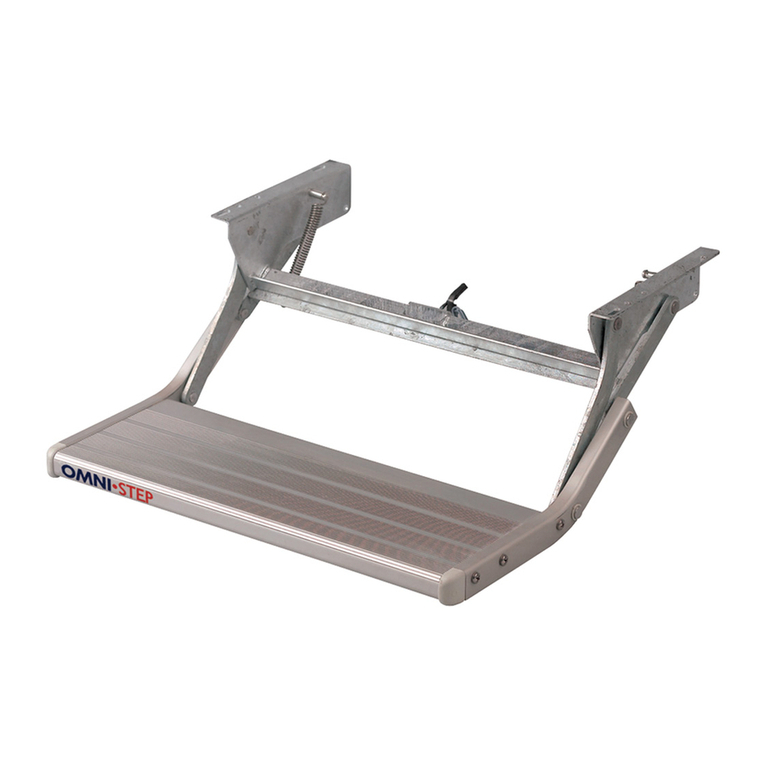
INSTALLATION OF THE STEP
These installation instructions are suggestions only. Because of
the many different coach types, the installation requirements
will vary (see fig. 2):
• right through the vehicle bottom,
• in rails incorporated in the bottom,
• on a special construction welded or bolted to the chassis.
- Extend the step by connecting 12V DC to the motor of the
step. Keep the purple wire against the positive pole and the
orange one against the negative pole.
- Cut off the connection when the step is fully extended. DO
NOT KEEP THE MOTOR UNDER TENSION FOR LONGER
THAN 2 OR 3 SECONDS.
- Drill 4 holes diam. 9 mm according to the coordinates shown
In fig.1 and 1bis. Keep in mind that when retracted, the step is
40 mm out of the frame.
- Install the step.
- Check the operation of the step: keep the purple wire against the
negative pole and the orange one against the positive pole of the
battery: the OMNISTEP retracts. Change the polarity (keep the
purple wire against the positive pole and the orange one against
the negative pole): the OMNISTEP extends.
INSTALLATION OF THE SWITCH S1 (fig. 3)
- Install the switch near to the door.
- Drill a diam. 48 mm hole in the wall.
- Mount the covering plate with 4 screws DIN 7981 - 2,9 x 9,5.
- Place an electric cable 2 x 2,5 mm2 from the battery to the
switch via a 20A fuse in the + conduction. In order to avoid
short-circuit, wait before introducing the fuse until the electric
connection is completed.
- Pass the motorwires of the OMNISTEP to the switch.
- Provide the wires for the switch with flat connectors 4,8 F.
- Make the electric connection as shown in figure 2.
- Introduce the fuse into the fuseholder and try operating.
CONNECTION OF A WARNING LAMP (fig. 3)
A switch (S2), which is pushed when the step is retracted, is
incorporated in the stepmotor. A warning light (L) can be
connected to this switch.
Therefore current is taken:
a) from the clamp of the electric accessories (position 1) of
the key contact or
b) from the relay which is activated by starting the engine.
Connect the wire to a clamp which becomes positive.
- Connect this clamp over the warning light to the grey switch
wire.
- Connect the brown switch wire to the negative pole of the
battery. Make sure to use the same battery as where the
positive current comes from.
INSTALLATION OF THE SWITCH S1 WITH AUXILIARY
RELAY FOR AUTOMATIC RETRACTION AT START (fig. 4)
- The installation of the relay prevents the operation of the step
whilst driving so that the installation meets the EMC
standards 89/336/EEC.
- Install the switch as described above.
- Fix the relay.
- Provide the wires for the relay with flat connectors 6,3 F.
- Make the electric connection as shown in figure 3.
- Put an electrolytic capacitor 2200 microFarad 16 VDC onto the
relais coil. This capacitor makes the step retract further, after
the current has been disconnected by the Omnistep switch. In
this way, the step is retracted untill its endstop.
OPERATION
- The OMNISTEP is operated by the lever switch.
- IMPORTANT: When extending the step, hold the switch until
the step is completely extended. NEVER MOUNT THE STEP
IF RETRACTED OF IF NOT FULLY EXTENDED, because
then the blocking is not working and the motor can be
damaged.
- Check if the step is retracted before departure.
MAINTENANCE
Dirt and frost can prevent the step from operating properly. In
this case the moving parts should be cleaned or defrosted.
All points of movement are layered in maintenance-free
bearings.
IN CASE OF ELECTRICAL FAILURE
If the step does not retract by motor: Loosen the square
connection according to fig. 5 (actions 1, 2 and 3), push the