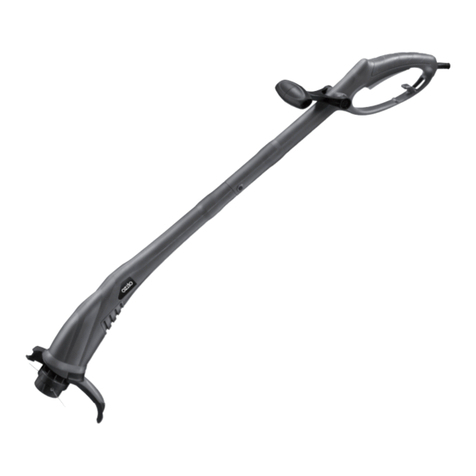
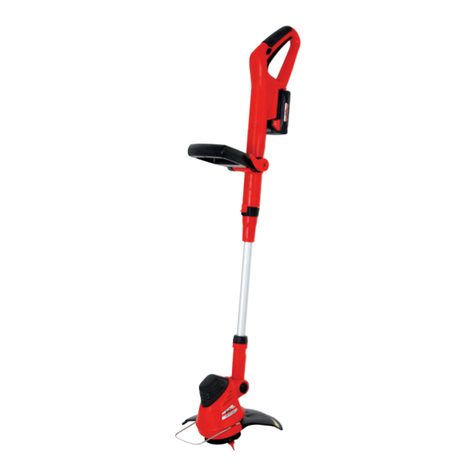
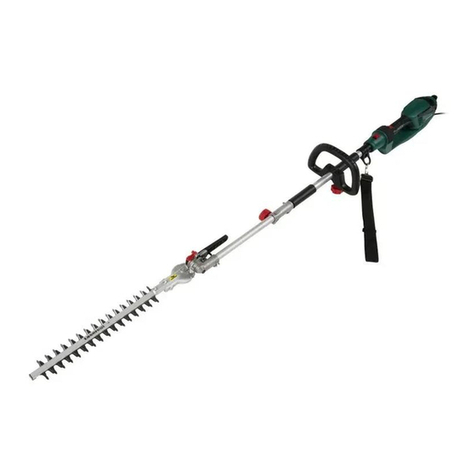
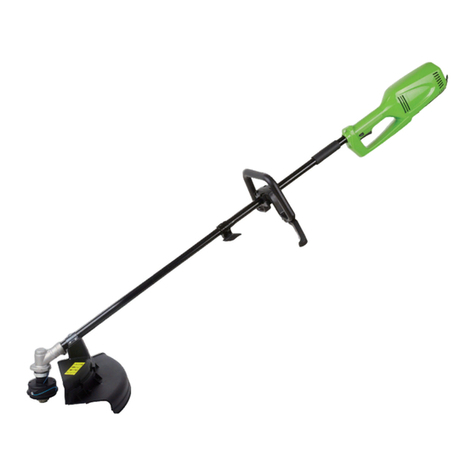
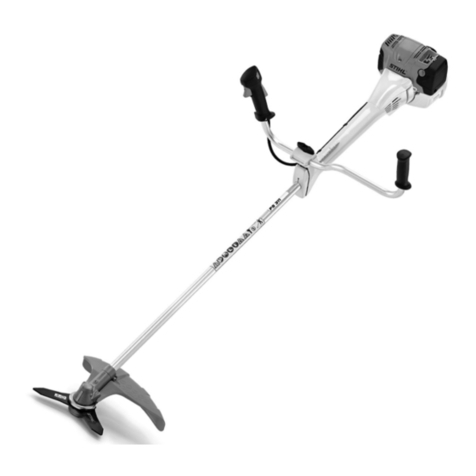
LINE TRIMMER SAFETY WARNINGS
Read the complete operating manual with due care.
Acquaint yourself with the controls and how to use the tool.
This appliance is not intended for use by persons(including children) with reduced physical, sensory or mental capabilities, or lack
of experience and knowledge, unless they have been given supervision or instruction concerning use of the appliance by a person
responsible for their safety. Children should be supervised to ensure that they do not play with the appliance.
Important!
For safety reasons the grass trimmer is not to be used by children, young people under 16 years
of age, or any other persons who are not acquainted with these directions for use.
Keep the instruction manual in a safe place for later use.
¥Examine the grass trimmer each time before you use it. Do not use the trimmer if any safety devices are damaged or worn.
¥Never put safety devices out of operation.
¥Do not use the grass trimmer if the cables are damaged or worn.
¥Stop using the equipment when there are people – particularly children – or pets nearby.
¥ Use the grass trimmer only for the purpose specied in these instructions.
¥You are responsible for safety in your work area.
¥ Inspect the items you want to cut before starting to work. Remove any foreign objects you nd. Watch out for foreign objects while
you work. If you still hit upon an obstacle while cutting, turn off the grass trimmer and remove the obstacle.
¥ Work only in good visibility.
¥Always make sure of your footing while working. Be careful when stepping backwards. Risk of stumbling!
¥Never leave the grass trimmer unattended at your work place. Store the trimmer in a safe place during interruptions.
¥If you interrupt your work to move to a different position it is imperative to switch off the grass trimmer while you are moving there.
¥Never use the grass trimmer in the rain or in moist or wet conditions.
¥Protect the grass trimmer from the damp and rain.
¥Before you switch on the grass trimmer, make sure that there are no stones or other objects touching the nylon line.
¥ Always wear suitable clothing to protect your head, hands and feet from injury. Wear a helmet, goggles or visor, high boots or
strong shoes, long trousers made of tough material, and work gloves.
¥Be sure to hold the grass trimmer away from your body when it is switched on!
¥If the grass trimmer is turned over or if it is not in working position, do not switch it on.
¥Switch off the motor and pull out the power plug when you are not using the grass trimmer, when you leave the trimmer
unattended, when you are checking the trimmer, if the power cable is damaged, when you want to remove and replace the spool,
and when you are moving the trimmer to another location.
¥Keep the grass trimmer away from other persons, particularly children and pets. There may be stones and other objects in the
ying cut grass.
¥Keep at least 5 m away from other persons and animals when you are working with the grass trimmer.
¥To prevent injury to yourself and damage to the grass trimmer, never cut against hard objects.
¥Use the edge of the guard to keep the grass trimmer away from walls, changes of surface and fragile objects.
¥Never use the grass trimmer without a guard.
CAUTION! The guard is vital for your safety and for the safety of others, and it is also
essential for the grass trimmer to work correctly. Failure to observe this instruction
will not only create a potential hazard, it will also result in the loss of your rights under the
warranty.
¥ Never try to stop the cutter (nylon line) with your hands. Wait until it stops by itself.
¥It is imperative to use only the original nylon line. Never use metal wire instead of the nylon line.
¥Beware of injuring yourself on the line cutting device.
¥Keep the air vents clear of dirt.
¥After use, unplug the machine and check it for damage.
¥Never attempt to cut grass that is not growing on the ground. For example, do not try to cut grass growing on walls, rocks,
etc.
¥ Within the working radius of the grass trimmer the user is responsible for any damage caused to third persons by use of
the trimmer.
¥Never cross roads or pebble paths with the grass trimmer switched on.
¥ When you are not using the grass trimmer, keep it in a dry place out of the reach of children.
¥Use the grass trimmer only as described in these directions for use and always hold it vertical to the ground. All other
positions are dangerous.
¥Check the screws regularly to see that they are properly tightened.
¥ The mains voltage must be the same as the voltage specied on the rating plate.
¥Check the power cable regularly for signs of damage or aging. Never use the grass trimmer if the power cable is in less
than perfect condition.
¥ Power cables used with the trimmer must not be of a lighter duty class than HO7RN-F rubber insulated exible cables
according to DIN 57282 / VDE 0282 with a minimum diameter of 1.5 mm2. Plug connectors must be equipped with
earthing contacts and the coupling must be rain-water protected.
¥If the cable is damaged during operation, disconnect it immediately from the power supply. DO NOT TOUCH THE CABLE
BEFORE IT IS DISCONNECTED FROM THE POWER SUPPLY.
¥To prevent danger, damaged power cables must be replaced by the manufacturer or by a service company authorized by
the manufacturer to carry out the work.
¥The equipment may only be powered via an earth-leakage circuit breaker (RCD) with a maximum operating current of 30
mA.
¥Keep cables and other objects out of the area you want to cut.
¥If you have to lift the grass trimmer to move it, switch off the motor and wait for the rotating tool to stop. Before you leave
the trimmer, switch off the motor and pull out the power plug.
¥Before you connect the grass trimmer to the power supply, make sure that none of its moving parts are damaged and that
the line spool is correctly inserted and fastened.
¥Never cut against hard objects when using the grass trimmer. This is imperative to avoid causing injury to the user and
damage to the trimmer.
¥Use only original replacement parts for repair and maintenance purposes.
¥ Have repairs carried out only by a qualied electrician.
¥Examine the grass trimmer for signs of wear or damage each time before you use it and after any collisions. Have
essential repairs carried out without delay.
¥Always keep your hands and feet away from the cutting mechanism, particularly when you switch on the trimmer.
¥After pulling out new line, always return the trimmer to normal working position before you switch it on again.
¥Never use replacement parts or accessories which are not foreseen or recommended by the manufacturer.
¥Pull out the power plug before carrying out any inspection, cleaning or other work on the trimmer and whenever it is not
being used.
¥Use the equipment only in broad daylight or in well-lit conditions.
¥Keep the extension cable away from cutting tools at all times.
Important: The nylon line continues to rotate for a few seconds after the motor is switched off.
The equipment does not start.
WARNING! When using mains-powered tools, basic safety precautions, including the
following, should always be followed to reduce risk of re, electric shock, personal injury
and material damage.
Read the whole manual carefully and make sure you know how to switch the tool off in an emergency,
before operating the tool.
Save these instructions and other documents supplied with this tool for future reference.
Before you connect the equipment to the mains supply make sure that the data on the rating plate are
identical to the mains data.
This tool is double insulated therefore no earth wire is required.
If the supply cord is damaged, it must be replaced by an electrician or a power tool repairer in order to avoid
a hazard.
Note: Double insulation does not take the place of normal safety precautions when operating this tool. The
insulation system is for added protection against injury resulting from a possible electrical insulation failure
within the tool.
Using an Extension Lead
Always use an approved extension lead suitable for the power input of this tool. Before use, inspect the
extension lead for signs of damage, wear and ageing. Replace the extension lead if damaged or defective.
When using an extension lead on a reel, always unwind the lead completely. Use of an extension lead not
suitable for the power input of the tool or which is damaged or defective may result in a risk of re and electric
shock.
GENERAL POWER TOOL SAFETY WARNINGS
ELECTRICAL SAFETY
WARNING! “Read all safety warnings, instructions, illustrations and specications
provided with this power tool.” Failure to follow the warnings and instructions may result in electric
shock, re and/or serious injury.
Save all warnings and instructions for future reference. The term “power tool” in the warnings refers
to your mains-operated (corded) power tool or battery-operated (cordless) power tool.
1. Work area safety
a. Keep work area clean and well lit. Cluttered or dark areas invite accidents.
b. Do not operate power tools in explosive atmospheres, such as in the presence of ammable
liquids, gases or dust. Power tools create sparks which may ignite the dust or fumes.
c. Keep children and bystanders away while operating a power tool. Distractions can cause you to
lose control.
2. Electrical safety
a. Power tool plugs must match the outlet. Never modify the plug in any way. Do not use any
adapter plugs with earthed (grounded) power tools. Unmodied plugs and matching outlets will
reduce risk of electric shock.
b. Avoid body contact with earthed or grounded surfaces, such as pipes, radiators, ranges and
refrigerators. There is an increased risk of electric shock if your body is earthed or grounded.
c. Do not expose power tools to rain or wet conditions. Water entering a power tool will increase the
risk of electric shock.
d. Do not abuse the cord. Never use the cord for carrying, pulling or unplugging the power tool.
Keep cord away from heat, oil, sharp edges or moving parts. Damaged or entangled cords increase
the risk of electric shock.
e. When operating a power tool outdoors, use an extension cord suitable for outdoor use. Use of a
cord suitable for outdoor use reduces the risk of electric shock.
f. If operating a power tool in a damp location is unavoidable, use a residual current device (RCD)
protected supply. Use of an RCD reduces the risk of electric shock.
3. Personal safety
a. Stay alert, watch what you are doing and use common sense when operating a power tool. Do
not use a power tool while you are tired or under the inuence of drugs, alcohol or medication. A
moment of inattention while operating power tools may result in serious personal injury.
b. Use personal protective equipment. Always wear eye protection. Protective equipment such as dust
mask, non-skid safety shoes, hard hat, or hearing protection used for appropriate conditions will reduce
personal injuries.
c. Prevent unintentional starting. Ensure the switch is in the off-position before connecting to
power source and/or battery pack, picking up or carrying the tool. Carrying power tools with your
nger on the switch or energising power tools that have the switch on invites accidents.
d. Remove any adjusting key or wrench before turning the power tool on. A wrench or a key left
attached to a rotating part of the power tool may result in personal injury.
e. Do not overreach. Keep proper footing and balance at all times. This enables better control of the
power tool in unexpected situations.
f. Dress properly. Do not wear loose clothing or jewellery. Keep your hair, clothing and gloves away
from moving parts. Loose clothes, jewellery or long hair can be caught in moving parts.
g. If devices are provided for the connection of dust extraction and collection facilities, ensure
these are connected and properly used. Use of dust collection can reduce dust-related hazards.
h) Do not let familiarity gained from frequent use of tools allow you to become complacent and
ignore tool safety principles. A careless action can cause severe injury within a fraction of a second.
4. Power tool use and care
a. Do not force the power tool. Use the correct power tool for your application. The correct power tool
will do the job better and safer at the rate for which it was designed.
b. Do not use the power tool if the switch does not turn it on and off. Any power tool that cannot be
controlled with the switch is dangerous and must be repaired.
c. Disconnect the plug from the power source and/or remove the battery pack, if detachable, from
the power tool before making any adjustments, changing accessories, or storing power tools.
Such preventive safety measures reduce the risk of starting the power tool accidentally.
d. Store idle power tools out of the reach of children and do not allow persons unfamiliar with the
power tool or these instructions to operate the power tool. Power tools are dangerous in the hands
of untrained users.
e. Maintain power tools and accessories. Check for misalignment or binding of moving parts,
breakage of parts and any other condition that may affect the power tool’s operation. If damaged,
have the power tool repaired before use. Many accidents are caused by poorly maintained power
tools.
f. Keep cutting tools sharp and clean. Properly maintained cutting tools with sharp cutting edges are
less likely to bind and are easier to control.
g. Use the power tool, accessories and tool bits etc. in accordance with these instructions, taking
into account the working conditions and the work to be performed. Use of the power tool for
operations different from those intended could result in a hazardous situation.
h) Keep handles and grasping surfaces dry, clean and free from oil and grease. Slippery handles and
grasping surfaces do not allow for safe handling and control of the tool in unexpected situations.
5. Service
a. Have your power tool serviced by a qualied repair person using only identical replacement
parts. This will ensure that the safety of the power tool is maintained.