EN
ASSEMBLY AND USER INSTRUCTIONS
Whenever this product is used the following information must be
taken into consideration: the bike rack is a safe product if used
correctly, but if it is used incorrectly it can cause damages to you
and to anyone driving behind you.
HOW TO INSTALL THE BIKE CARRIER ON
THE TOWBALL
Forpersonalsafetyandtoavoiddamagingthevehiclewe
recommend 2 people mount the bike carrier.
Follow in sequence the actions in g. A-B-C1-C2.
Adjustment of closing lever force
It is always necessary tomakethe rst adjustmentwhen the product is
purchased. Then, every time the product is used, the clamping force must
be checked and adjusted if necessary. In order toprevent accidents and
damageit isadvisabletoaskasecondpersontoassistyouinthis
procedureas well.Afterdisengaging andlifting thelever orizontal
position (2-3 Fig. C1),The screw must be adjusted with the wrench
providedsothattheclampingforceontheleverisincreasedtoa
minimum of 45 Kg. (2-3 Fig. C2). Makesurethatthe bikerack does
not rotate when the clamping device has been locked.
ONLY FOR ART. 713/3E
Clean the parts of the bodywork that will be in contact with the straps of the
bike carrier. Attach the strap hooks to the edges of the vehicle hatch, then
insert the straps in the buckles (make sure the inlet direction is correct)
(1-2-3 Fig. D).
IMPORTANT
: Give the straps a good tug to check for
tightness. Check the tightness before starting and during the trip.
POSITIONING AND FIXING THE BIKES ON
THE BIKE RACK
In the case of bikes with carbon frames or forks,always consult the bike
manufacturer or dealer to check if you are allowed to use the carrier.
Place the biggest and heaviest bikeon the bikerack first,position the
wheels in the tire cradles and fix it to the shortest arm (
1 Fig. E
) .
Secure the wheels by means of the fixing straps (
2 Fig. E
).
Repeat the operations in (
1-2 Fig.E
)for the second and thirdbikes.The
first and second bikes aresecured tothe fixing arch with the fixing arms
(
1F ig. E
), whereas the thirdbikeis secured to the second bikewith
fixing arm (
3 Fig. E1
).
IMPORTANT
: For safe transportation of the load the bike carrier
is supplied trap for tying es to the fixing arch . Check that the
belt is mounted correctly by pulling on it (
4 Fig. E2
).
To load easily your bike on the carrier you can use the specific
trail included in the product pacakge. To hook it correctly please
follow instruction (
Fig. F
).
BIKE RACK INCLINATION
To tilt the bike rack hold it up with one hand while you press the
pedal (1-2 Fig.
G
) . To avoid injury or damage, this operation of tilting
the bike rack should be carried out with the help of a third person. To close
the bike rack, lift it until the tilt mechanism engages completely by
passing from the tilt position (Fig.
G
1) to the closed position (Fig.
G
2).
- Do not use the cycle carrier on the road with wheel supports and light
bar in closed position.
- Never exceed the permitted capacity of the towing hook installed. The
combined weight of the bike rack and the load must never exceed the
permitted capacity. Keep the towing hook ball surface clean from dirt
and oil.
-The driver is always responsible for the load he is transporting and
consequently he is also responsible for checking the fastenings both
before starting the trip and at regular intervals during the trip.
- Check the car manual for the specications concerning the maximum
permissible rear axle weight.
-Verify compliance with the value D(maximum load bearing capacity)
of the towball specied by the car or towball manufacturer; the value
D for the towball must be at least (760 Kg) 7.6kN; older towballs
often only specify the permissible load on the towball GAand the
total permissible load of the towing vehicle GKrather than value D; in
this case the value Dcan be calculated using the values specied in
the vehicle maintenance or registration booklet:
- Remove from the transported bikes children's seats, transport
baskets, rain covers or other elements that could get lost or increase
the air resistance.
- Do not carry more bikes than the number indicated for a specic
model.
- Bike parts, such as for example the handlebars or pedals, must not be
left in the normal position of use; they must be folded to avoid
dangerous projections.
- Compatibility with the bike carrier must be checked in the case of
bikes with particular forms.
- Ifthe bicycledoes nothavea crossbar(woman's bike)it maybe
necessary to use an additional bar (optional art. 395).
- Compatibility cannot be guaranteed in the case of children's bikes.
- Ensure that the bike rack is tted correctly on the towing hook and
that the bikes are secured as instructed.
- The bike rack is only suitable for transporting bicycles.
- Before leaving, check that the rear lights function correctly. Also check
that the indicator lights work correctly.
- Keep the connections clean (lighting board power plug and power
outletonthevehicle);usesuitablecleaningmaterialswhen
necessary.
- Do not use and/or attach the bike rack to the car before making the
electrical connections.
- Check that the electrical cables are not damaged or likely to be
damaged by interference with other elements of the vehicle or that
they could, in any way, be accidently cut.
- The lighting devices are not designed t be immersed in water.
- Any major work required to be done on the electrical system and
connections must be performed by qualied personnel.
- Provide an additional number plate to be attached to the towball bike
rack.
ATTENTION – SAFETY REQUIREMENTS
D = x
9,81 (GA xGK)
1000 (GA +GK)
(D in [kN] / GAin [kg] / GKin [kg])
As well as the information described below please observe the
"
Conditions, suggestions and limits for use
" specied in the EC
type test certicate.
- Weight and maximum capacity of bike racks:
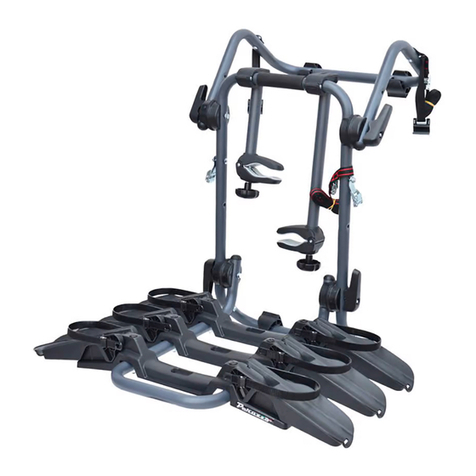
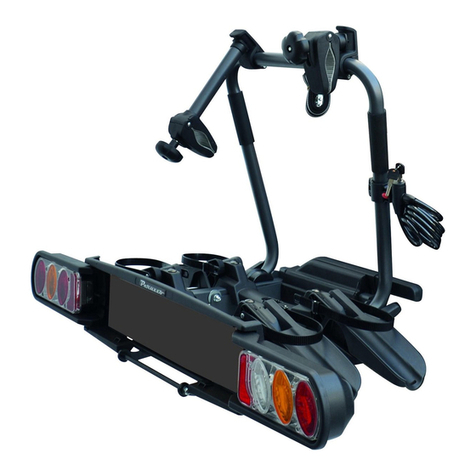
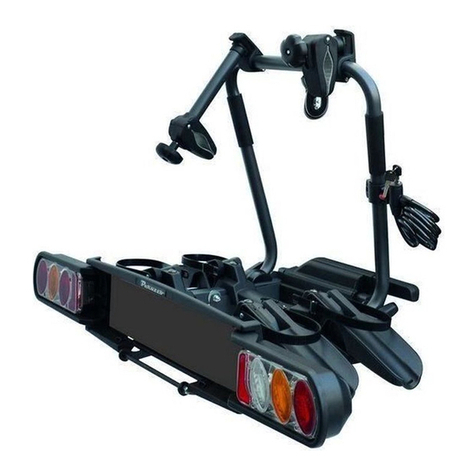
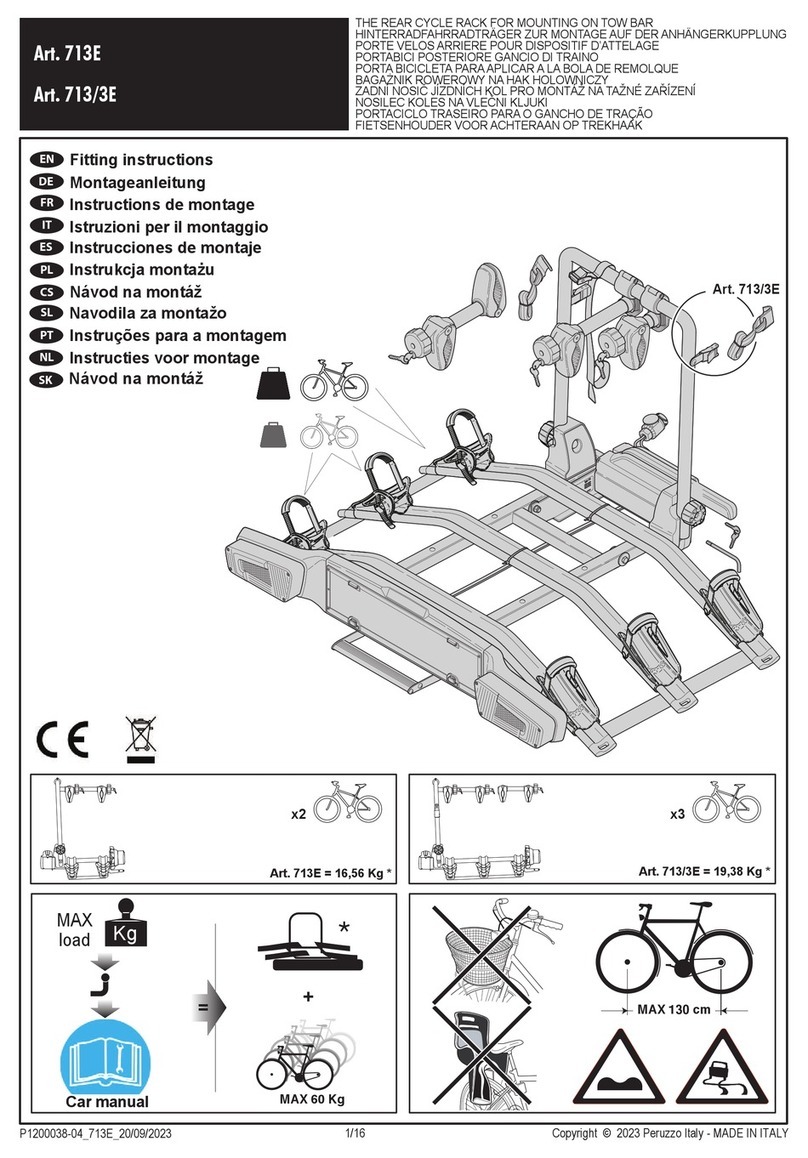
* Model 713E (16,56 kg.) ---> 2 bikes, max. capacity 60 kg.
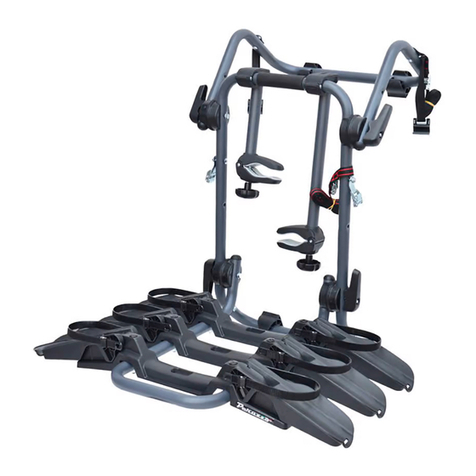
* Model 713/3E (19,38 kg.) ---> 3 bikes, max. capacity 60 kg.
713E_28/05/20 9/32 Copyright © 2020 Peruzzo Italy - MADE IN ITALY