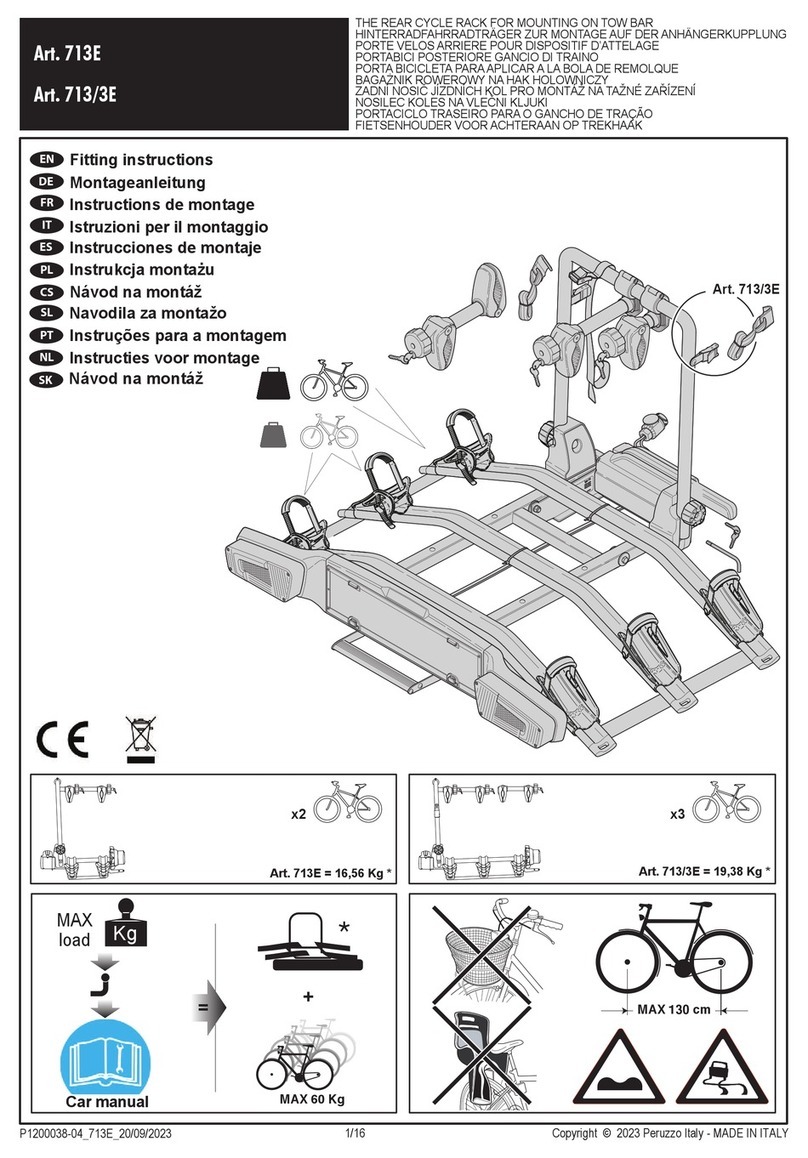
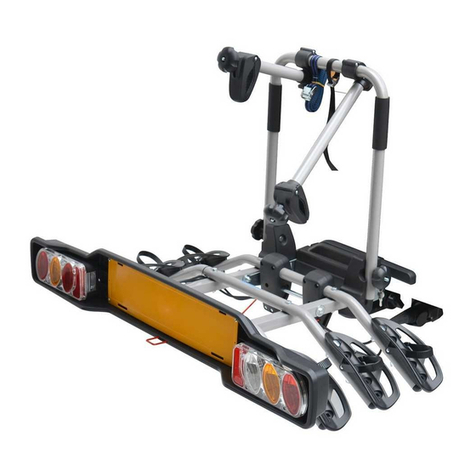
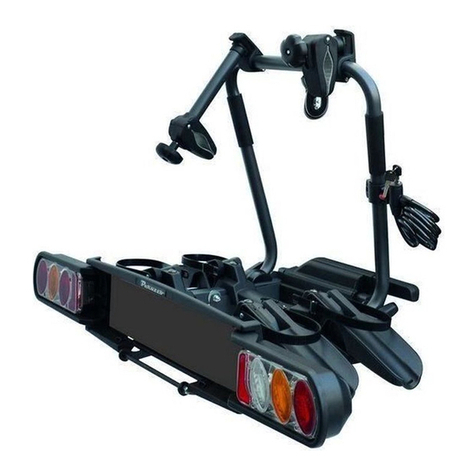
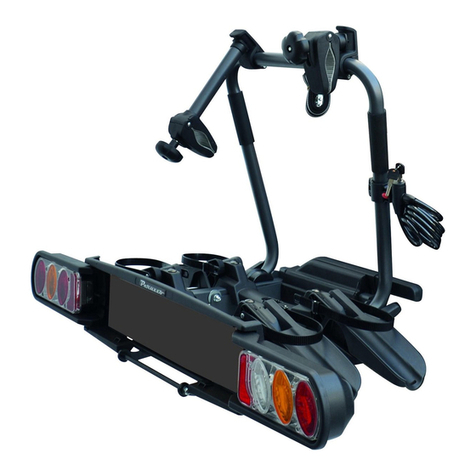
EN
ASSEMBLY AND USER INSTRUCTIONS
Whenever this product is used the following information must be
taken into consideration: the bike rack is a safe product if used
correctly, whereas if it is used incorrectly it can cause damages
to you and to anyone driving behind you.
1) Insert the end plugs 32 in the square bearing tubes 25-26 (Fig. A).
2) Insert the end plugs 23 in the bike carrier bars 27 (Fig. A) and in the
bike xing arch 31 (Fig. D2).
3) Mount the tyre cradles 21 on the bike carrier bar 27 in the most suita-
ble positions for the dimensions of your bike and x them with the
screws 22, nuts and washers 53 (Fig. A).
4) Fix the carrier bars 27to the square bearing tubes 25-26with the
screws, nuts and washers 54 (Fig. A).
5) Fix the square tube 24 of the light bar 17 to the square bearing tubes
25-26 with the screws, washers and nuts 51 (Fig. A).
6) Mount the rear lights 18on the light bar 17and x them with the
washers and nuts 55 (Fig. B) while taking care not to damage the wires.
Thread the 13 pin plug through the central hole of the light bar 17.
7) Fix the number plate frame 19 to the light bar 17 with the screws 56.
8) Fix the light bar assembly 17 to the square tube 24 with the screws 20,
the nuts and the washers 52; make sure you thread the tilt hook 5into
the slot provided (Fig. C).
9) Mounting the bike xing arch 31:
- Unscrew and remove the knobs36 and the washers 57 from both
sides (Fig. D1);
- Carry out the operations 1and 2(Fig. D2);
- Place the bike xing arch 31in the half pipe of the tilt adjustment
element 33, then x it with the washers 57 and the knobs 36 (Fig. D2).
HOW TO INSTALL THE BIKE RACK ON THE
TOWING HOOK
To mount the bike rack in safety and to avoid damaging the vehicle, you
should request the help of another person.
10) Remove the safety screw 13 from the xing block 50 (Fig. E).
11)Unscrew the screw 8until the hemisphere 14(Fig. E) is completely
open.
12) Apply the xing block 11 with the hemisphere open 14 to the hitch ball
58 (Fig. F) .
13) Tighten the screw 8with the wrench provided 12 until the hemisphere
14 is secured to the hitch ball 58 (the manual force should be equal to at
least 40 Kg.) (Fig. F).
IMPORTANT:
Lastly mount the safety screw 13 to the xing block 50
(Fig. F) to avoid any accidental openings.
ONLY FOR ART. 668/4
14) Attach the strap hooks 40 to the edges of the vehicle hatch, then insert
the straps in the buckles 39 (make sure the inlet direction is correct)
(Fig. F1).
IMPORTANT
: Give the straps a good tug to check for tightness. Check the
tightness before starting and during the trip.
POSITIONING and FIXING the BIKES ON
THE BIKE RACK
15) Place the biggest and heaviest bike on the bike rack rst, position the
wheels in the tire cradles 21 and lean it up against the bike xing arch
31. Secure the bike to the bike xing arch 31 with the xing strap 30
(Fig. H1). Secure the wheels by means of the xing straps 37 (Fig. G).
Check that the belts are mounted correctly by pulling on them.
16) Repeat the operations in 15 for the second, third and fourth bikes. The
second and third bikes are secured to the xing arch 31 with the xing
arms 15/16 (Fig. H1), whereas the fourth bike is secured to the third
bike with xing arm 41 (Fig. H2).
IMPORTANT
: For safe transportation of the load the bike carrier is
supplied with a strap 38 for tying all the bikes to the xing arch 31.
Check that the belt is mounted correctly by pulling on it.
BIKE RACK INCLINATION (Fig.I/L/M)
17) To tilt the bike rack hold it up with one hand while you pull the hook
5with the other (Fig. I/L).To avoid injury or damage, this operation
of tilting the bike rack should be carried out with the help of a third
person.To close the bike rack lift it until the tilt hook 5engages
securely in the transit position (Fig. M).
Aswell as the informationdescribed belowplease observethe
"
Conditions, suggestions and limits for use
" specied in the EC
type test certicate.
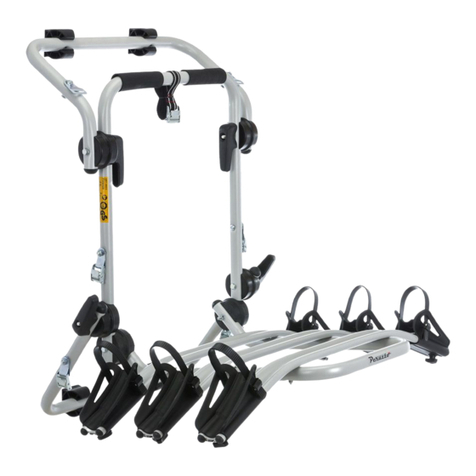
- Weight and maximum capacity of "SIENA" bike racks:
*Model 668(10,85 kg)- 669(10,65kg) ---> 2bikes,max.
capacity 34 kg.
* Model 668/3 (13,56 kg) - 669/3 (13,33 kg) ---> 3 bikes, max.
capacity 51 kg.
* Model 668/4 (15,93 kg.) ---> 4 bikes, max. capacity 60 kg.
- Never exceed the permitted capacity of the towing hook installed. The
combined weight of the bike rack and the load must never exceed the
permitted capacity. Keep the towing hook ball surface clean from dirt
and oil.
-The driver is always responsible for the load he is transporting and
consequently he is also responsible for checking the fastenings both
before starting the trip and at regular intervals during the trip.
- Check the car manual for the specications concerning the maximum
permissible rear axle weight.
- Verify compliance with the value D(maximum load bearing capacity)
of the towball specied by the car or towball manufacturer; the value
D for the towball must be at least (760 Kg) 7.6kN; older towballs
often only specify the permissible load on the towball GAand the
total permissible load of the towing vehicle GKrather than value D; in
this case the value Dcan be calculated using the values specied in
the vehicle maintenance or registration booklet:
- Remove from the transported bikes children's seats, transport
baskets, rain covers or other elements that could get lost or increase
the air resistance.
- Do not carry more bikes than the number indicated for a specic
model.
- Bike parts, such as for example the handlebars or pedals, must not be
left in the normal position of use; they must be folded to avoid
dangerous projections.
- Ensure that the bike rack is tted correctly on the towing hook and
that the bikes are secured as instructed.
- The bike rack is only suitable for transporting bicycles.
ATTENTION – SAFETY REQUIREMENTS
D = x
9,81 (GA xGK)
1000 (GA +GK)
(D in [kN] / GAin [kg] / GKin [kg])
668_SIENA_12/07/18 9/33 Copyright © 2009 Peruzzo Italy - MADE IN ITALY