Installation & Operation Manual Copyright © Puretec Pty Ltd 2018
Step 5: Install RO Assembly
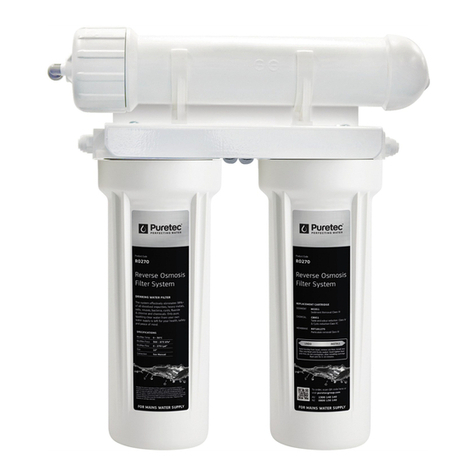
The RO Assembly includes the following components: sumps (3), support leg, prelter, RO
membrane elements (2), and postlter. The tubing is attached to the manifold by the elbow
connectors. When choosing a location for the system, allow enough tubing for it to be moved for
periodic servicing of the lters and membrane elements (Figure 6 RO Assembly).
Figure 6
NOTE: Make sure the tubing is pushed past the O-rings for a
secure fit. Also, when replacing any tubing, cut tubing
back ~1/4 inch prior to re-inserting to prevent leaks.
INSTALLATION cont.
Step 4: Make Tubing Connections
The connections to the faucet should be complete, the remaining
connections are:
• Feed connection—clear tubing from feed valve to white elbow
connector
• Drain connection—either red tubing from the air gap or black
tubing from grey elbow connector will attach to the drain
adapter
• Permeate connection—blue tubing from faucet to blue elbow
connection
• Attach the fittings to the manifold
A typical connection is shown in Figure 7 Side View and Cutaway of
Tubing Fitting.
NOTE: For optimal system performance, we recommend using tubing
lengths that are as short as possible.
Postfilter
Install the postfilter in line with the blue permeate tubing. Make sure
flow direction aligns with water path. Secure tubing with collet lock
clips.
Drain Adapter (Optional)
The drain adapter has a rubber inlet that accepts the 3/8-inch black
drain tube or the 1/2-inch red tube. The 3/8-inch black tubing will
connect here if the faucet is not using the air gap module.
When the tubing is in position, use the supplied hose clamps to
secure the connection.
NOTE: When sliding tubing into the drain adapter inlet, wet the
tubing. Water will help the tubing slide into the rubber inlet.
Feed Pressure Gauge
The supplied pressure gauge can be connected to the feed line to
monitor system feed pressure. For proper system performance, the
dynamic feed pressure must be between 40 psi (2.76 bar) and 80 psi
(5.52 bar) when the system is in operation.
The feed pressure gauge is intended for use only during
installation and troubleshooting of the RO system. The
pressure gauge should be removed during normal system
operation because some regulatory agencies did not
evaluate the RO system with the feed pressure gauge in
place.
Step 5: Install RO Assembly
The RO Assembly includes the following components: sumps (3),
support leg, prefilter, RO membrane elements (2), and postfilter. The
tubing is attached to the manifold by the elbow connectors. When
choosing a location for the system, allow enough tubing for it to be
moved for periodic servicing of the filters and membrane elements
(Figure 8 RO Assembly).
Do not attempt to mount/hang the system. Do not
try to drill mounting holes anywhere on the system.
If putting above ground/cabinet level, a sturdy,
permanent shelf is recommended.
O-Ring
O-Ring
Collet
Tubing
Collet
Lock Clip
Figure 7 Side View and Cutaway of Tubing Fitting
Figure 8 RO Assembly
WARNING: Do not attempt to mount/hang the system. Do not try to drill mounting holes
anywhere on the system. If putting above ground/cabinet level, a sturdy, permanent shelf is
recommended.
Recommended Placement Positions
The RO assembly should be positioned in one of two ways.
The rst position is with the unit standing upright using the support leg with the sumps
horizontal. The tubing is directed to provide the best t.
The second position, sets the unit on end so the sumps are pointing up. The tubing is directed
upward and the locking bar is down to lock the tubing connections. See Figure 7 system
positions.
Note: Ensure that the support leg is installed on the sumps.
Figure 7
Recommended Placement Positions
The RO assembly should be positioned in one of two ways.
The first position is with the unit standing upright using the support
leg with the sumps horizontal. The tubing is directed to provide the
best fit.
The second position, sets the unit on end so the sumps are pointing
up. The tubing is directed upward and the locking bar is down to lock
the tubing connections. See Figure 9 System Positions.
NOTE: Ensure that the support leg is installed on the sumps.
Connection Lubrication
Connections with O-rings must be properly lubricated. The following
instructions describe the method and locations for lubrication.
Six packets of silicone lube are supplied. One packet should be
completely used to lubricate the O-ring contact surfaces in the 3
manifold ports and 2 RO membrane locations (Figure 10). Follow
Figure 11 and lubricate the filter seat and the flat surface below the
threads for the 3 sump locations. Use a complete packet of silicone
for each sump location.
NOTE: To properly lubricate the O-ring contact area, a film of clean
silicone grease is applied. The film should cover all of the
surface area that the O-ring will slide over and seal with. Do
not use grease containing petroleum products.
INSTALLATION cont.
Figure 9 System Positions
First Position
Locking Bar
Second Position
Support Leg