manuals.online logo
Brands
  1. Home
  2. •
  3. Brands
  4. •
  5. TP-Link
  6. •
  7. Switch
  8. •
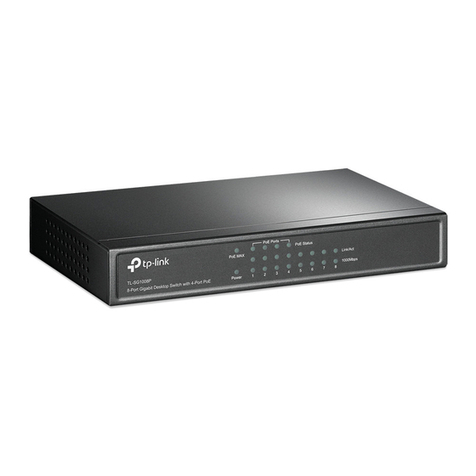
  9. TP-Link TL-SF1008P User manual

TP-Link TL-SF1008P User manual

Other manuals for TL-SF1008P

6

This manual suits for next models

2

Other TP-Link Switch manuals

TP-Link TL-SG108-M2 User manual

TP-Link

TP-Link TL-SG108-M2 User manual

TP-Link JetStream TL-SL3452 User manual

TP-Link

TP-Link JetStream TL-SL3452 User manual

TP-Link TL-SG2452 User manual

TP-Link

TP-Link TL-SG2452 User manual

TP-Link JetStream T2600G-18TS User manual

TP-Link

TP-Link JetStream T2600G-18TS User manual

TP-Link TL-SX1008 User manual

TP-Link

TP-Link TL-SX1008 User manual

TP-Link UH720 User manual

TP-Link

TP-Link UH720 User manual

TP-Link HS200 User manual

TP-Link

TP-Link HS200 User manual

TP-Link TL-SL2218 User manual

TP-Link

TP-Link TL-SL2218 User manual

TP-Link TL-SG108PE User manual

TP-Link

TP-Link TL-SG108PE User manual

TP-Link TL-SG1008D - Switch User manual

TP-Link

TP-Link TL-SG1008D - Switch User manual

TP-Link TL-SG1016PE User manual

TP-Link

TP-Link TL-SG1016PE User manual

TP-Link TL-SG108E User manual

TP-Link

TP-Link TL-SG108E User manual

TP-Link Tapo S200D User manual

TP-Link

TP-Link Tapo S200D User manual

TP-Link JetStream TL-SL5428E User manual

TP-Link

TP-Link JetStream TL-SL5428E User manual

TP-Link Omada DS1016G User manual

TP-Link

TP-Link Omada DS1016G User manual

TP-Link TL-SL2428 User manual

TP-Link

TP-Link TL-SL2428 User manual

TP-Link JetStream T3700G-52TQ Instruction Manual

TP-Link

TP-Link JetStream T3700G-52TQ Instruction Manual

TP-Link T1700X-16TS User manual

TP-Link

TP-Link T1700X-16TS User manual

TP-Link TL-SG108 User manual

TP-Link

TP-Link TL-SG108 User manual

TP-Link TL-SL2428 User manual

TP-Link

TP-Link TL-SL2428 User manual

TP-Link JetStream TL-SG3424 User manual

TP-Link

TP-Link JetStream TL-SG3424 User manual

TP-Link TL-SG108E User manual

TP-Link

TP-Link TL-SG108E User manual

TP-Link TL-SL5428 User manual

TP-Link

TP-Link TL-SL5428 User manual

TP-Link TL-SG5426 - User manual

TP-Link

TP-Link TL-SG5426 - User manual

Popular Switch manuals by other brands

SMC Networks SMC6224M Technical specifications

SMC Networks

SMC Networks SMC6224M Technical specifications

Aeotec ZWA003-S operating manual

Aeotec

Aeotec ZWA003-S operating manual

TRENDnet TK-209i Quick installation guide

TRENDnet

TRENDnet TK-209i Quick installation guide

Planet FGSW-2022VHP user manual

Planet

Planet FGSW-2022VHP user manual

Avocent AutoView 2000  AV2000BC AV2000BC Installer/user guide

Avocent

Avocent AutoView 2000 AV2000BC AV2000BC Installer/user guide

Moxa Technologies PT-7728 Series user manual

Moxa Technologies

Moxa Technologies PT-7728 Series user manual

Intos Electronic inLine 35392I operating instructions

Intos Electronic

Intos Electronic inLine 35392I operating instructions

Cisco Catalyst 3560-X-24T Technical specifications

Cisco

Cisco Catalyst 3560-X-24T Technical specifications

Asante IntraCore IC3648 Specifications

Asante

Asante IntraCore IC3648 Specifications

Siemens SIRIUS 3SE7310-1AE Series Original operating instructions

Siemens

Siemens SIRIUS 3SE7310-1AE Series Original operating instructions

Edge-Core DCS520 quick start guide

Edge-Core

Edge-Core DCS520 quick start guide

RGBLE S00203 user manual

RGBLE

RGBLE S00203 user manual

Thrustmaster FLIGHT SIMULATOR X quick guide

Thrustmaster

Thrustmaster FLIGHT SIMULATOR X quick guide

Southwire SURGE GUARD 41390 RVC troubleshooting guide

Southwire

Southwire SURGE GUARD 41390 RVC troubleshooting guide

Buhler Nivotemp NT 61 Brief instructions

Buhler

Buhler Nivotemp NT 61 Brief instructions

Kramer VS-41HDCP user manual

Kramer

Kramer VS-41HDCP user manual

Techly IDATA AU-270 user manual

Techly

Techly IDATA AU-270 user manual

Belkin F1U109 user manual

Belkin

Belkin F1U109 user manual

manuals.online logo
manuals.online logoBrands
  • About & Mission
  • Contact us
  • Privacy Policy
  • Terms and Conditions

Copyright 2025 Manuals.Online. All Rights Reserved.

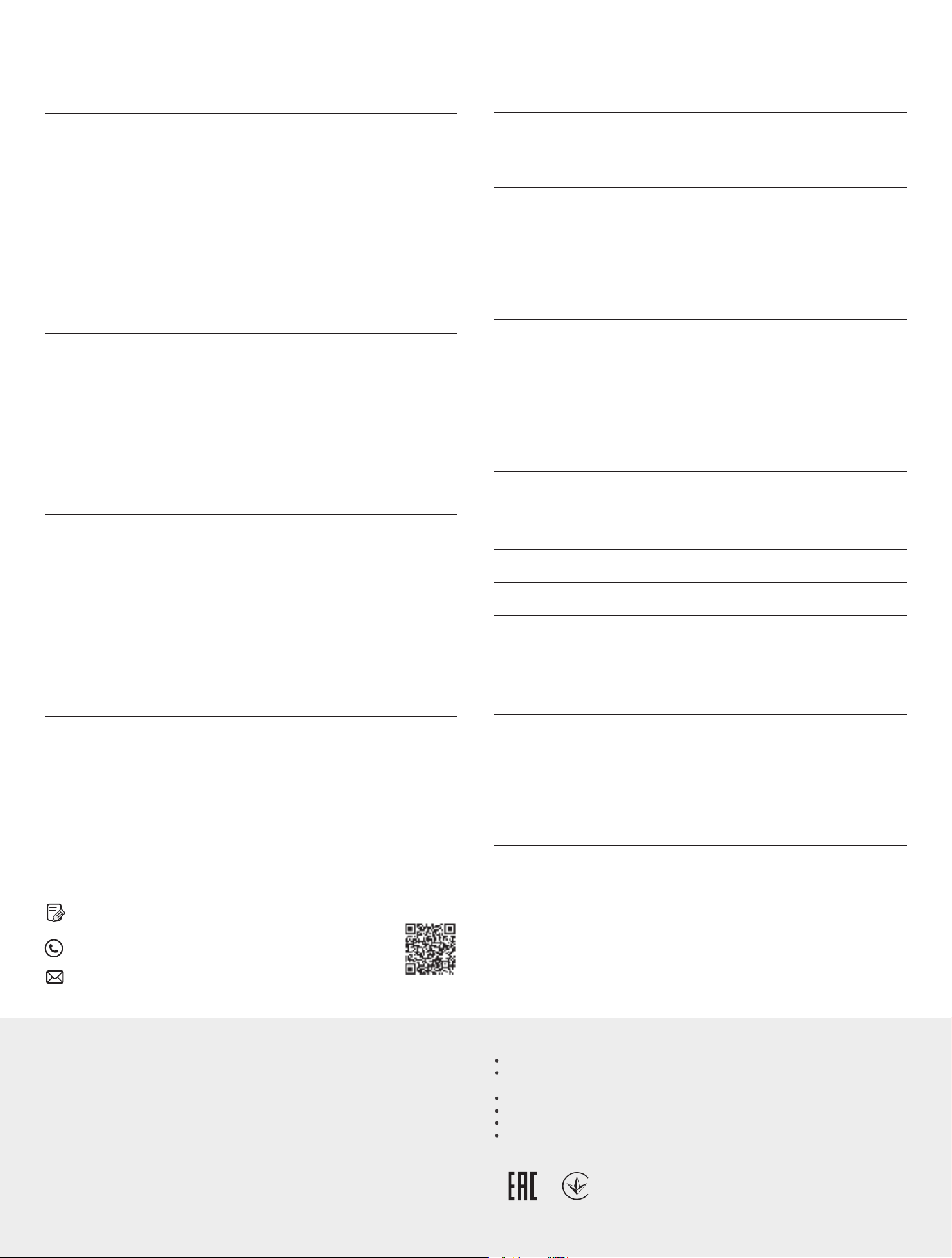
Installation Guide
Connection
Unmanaged Desktop PoE/PoE+ Switch
PC
IP Camera AP
Ethernet Ports (1-8)
PoE Ports (1-4)
IP Phone
PoE Devices
PoE ports can also connect to non-PoE devices, but only transmit data.
Note:
Internet
Link/Act Link/Act
On: Link present but no activity
Flashing: Transmitting/receiving data
O: No link
PoE Status PoE Status
On: PoE power provided
Flashing: Current-overload/ Short-circuit
O: No PoE power provided
Power Power
On: Power on
O: Power o
© 2020 TP-Link 7106509063 REV7.0.0
LED Explanation
DC Power Adapter
AC Power Cord
Switches Explanation
Note: For simplicity, we will take TL-SF1008P for example throughout the Guide.
O: Ports run at 10/100 Mbps and support PoE power supply up to 100 m away.
On: Ports run at 10 Mbps and support PoE power supply up to 250 m away.
Extend (for TL-SF1008LP/TL-SF1008P/TL-SF1009P)
PoE MAX PoE MAX
TL-SF1008LP
On: 34 W ≤ Total power supply < 41 W
Flashing: Total power supply = 41 W
O: Total power supply < 34 W
TL-SF1008P
On: 59 W ≤ Total power supply < 66 W
Flashing: Total power supply = 66 W
O: Total power supply < 59 W
TL-SF1009P
On: 58 W ≤ Total power supply < 65 W
Flashing: Total power supply = 65 W
O: Total power supply < 58 W
O: The PoE Auto Recovery function is disabled.
On: The switch will constantly detect the working status of a PoE powered device (PD).
When the switch nds that the PD works abnormally, the switch will reboot it.
Recovery (only for TL-SF1008P)
O: Ports can transmit data with each other.
On: Downlink ports cannot transmit data with each other. They can transmit data only with
the uplink port.
Isolation (only for TL-SF1009P)
O: All the ports transmit data with the same priority.
On: The specic ports transmit data with a higher priority than other ports.
Priority (for TL-SF1008LP/TL-SF1008P/TL-SF1009P)
Note: The numbers in brackets indicate the ports where the feature takes eect. For example, when Extend(1-4) is toggled to On, the Extend mode will be enabled for ports 1-4.
Frequently Asked Questions (FAQ)
The Power LED should be lit when the power system is working normally. If the Power LED is
not lit, please check as follows:
A1:
Make sure the AC power cord is connected the switch with power source properly.
A2:
Make sure the voltage of the power supply meets the requirements of the input voltage
of the switch.
A3:
Make sure the power source is on.
Q1. The Power LED is not lit.
It is recommended that you check the following items:
A1:
Make sure that the cable connectors are rmly plugged into the switch and the device.
A2:
Make sure the connected device is turned on and working well.
A3:
The cable must be less than 100 meters long (328 feet). If Extend Mode is enabled, it
should be less than 250 meters (820 feet).
Q2. The Link/Act LED is not lit when a device is connected to the
corresponding port.
When the total power consumption of connected PoE devices exceeds the maximum, the
PoE port with a smaller port number has a higher priority. The system will cut o power to
the ports with larger port numbers to ensure supplying to other ports.
Take TL-SF1008P as an example. If port 1, 2 and 4 are consuming 15.4 W respectively, and
an additional PoE device with 20 W is inserted to port 3, the system will cut o the power of
port 4 to compensate for the overload.
Q3. Why are PoE ports not supplying power for PoE devices?
For technical support and other information, please visit
https://www.tp-link.com/support, or simply scan the QR code.
If you have any suggestions or needs on the product guides, welcome
to email tech[email protected]om.cn.
To ask questions, find answers, and communicate with TP-Link users or
engineers, please visit https://community.tp-link.com to join TP-Link
Community.
TP-Link hereby declares that the device is in compliance with the essential requirements and
other relevant provisions of directives 2014/30/EU, 2014/35/EU, 2009/125/EC, 2011/65/EU
and (EU)2015/863.
The original EU declaration of conformity may be found at https://www.tp-link.com/en/ce.
EU Declaration of Conformity
PoE Disclaimer
The speed of the ports in extend mode will downgrade to 10 Mbps. The actual transmission
distance may vary due to power consumption of PoE-powered devices or the cable quality
and type.
PoE budget calculations are based on laboratory testing. Actual PoE power budget is not
guaranteed and will vary as a result of client limitations and environmental factors.
General Specications
Specications
IEEE 802.3i, IEEE 802.3u, IEEE 802.3x, IEEE 802.3af,
IEEE802.3at (Except TL-SF1008LP)
CSMA/CD
TL-SF1008LP/TL-SF1008P:
8 10/100 Mbps RJ45 Ports
Auto-Negotiation/Auto MDI/MDIX
PoE Ports: Port 1–4
TL-SF1009P:
9 10/100 Mbps RJ45 Ports
Auto-Negotiation/Auto MDI/MDIX
PoE Ports: Port 1–8
10BASE-T:
UTP category 3, 4, 5 cable (maximum 100 m)
EIA/TIA-568 100
Ω
STP (maximum 100 m)
100BASE-TX:
UTP category 5, 5e cable (maximum 100 m)
EIA/TIA-568 100
Ω
STP (maximum 100 m)
1000BASE-T (Only for TL-SL1210MP):
UPT category 5e cable or above (maximum 100m)
EIA/TIA-568 100
Ω
STP (maximum 100 m)
TL-SF1008LP/TL-SF1008P: 1.6 Gbps
TL-SF1009P: 1.8 Gbps
2K
Store-and-Forward
Automatically learning, automatically aging
External Power Adapter
Input: 100-240 VAC, 50/60 Hz
Output:
TL-SF1008LP: 53.5 VDC/0.81 A
TL-SF1008P/TL-SF1009P: 53.5 VDC/1.31 A
TL-SF1008LP: 41 W (up to 15.4 W for each PoE port)
TL-SF1008P: 66 W (up to 30 W for each PoE port)
TL-SF1009P: 65 W (up to 30 W for each PoE port)
Ye s
105 mm
Standard
Wall Mountable
Distance Between
Mounting Holes
Network Media (Cable)
MAC Address Table
Interface
Switching Capacity
Protocol
Power Supply
Transfer Method
MAC Address Learning
Safety Information
Keep the device away from water, re, humidity or hot environments.
Do not attempt to disassemble, repair, or modify the device. If you need service, please
contact us.
Do not use damaged charger or USB cable to charge the device.
Do not use any other chargers than those recommended.
Adapter shall be installed near the equipment and shall be easily accessible.
The plug on the power supply cord is used as the disconnect device, the socket-outlet
shall be easily accessible.
PoE Budget
A1:
Before upgrading a connected PoE powered device (PD), disable PoE Auto Recovery to
avoid the PD’s damage.
A2:
When a PD is in a certain mode (e.g. an IPC in sleep mode) in which it does not send
data packets to the switch for a long period, disable PoE Auto Recovery to avoid the PD
repeatedly rebooting.
Q4. What should I know before using the PoE Auto Recovery
feature?