TFP1090
Page 10 of 22
Operating
Principles
Dry Pipe Valve
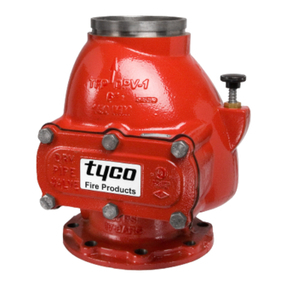
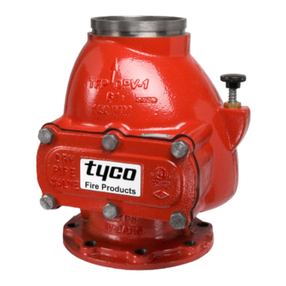
The TYCO Model DPV-1 Dry Pipe Valve
is a differential type valve that utilizes
a substantially lower system (air or ni-
trogen) pressure than the supply (wa-
ter) pressure, to maintain the set posi-
tion shown in Figure 4A. The differential
nature of the Model DPV-1 Dry Pipe
Valve is based on the area difference
between the air seat and the water seat
in combination with the ratio of the ra-
dial difference from the Hinge Pin to the
center of the Water Seat and the Hinge
Pin to the center of the Air Seat. The
difference is such that the Model DPV-1
has a nominal trip ratio of 5,5:1 (water
to air).
Table A establishes the minimum re-
quired system air pressure that includes
a safety factor to help prevent false op-
erations that occur due to water supply
uctuations.
The Intermediate Chamber of the
Model DPV-1 Dry Pipe Valve is formed
by the area between the Air Seat and
Water Seat as shown in Figure 4B. The
Intermediate Chamber normally re-
mains at atmospheric pressure through
the Alarm Port connection and the valve
trim to the normally open Automatic
Drain Valve (Ref. Figures 8 through
15). Having the Intermediate Chamber,
Figure 4B, open to atmosphere is criti-
cal to the Model DPV-1 Valve remaining
set, otherwise the full resulting pressure
of the system air pressure on top of the
Clapper Assembly cannot be realized.
For example, if the system air pres-
sure is 1,7 bar and there was 1,0 bar
pressure trapped in the Intermediate
Chamber, the resulting pressure across
the top of the Clapper would only be 0,7
bar. This pressure would be insufcient
to hold the Clapper Assembly closed
against a water supply pressure of 6,9
bar.
When one or more automatic sprin-
klers operate in response to a re,
air pressure within the system piping
is relieved through the open sprin-
klers. When the air pressure is suf-
ciently reduced, the water pressure
overcomes the differential holding
the Clapper Assembly closed and the
Clapper Assembly swings clear of the
water seat, as shown in Figure 4C. This
action permits water ow into the sys-
tem piping and subsequently to be
discharged from any open sprinklers.
Also, with the Clapper Assembly open,
the intermediate chamber is pressur-
ized and water ows through the Alarm
Port (Ref. Figure 4B) at the rear of the
Model DPV-1 Dry Pipe Valve. As the
ow through the Alarm Port exceeds
the drain capacity of the Automatic
Drain Valve, the alarm line is pres-
surized to actuate system water ow
alarms.
After a valve actuation and upon subse-
quent closing of a system Main Control
Valve to stop water ow, the Clapper
Assembly will latch open as shown
in Figure 4D. Latching open of the
Model DPV-1 Dry Pipe Valve will per-
mit complete draining of the system
(including any loose scale) through the
main drain port.
During the valve resetting procedure
and after the system is completely
drained, the external reset knob can
be easily depressed to externally un-
latch the Clapper Assembly as shown
in Figure 4E. As such, the Clapper
Assembly is returned to its normal set
position to facilitate setting of the dry
pipe sprinkler system, without having to
remove the Handhole Cover.
Accelerator
The Inlet Chamber of the TYCO Model
ACC-1 Dry Pipe Accelerator (Ref. Figure
6), is pressurized via its connection to
the system. The Pilot Chamber is, in
turn, pressurized through its inlet port
which is formed by the annular opening
around the lower tip of the Anti-Flood
Valve. As the Pilot Chamber increases
in pressure, the Differential Chamber
is pressurized through the Restriction.
The Accelerator is in its set position
while it is being pressurized as well
as after the Inlet, Pilot Chamber and
Differential Chamber pressures have
equalized. When in the Set position,
the Outlet Chamber is sealed off by
the Exhaust Valve which is held against
its seat by a combination of the Spring
pushing up against the Lever and the
net downward force exerted by the
pressure in the Pilot Chamber.
Both small and slow changes in system
pressure are accommodated by ow
through the Restriction. When, howev-
er, there is a rapid and steady drop in
system (that is, Inlet and Pilot Chamber)
pressure, the pressure in the Differential
Chamber reduces at a substantially
lower rate. This condition creates a net
downward force on the Plunger which
rotates the Lever. As the Lever is ro-
tated (Ref. Figure 7), the Relief Valve
is raised out of the Relief Port and the
Anti-Flood Valve is depressed down-
ward into the Pilot Chamber Inlet Port,
venting the Pilot Chamber.
The system pressure in the Inlet
Chamber then forces (raises) the
Exhaust Valve off its seat. This contin-
ues the rotation of the Lever into the
tripped (latched) position (Ref. Figure
7). As the Exhaust Valve is raised off
its seat, system pressure is transmitted
to the intermediate chamber of the Dry
Pipe Valve which neutralizes the dif-
ferential pressure holding the valve
closed.
Water and any water borne debris such
as silt is prevented from entering the
Pilot Chamber by virtue of the Anti-
Flood Valve having sealed off its inlet
port.
After the accelerator/Dry Pipe Valve
has tripped and the sprinkler system
has been drained, the piping from the
system to the Accelerator must also be
drained and the Accelerator reset/in-
spected according to the instructions
given in the Valve Setting Procedure
section.
The rate-of-ow through the
Restriction has been set such that
the Model ACC-1 Dry Pipe Valve
Accelerator provides the maximum
practical sensitivity to a loss in system
pressure due to a sprinkler operation
while still being capable of automatical-
ly compensating for normal variations
in system pressure such as are caused
by environmental temperature changes.
A test for verifying that the rate-of-ow
through the Restriction is within the
range for optimum Accelerator per-
formance is given in the Valve Setting
Procedure section.