Dry Pilot
Actuation
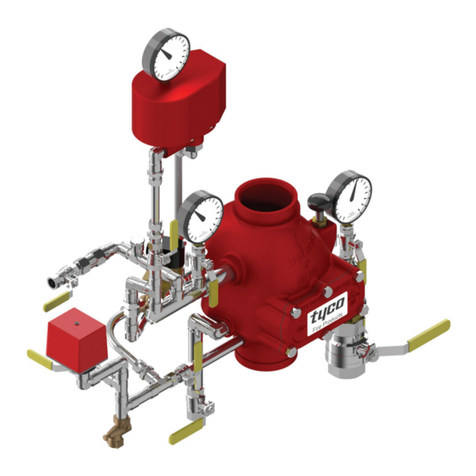
The Dry Pilot Actuation Trim provides
for installation of a detection system
consisting of dry pilot sprinklers (heat
detectors) and manual control stations
interconnected with minimum 1/2 inch
(DN15) steel pipe. The pilot line, which
is to be pressurized with air or nitro-
gen, is connected to the “Dry Pilot De-
tection” connection shown in Figures 7
and 12. Provision must be made for a
5.6 K-factor orifice, Inspector’s Test
Connection at the most remote loca-
tion from the DV-1 Valve. Nominal in-
stallation dimensions for Dry Pilot Ac-
tuation Trim are shown in Figure 7.
The Dry Pilot Actuation Trim is pro-
videdwithalistedand approvedModel
DP-1 Dry Pilot Actuator, which is de-
scribed in Technical Data Sheet
TFP1380.TheActuatorisratedforuse
at a maximum pilot service pressure of
50 psi (3,4 bar) and a maximum water
supply service pressure of 175 psi
(12,1 bar).
Operation of a pilot sprinkler or open-
ing of a manual control station re-
leases pneumatic pressure from the
pilot line. In turn, the Dry Pilot Actuator
opens resulting in a rapid pressure
drop in the Diaphragm Chamber of the
DV-1 Valve, and the force differential
applied through the Clapper Latch
which holds the Clapper down in the
set position is reduced to below the
valve trip point.
Dry pilot sprinklers are to be minimum
5.6 K-factor orifice listed or approved
automatic sprinklers. Manual Control
Stations are to be the Model MC-1
described in Technical Data Sheet
TFP1382.
Graph C shows the“minimum pilot line
service pressure” as a function of the
water supply pressure. The pressure
in the dry pilot actuation system must
be automatically maintained using one
of the following maintenance devices,
as appropriate.
•Model AMD-1 Air Maintenance De-
vice (pressure reducing type), refer
to Technical Data Sheet TFP1221.
•Model AMD-2 Air Maintenance De-
vice (compressor control type), refer
to Technical Data Sheet TFP1231.
•Model AMD-3 Nitrogen Mainte-
nance Device (high pressure reduc-
ing type), refer to Technical Data
Sheet TFP1241.
NOTES
The dew point of the pilot line air pres-
sure must be maintained below the
lowest ambient temperature to which
the dry pilot actuation system will be
exposed. Accumulation of water in the
pilotlineconnectiontothe Actuatorwill
lower the air pressure at which the
Actuator will open and possibly pre-
vent proper operation. Also, introduc-
tion of moisture into the pilot lines ex-
posed to freezing temperatures can
create an ice buildup which could pre-
vent proper operation of the Actuator.
An air dryer must be installed where
the moisture content of the air supply
is not properly controlled at less than
the required value.
It is recommended that an AMD-3 Ni-
trogen Maintenance Device be utilized
in dry pilot actuation system applica-
tions where the dew point must be
maintained below -20°F/-29°C. See
Technical Data Sheet TFP1241.
It is recommended that internally gal-
vanized pipe and cast iron fittings be
used for dry pilot lines.
Supervision of the pressure in the dry
pilot actuation system and/or alarm
which separately indicates operation
of the detection system is recom-
mended and may be required by the
authority having jurisdiction. A dual
setting low pressure alarm switch,
such a PotterElectric PS40-2A,is suit-
able for the service. The recom-
mended pressure settings are as fol-
lows:
•Low pressure alarm setting at ap-
proximately 6 psi (0,4 bar) below the
minimum pilot line service pressure
requirement shown in Graph C.
•Fire alarm setting at approximately
15 psi (1,0 bar) below the minimum
pilot line service pressure require-
ment shown in Graph C.
The Pressure Relief Valve (Ref. Item
D6 - Fig. 6) is factory set to relieve at
apressureofapproximately45psi(3,1
bar); however, it may be field adjusted
to a lower pressure, if required.
Page8of20 TFP1330