7
INSTRUCTIONS (continued)
To unroll the bale, simply lower the bale to the ground
and drive forward slowly. It may be necessary to contin-
ue lowering the bale to keep it in contact with the ground.
Keep a lookout forward to avoid any obstacles or
livestock that might be in the way.
When you have unrolled the amount of hay you want to
feed, raise the 3 pt. hitch and the bale will stop unrolling
hay. Drive the unit outside the feeding area and the bale
may be released for feeding the remainder at a later time.
A heavy load can cause your tractor to tip over.
When moving heavy loads, keep the load low, go
slowly around turns, and be sure front of the tractor
is properly counterbalanced with weights.
Make sure brakes are securely set before getting
off the tractor. NEVER place any part of your body
under the raised bale when removing twine or
netting from the bale.
When moving large round hay bales to a storage
area – make sure storage area you select is level and
that the hay bale will not roll when released. A rolling
hay bale is dangerous and could cause injury or
death.
Be careful when backing up with a bale on the back
of the tractor. Remember – visibility is limited. Check
area carefully before backing.
OPERATION
——————————————————
Make sure all operators have read all the safety
warnings and precautions in this manual and those in the
tractor operator’s manual.
Be sure tractor is properly counterbalanced with
weights before attempting to lift any load with the HHU-
2045 Attachment.
If you are handling bales with both the front end loader
and the 3 pt. hitch on the tractor, always load the 3 pt.
attachment first and unload last.
Before using the Hay Handler/Unroller always raise
the parking stand and pin in the raised position.
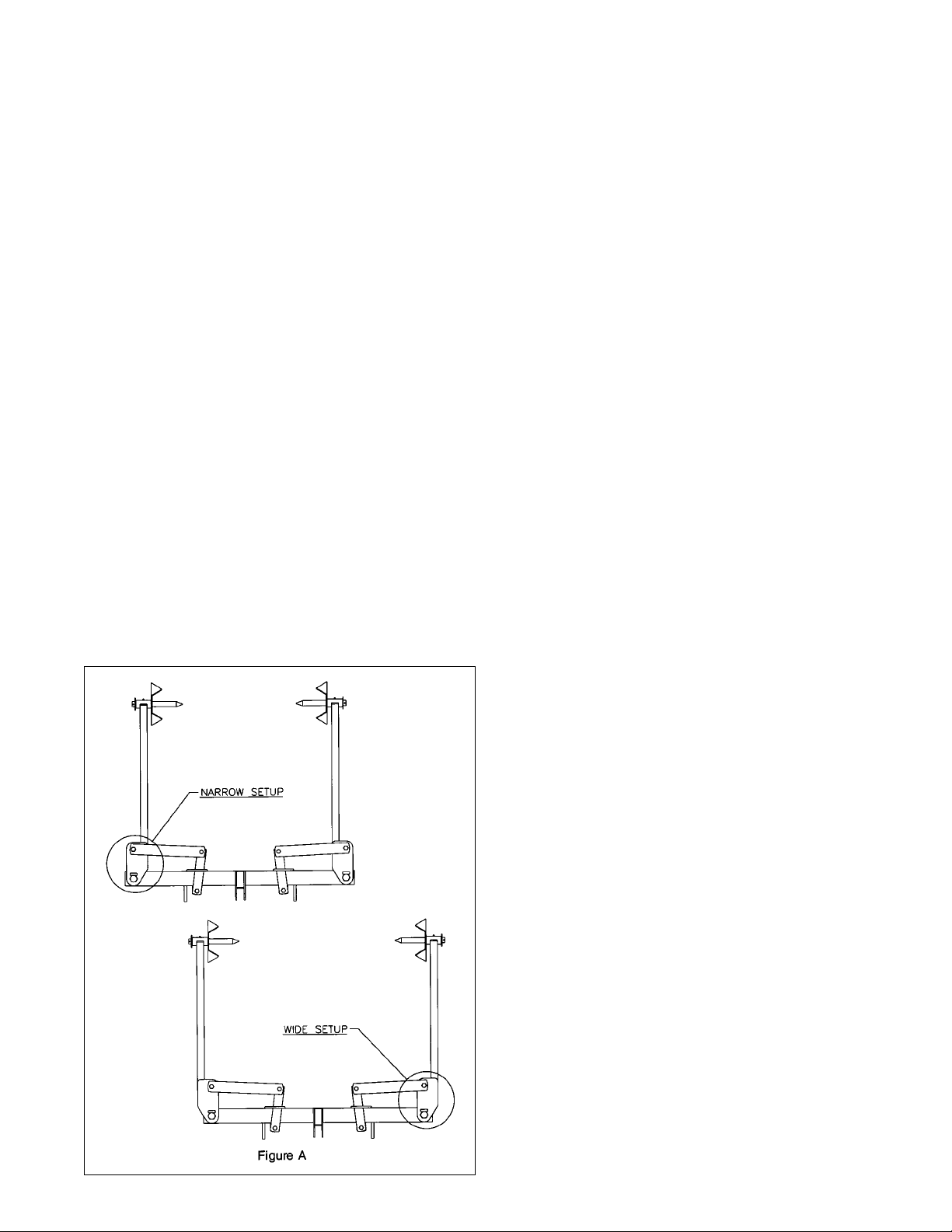
The Hay Handler/Unroller can be tilted within a wide
range by choosing one of three (3) hole positions in the
mast and by adjusting the top link. This adjustment range
allows you to vary the height so that the clamp arm can
be raised to best handle your size bales.
Before attempting to move or unroll a large round hay
bale, examine the bale and determine which way the bale
is wrapped. The bale needs to be gripped so it will unroll
from the bottom as it is rolled forward on the ground.
Position your tractor square with the bale and open the
clamp arms all the way. Back the tractor until the spike
spinners are close to the center of the bale. Bales should
be gripped at the center of the ends of the bale only.
Close the clamp arms until the bale is gripped securely
between the two spike spinner assemblies and raise the
tractor’s 3 pt. hitch.
The bale is ready for transport.
NOTE: In cold weather, a bale frozen to the ground may
exceed the lifting capacity of HHU-2045 implement.
Damage to implement may occur. Not covered under
warranty.
When storing the Hay Handler/Unroller, lower the park-
ing stand and pin. This will allow easy disconnect and
re-connection with a Quick Hitch.
MAINTENANCE & STORAGE
——————————————————
Periodically lubricate all pivot points and spinner
assemblies with a good grade of grease.
Check all bolts to make sure they are properly tight-
ened.
Check hydraulic hoses and fittings for leaks and
replace or tighten as necessary. Make sure hoses are not
being pinched or chafed by movement of unit or 3 pt. hitch
linkage.
Replace safety decals if damaged or missing.
Storage location should be level and solid to make
hitching and unhitching easy. Store in a clean, dry loca-
tion away from children and livestock.
UNROLLING HAY BALE
——————————————————
The Hay Handler/Unroller allows you to change your
feeding area and eliminate the manure piles that can
occur when using hay feeders.
You can control how much hay is fed to eliminate waste.
Feed only an amount of hay that the cattle will clean up in
one feeding.You may need to experiment with the amount
for a few days to establish the correct amount. Allow for
badly damaged or weathered hay.
By unrolling the hay in a long ribbon, all cattle have an
equal opportunity to eat and the cattle are in a line for
easy examination.
Before unrolling the bale, it is necessary to remove the
twine or netting from the bale.
CAUTION
CAUTION
CAUTION
CAUTION