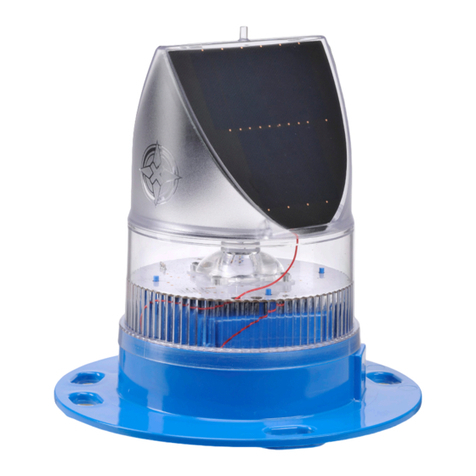
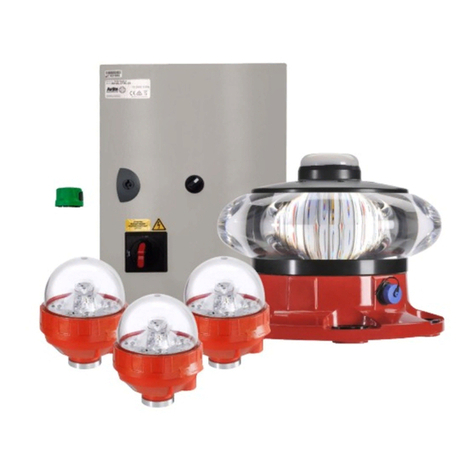
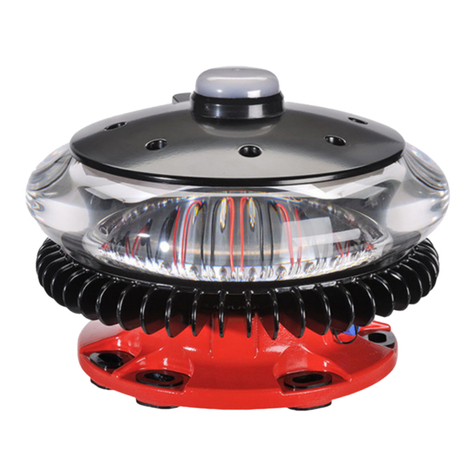
10 Medium Intensity Obstruction Light
AV-OL-MI
6.0 Operation and Setup
When powered up, the light will constantly check day/night status using its internal ambient light sensor. The ambient
light sensor averages its measurement for 30 seconds.
FAA: By default the lights turn ON when the ambient light decreases to not less than 35 footcandles (376.7 lux) and
turn OFF when the ambient light decreases to not more than 60 footcandles (645.8 lux).
ICAO: By default the lights turn ON when the ambient light decreases to not less than 100 lux and turn OFF when the
ambient light increases to not more than 150 lux.
If the light detects a LED failure the alarm relay can be used to provide a feedback to the user.In night mode, the MI is
illuminated red and either ashes (for ICAO Type B or FAA L-864) or remains steady burning (for ICAO Type C). In day
mode, the light will not be illuminated.
Light intensity & operation mode setting for FAA or ICAO compliant light xture
The xture will be supplied with either the FAA or ICAO compliant optic as specied by product type. The MI comes
preset to the intensity setting required to produce either an FAA (L-864) or ICAO (Type B or Type C) photometric
prole in dusk-till-dawn mode and does not need to be set by the user.
Note: The ICAO Model and FAA Model have their own unique optic. The ICAO model cannot be used for FAA purposes
and the FAA model cannot be used for ICAO purposes. The model required needs to be specied at the time of order.
6.1 GPS Syncronisation
Avlite has utilised the latest advancements in GPS technology to develop an internal synchronisation system that is
incorporated into the lights. Using overhead satellites, multiple obstruction lights set to the same ash pattern are able
to ash in synchronisation (for MI Type B or FAA L-864 during night operation only). No additional power supplies,
aerials or control systems are required, and with its microprocessor- based system, the GPS option is specically
designed to provide maximum reliability and performance over a wide range of environmental conditions.
Operating Principle
Each light operates independently and requires no operator intervention. A minimum of 4 satellites need to be in view
for the built-in GPS receiver to collect time data. At dusk, the light sensor will turn the light on. If time data is available,
the MI will come on synchronised to every other obstruction light with the same selected ash code. Synchronisation is
achieved using an internal algorithm based on the highly accurate time base and time data received from the satellites.
The satellite data is provided from a number of earth stations using atomic clocks as the time base. Continuous self-
checking ensures that the lights will continue to run in synchronisation.
Light Activation
At power-up the microprocessor checks that the internal GPS module is programmed correctly and is able to provide
valid time base and time data. Once outside with a clear view of the sky, valid data should become available within 20
minutes.
Note: Lights will not synchronise if dierent ash codes are selected.