7
CHAPTER 4: Operation
4. Operation
Operating your Dual System Video
Converter is very simple. There are
few controls to adjust and no hidden
DIP switches to set. The Converter
will feel warm when operating. This
is normal. To avoid overheating, do
not place any object on top of the
Converter.
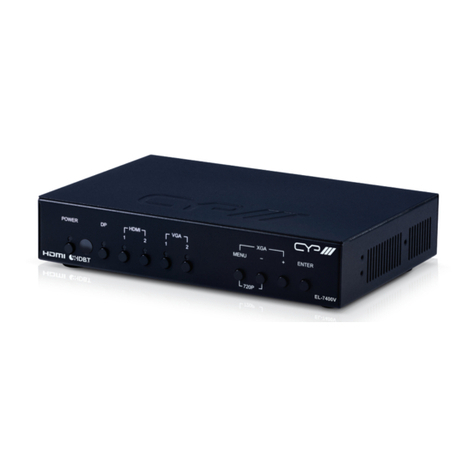
4.1 Indicators
The red POWER indicator lights up
when your Converter is receiving DC
power. If this light is glowing dimly
or not at all, there might be
something wrong with the external
power supply. See Chapter 6.
The green LOCK indicator lights
when the Converter is receiving a
valid computer signal through the
COMPUTER IN connector on its
rear panel. Which video-display
mode the Converter will use
depends on the monitor attached
to the COMPUTER port (see
Section 4.3).
4.2 Front-Panel Controls
UNDERSCAN: When this switch
is in the NORMAL position, images
that the Converter outputs in
Composite, S-Video, and RGBS
formats will fill the entire viewable
screen area. Because some monitors
“overscan” their screens, some
desirable parts of your images could
be cropped off of the screen. If this
is the case, flip this switch to the
UNDERSCAN position to shrink
the images, both horizontally and
vertically, approximately 10% in size.
FLICKER REDUCTION: When
this switch is in the NORMAL
position, the Converter sends images
using fully interlaced Composite,
S-Video, and RGBS video signals.
However, thin horizontal lines in
the images might appear to “flicker”
on and off at a very fast rate. This
annoying flicker, if present, can be
virtually eliminated by setting this
switch to the FLICKER REDUCTION
position. There is a trade-off with this
feature: you might notice a slight loss
of vertical resolution, detail, or
brightness.
FREEZE IMAGE: You might want
to freeze an image on the screen
without altering or discontinuing
your software application. If this
switch is moved to the FREEZE
IMAGE position, the image on the
Composite, S-Video, and RGBS
outputs is frozen. It will remain
frozen until you move the switch
back to the NORMAL position,
at which time whatever image is
currently being received through
COMPUTER IN will be displayed.