WARNING
1. Always check that the circuit breaker in the electrical panel is in the
OFF position, and that all high voltage circuits (more than 42.4V) are
completely isolated from the mains supply before doing any work.
2. Ensure that all low voltage systems (Less than 42.4V) are suitably
protected from damage, by disconnecting all sources of power such
as chargers and batteries before doing any work.
3. All electrical work must be carried out according to the requirements
of all applicable local electrical codes.(It is recommended that a
licensed electrical contractor perform such work.)
CONNECT ALL WIRING
1
!
!
Connect all cables as required to the control card and battery charger (See
Figure 11 & 12). (IM page 48 & 49)
Check that the power source jumper is in the correct position. (PSU or STD
refer to IM page 27, Fig. 24)
Figure 9 Cabling Requirements
1
2
4
5
6
7
3
To dwelling
Isolator
Box
6
10 11
10
SET THE CONNECTING ARM LENGTH
!
!
!
!
!
!
!
!
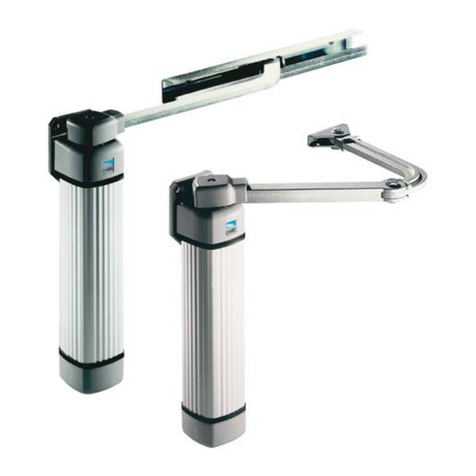
Loosen the connecting arm slightly and move it to its fully retracted position.
Open the gate ½ way.
Assemble the connecting arm to the gate bracket.
Now slowly push the gate to its closed position. (The drive arm will turn, and
the connecting arm will extend while doing so)
Check that the hinge points of the gate bracket, connecting arm and motor
output shaft are in a straight line as shown in Figure 8.
Carefully unhook the connecting arm from the gate bracket and tighten
lightly.
Check the gate opens and closes sufficiently by manually operating the
gate.
!
!
Fully tighten connecting arm.
Apply the warning decals supplied to either side of the gate frame.
IF THE GATE OPENS TOO LITTLE
IF THE GATE OPENS TOO MUCH
Lengthen the drivearm by 10 mm and readjust the connecting arm.
Shorten the drivearm by 10 mm and readjust the connecting arm.
NB. Hinge points must be in a
straight line when gates are closed
GATE LEAF IN CLOSED POSITION
Figure 8 Align Gates
ALIGNMENT OF HINGE POINTS
Electrical Set-UpElectrical Set-Up