8
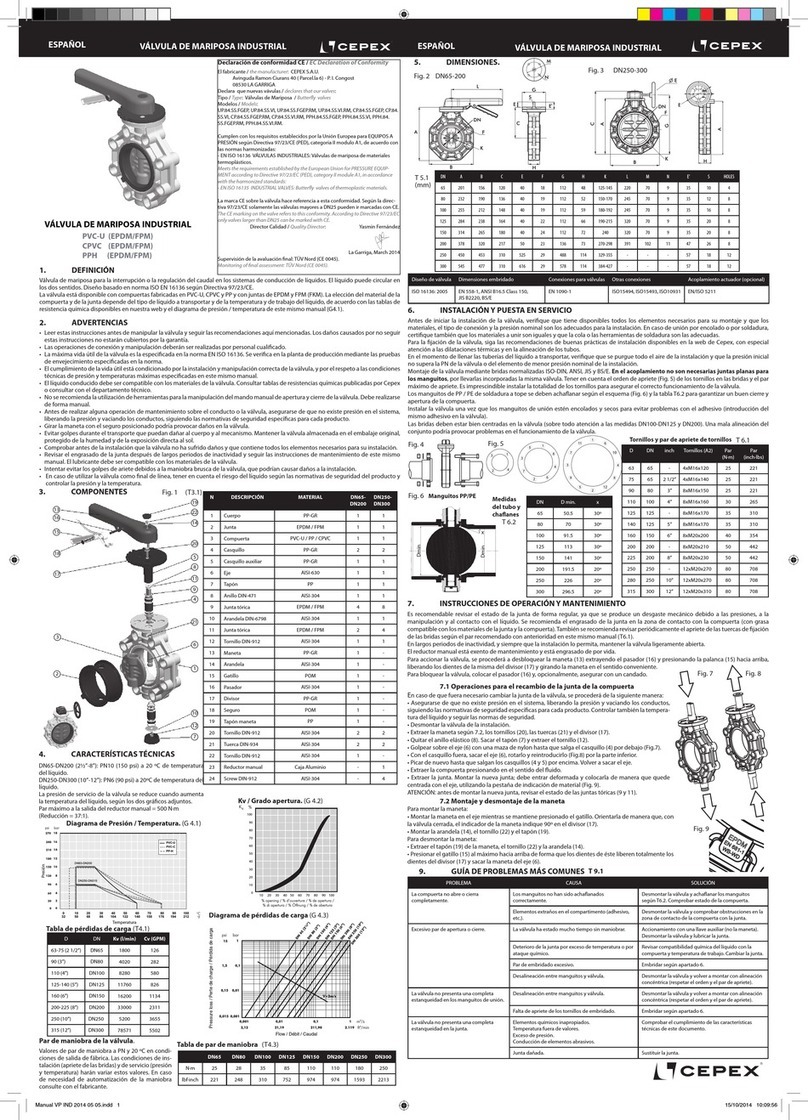
7.2 Assembling and Removing the Handle
To assemble the handle:
Fit the handle on the shaft while holding the lever. Place it so that, with the valve closed, the handle
indicator shows 90º on the throttle plate (21).
Fit the washer (16), screw (26) and cap (23).
To remove the handle:
Remove the round cap (23) from the handle, the screw (26) and the washer (16).
Press the lever (17) fully upwards so that its teeth are fully disengaged from the teeth on the
throttle plate (21). Remove the handle from the shaft (7).
7.1 Replacing the Sealing Gasket
Should it be necessary to replace the sealing gasket, proceed as follows:
· Ensure that the system is depressurised by releasing the pressure and emptying the pipes, fo-
llowing the specic safety regulations of each product. Also check the temperature of the liquid
and follow safety standards of temperature.
· Remove the valve from the installation.
· Remove the handle as per 7.2, screws (24), nuts (25) and throttle plate (21).
· Remove the ring (9). Take o the cap (8) and remove the screw (14).
· Tap on the shaft (7) with a rubber mallet until the bearing (14) is exposed from the bottom (Fig. 7).
· Once the bearing is out, remove the shaft (7), turn it and re-insert it (Fig. 8) from the bottom.
· Tap again until the bearings (5 and 6) emerge from the top. Remove the shaft again.
· Remove the disc by pressing in the direction of the uid.
· Remove the sealing gasket. Fit the new sealing gasket; it needs to be warped and placed so that it
lines up with the shaft, according to the indication tab of the gasket (Fig. 9).
WARNING: Before installing the new gasket, check the condition of the O-rings (10, 11 and 13).
Fig. 7 Fig. 8
7. OPERATION AND MAINTENANCE INSTRUCTIONS
It is recommended that the condition of the sealing gasket is checked regularly, since it may display signs of mechanical wear due
to pressure, handling and contact with the liquid. The sealing gasket should be greased in the disc contact area (the grease must
be compatible with the materials of the gasket and the disc). It is also advisable to check regularly that the ange xing nuts are
tightened correctly, as per the recommended torque values specied above (T6.1).
In long periods of inactivity, and in case that the installation allows it, maintain the valve slightly open. It is recommended to force a
periodic movement to avoid the lock of the valve in long periods of time in closed position. It is advisable to pass the liquid before
maneuvering the valve.
The manual gearbox is maintenance-free and greased for life.
To operate the valve, unlock the handle (13) removing the pin (16) and pulling the lever (15) upwards, releasing its teeth from the
throttle plate (15), then turning the handle in the appropriate direction.
To lock the valve, insert the pin (16) and, optionally, secure with a padlock.
Fig. 9
8. SOLUCIÓN DE PROBLEMAS T 8.1
FAULT POSSIBLE CAUSE FAULT CLEARANCE
The disc does not fully open or
close.
The sockets were not correctly bevelled. Disassemble the valve and bevel the sockets as indicated
in table T6.2.
Foreign materials in the compartment (adhesive, etc.). Disassemble the valve and check for obstructions in the
disc and gasket contact area.
Excessive opening or closing
torque.
The valve has been inactive for a long time. Operate with an auxiliary release key (not plastic handle).
Disassemble the valve and lubricate the sealing gasket.
Overtemperature or chemical attack cause damage to
the gasket.
Check the chemical compatibility of the liquid with the
disc and the working temperature. Replace the gasket.
Excessive ange torque. Tighten anges as indicated in section 6.
Misalignment between sockets and valve. Disassemble the valve and reassemble with concentric
alignment (observe the correct tightening sequence and
torque).
The valve is not fully watertight at
the sockets.
Misalignment between sockets and valve. Disassemble the valve and reassemble with concentric
alignment (observe the correct tightening sequence and
torque).
Flange screws not tight enough. Tighten anges as indicated in section 6.
The valve is not completely
watertight at the sealing gasket .
Inadequate chemicals.
Temperature out of range.
Excess pressure.
Conduction of abrasive elements.
Check compliance with the specications in this
document.
Damaged sealing gasket. Replace the gasket.
ENGLISHEXTREME BUTTERFLY VALVE