manuals.online logo
Brands
  1. Home
  2. •
  3. Brands
  4. •
  5. Chino
  6. •
  7. Controllers
  8. •
  9. Chino KP3000 User manual

Chino KP3000 User manual

Other Chino Controllers manuals

Chino LT830 Series User manual

Chino

Chino LT830 Series User manual

Chino CP350 Series User manual

Chino

Chino CP350 Series User manual

Chino KP 2000 Series User manual

Chino

Chino KP 2000 Series User manual

Chino KP1000 User manual

Chino

Chino KP1000 User manual

Chino DB600 Series User manual

Chino

Chino DB600 Series User manual

Chino JU Series User manual

Chino

Chino JU Series User manual

Chino JW Series User manual

Chino

Chino JW Series User manual

Chino DB600 Series User manual

Chino

Chino DB600 Series User manual

Chino DB630E User manual

Chino

Chino DB630E User manual

Chino DB600 Series User manual

Chino

Chino DB600 Series User manual

Chino GT120 Series User manual

Chino

Chino GT120 Series User manual

Chino LT300 Series User manual

Chino

Chino LT300 Series User manual

Popular Controllers manuals by other brands

Sunricher SR-ZV9003T3-RGBW-US Installation

Sunricher

Sunricher SR-ZV9003T3-RGBW-US Installation

Ksenia intro Installation and configuration manual

Ksenia

Ksenia intro Installation and configuration manual

Inovance CAN200 Series manual

Inovance

Inovance CAN200 Series manual

Gauzy LC6 FLEX Controller Installation and operation guide

Gauzy

Gauzy LC6 FLEX Controller Installation and operation guide

Viking SLP-1 Technical practice

Viking

Viking SLP-1 Technical practice

CKD KBX-30E-U Series instruction manual

CKD

CKD KBX-30E-U Series instruction manual

Sharp Energy Sun Flux User manual & installation guide

Sharp Energy

Sharp Energy Sun Flux User manual & installation guide

Yamaha RCX40 user manual

Yamaha

Yamaha RCX40 user manual

AB Quality PowerFlex 400 Frames D-H Service bulletin

AB Quality

AB Quality PowerFlex 400 Frames D-H Service bulletin

Yamaha MJC8 owner's manual

Yamaha

Yamaha MJC8 owner's manual

AL-KO ATC operating instructions

AL-KO

AL-KO ATC operating instructions

Savant SmartControl 2 Deployment guide

Savant

Savant SmartControl 2 Deployment guide

GameSir T3S user manual

GameSir

GameSir T3S user manual

Kostal inveor operating manual

Kostal

Kostal inveor operating manual

Emerson Yarway 20-55 Operating and safety instructions

Emerson

Emerson Yarway 20-55 Operating and safety instructions

CoCo ACM-LV24 Quick installation guide

CoCo

CoCo ACM-LV24 Quick installation guide

Brooks SLA5810/20 Installation and operation manual

Brooks

Brooks SLA5810/20 Installation and operation manual

SIGMA TEK SR 011 Technical manual

SIGMA TEK

SIGMA TEK SR 011 Technical manual

manuals.online logo
manuals.online logoBrands
  • About & Mission
  • Contact us
  • Privacy Policy
  • Terms and Conditions

Copyright 2025 Manuals.Online. All Rights Reserved.

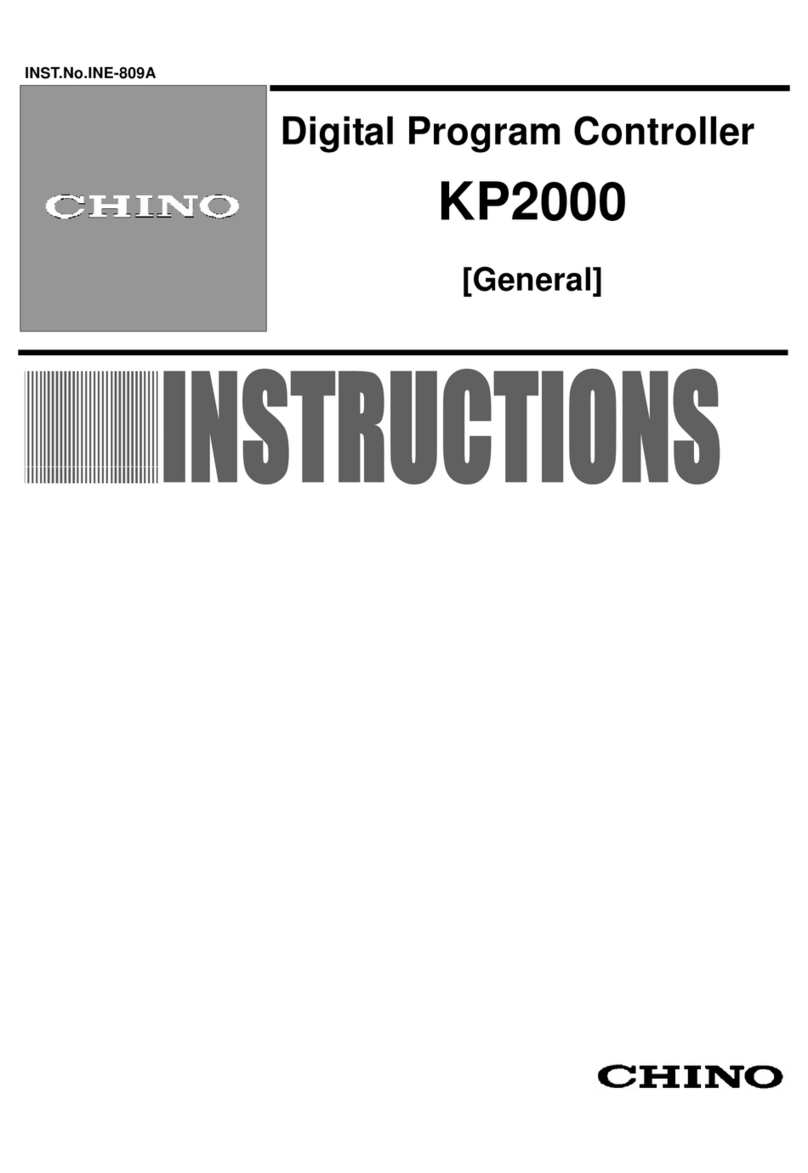
INST.No.INE-812A
Digital Program Controller
KP3000
COMMUNICATIONS
INTERFACES
Retain this manual apart from the instrument
and in an easil
y
accessible
p
lace.
Please make sure that this manual is handed to the final user of the instrument.
1. Introduction ...........................................- 1 -
2. For safe use of the product..................- 2 -
2-1 Prerequisites for use ..........................- 2 -
2-2. Symbol mark ......................................- 2 -
3. Overview ................................................- 3 -
3-1. RS-232C communication interface...- 3 -
3-2. RS-422A/485 communication interface - 3 -
4. Communication Protocol .....................- 4 -
4-1. MODBUS Protocol .............................- 4 -
4-2. PRIVATE Protocol ..............................- 4 -
5. Communication Specifications ...........- 5 -
5-1. MODBUS.............................................- 5 -
5-2. PRIVATE..............................................- 5 -
6. Setting the parameters for PC
communication .....................................- 6 -
6-1. Communication speed (COM BIT RATE)
............................................................- 7 -
6-2. Set device number (COM NUMBER) - 7 -
6-3. Set the communication function (COM
KIND) ..................................................- 7 -
6-4. Setting communication protocol (COM
PROTOCOL).......................................- 8 -
6-5. Setting communication character (COM
CHARACTER) ....................................- 8 -
7. Wiring...................................................- 10 -
7-1. Precautions while wiring.................- 10 -
7-2. Cable for communication................ - 11 -
7-3. RS-232C connection........................- 14 -
7-4. Wiring of RS-422A/485 ....................- 15 -
8. MODBUS protocol...............................- 16 -
8-1. Message transmission mode..........- 17 -
8-2. Data time interval.............................- 18 -
8-3. Message configuration....................- 18 -
8-4. Method of creating a message .......- 25 -
8-5. Function code ..................................- 26 -
8-6. Process during abnormality ...........- 30 -
8-7. Reference table ................................- 32 -
8-8. MODBUS protocol support reference
table..................................................- 53 -
9. PRIVATE protocol............................... - 59 -
9-1. Difference between RS―232C and
RS-422A/485.................................... - 59 -
9-2. Basic procedure of communication- 61 -
9-3. Communication format................... - 63 -
9-4. Positive response and negative
response.......................................... - 70 -
9-5. Communication time chart ............. - 72 -
10. Communication (Digital) transmission - 74 -
10-1. Overview ........................................ - 74 -
10-2. Specifications of communication
division............................................ - 75 -
10-3. Communication transmission
setting ............................................. - 76 -
10-4. Wiring ............................................. - 77 -
10-5. Example of combination............... - 78 -
11. Appendix ...........................................- 79 -
11-1. Communication format list ........... - 79 -
Table of Contents

-1-
1. Introduction
Thank you for purchasing Digital Program Setter 'KP3000 series'.
KP 3000 series is Digital Program Setter with output accuracy of ±0.1%, output update cycle of
approximately 0.1 seconds and front size of 96X96mm.
Up to 30 types of program patterns etc. are various functionalities that are provided as standard
provisions. Besides a digital indicator with large easy to view LED display, various settings have an
interactive system with high resolution dot matrix LCD display and handling is also easy with precise
control.
Understand the setter properly and read this instruction manual beforehand in order to avoid any
trouble.
This is a 'Communication' instruction manual. For general specifications, read 'General' instruction
manual along with this manual.
1. You should not copy or forward fully or partially this document without prior notice.
2. The contents of this document may be changed without notice.
3. We have taken enough care regarding the contents of this document however if at all you
notice a mistake or an omission contact our nearest office.
4. Please understand that regarding the result of the operation, whatever is the result the
company will not be responsible.
Notice
- For the persons doing instrumentation, installation and sales -
Be sure to handover this instruction manual to the persons using the controller.
- For the users of the controller -
Preserve this instruction manual until you scrap the controller.
Request
-2-
2. For safe use of the product
In order to use the controller safely, read the following precautions and understand them.
2-1 Prerequisites for use
The controller is a general product of component type that is to be used by mounting it in a panel for
instrumentation inside a room. Do not use it in any other condition.
When using, design a fail safe on the final product side and review regularly and use the controller after
confirming the safety of the system. For the wiring, adjustment and operation of the controller, contact a
professional having knowledge of instrumentation.
It is necessary that the people actually using this controller read this instruction manual, and have enough
understanding of various precautions and the basic operations of the controller.
2-2. Symbol mark
The following symbol marks are used in the product itself and in this instruction manual hence
understand the meaning of these symbol marks properly.
Symbol mark Meaning
If there is a possibility of death or severe injuries then explain the
precautions to avoid that possibility.
If there is a possibility of small injuries or a possibility of the controller or
its nearby devices getting damaged then explain the precautions to avoid
those possibilities.
It is a symbol for ground terminal. Always connect the ground terminal to
protective grounding.
Warning
Precaution
-3-
3. Overview
RS-232C, RS-422A, RS-485 are available in communication interface of KP and are used for
communication with personal computer (hereinafter referred to as PC).
PC can receive measurement data from KP, various parameters can be set and operation commands
can be issued. Number of KP connections is 1 for RS-232 and maximum 31 for RS-422A, RS-485.
3-1. RS-232C communication interface
RS-232C is the data communication standard set and executed by Electronic India Alliance (EIA) and
Japanese equivalent for that is JIS C 6361.
This standard is basically an interface with modem and data terminal device connected to it and only
electrical and mechanical specifications are given.
Presently RS-232C communication interface that is used in industrial instruments like PC and DB
series, only some of them completely conform to the above standards, and signal wire count and
connectors for connection etc. may sometimes differ from the standards.
As nothing is specified about the software part or what we call 'data transmission procedure' it does not
mean that the devices that RS-232C communications interface can be connected unconditionally.
Hence, it is necessary that the designer investigates and confirms the specifications and transmission
procedure of the mutual device. However if the connection partner is able to program those specifications
optionally like the PC, the designer, by creating the appropriate program, can combine it with almost all
the devices.
When investigating the RS-232C standards, the method of referring to JIS C 6361 is the simplest
method.
3-2. RS-422A/485 communication interface
RS-422A/485 communication interface can communicate by connecting in parallel the KP series of a
number of machines (maximum 31) through the signal that conforms to RS-422A/485.
PCs that have RS-422A/485 communication interface are less however as it is a serial communication,
connection can be easily done by using RS232C RS-422A/485 signal converter.
Line converter (Our company model: SC8-10) for RS-232C RS-422A/485 signal conversion is
available with our company. You may order it from us.
Difference between RS-422A and RS-485 is that RS-422A uses 4 signal wires whereas RS-485 uses 2
signal wires.
-4-
4. Communication Protocol
KP has the following two protocols and switching can be done by front key settings.
4-1. MODBUS Protocol
MODBUS is a registered trademark of SCHNEIDER company.
MODBUS protocol has two modes namely RTU mode and ASCII mode and switching can be done
using front key settings. It has the transmission function of measurement data and settings, operation
function.
4-2. PRIVATE Protocol
PRIVATE is usual CHINO protocol.
Switching is done by setting the front key. It has the transmission function of measurement data and
settings, operation function.
Old instrument of CHINO products is compatible with new instrument, however the parameter,
which can not be set by PRIVATE, can be set by MODBUS. We recommended using MODBUS
protocol if communication is set newly.
-5-
5. Communication Specifications
5-1. MODBUS
・Communication system : Half duplex asynchronous system (Polling selecting system)
・Protocol : MODBUS protocol
・Communication speed : 38400,19200,9600,4800,2400bps switching
・Start bit : 1 bit
・Data length : 7 bits (ASCII mode)
8 bits (RTU mode/ASCII mode)
・Parity bit : None/even/odd
・Step bit : 1 bit/2 bits
・Transmission code : ASCII (ASCII mode)
Binary (RTU mode)
・Error check : LRC (ASCII mode)
(Error detection) CRC-16 (RTU mode)
・Data transmission procedure : No procedure
・Usage signal name : Sending and receiving data only(Without using the control signal)
5-2. PRIVATE
・Communication system : Half duplex asynchronous system (Polling selecting system)
・Protocol : PRIVATE protocol
・Communication speed : 38400,19200,9600,4800,2400bps switching
・Start bit : 1 bit
・Data length : 7 bits
・Parity bit : Even
・Stop bit : 1 bit
・Transmission code : ASCII code
・Error check : BCC (Block check character) Check sum
(Error detection)
・Data transmission procedure : No procedure
・Usage signal name : Sending and receiving data only (Without using the control signal)
-6-
6. Setting the parameters for PC communication
According to the flow chart, set these 5 parameters 'Communication speed', 'Device number',
'Communication function', 'Communication protocol' and 'Communication character'.
1. Click

key from the operation screen.
2. Select MODE 8 from 'Select MODE screen' using


key.
3. Set the following fields of Communication settings screen (MODE 8).
Communication (Option)
↓

key
Communication speed
Select the following communication speeds using


key
Register using

key
Setting range:2400,4800,9600,19200,38400
↓

key
Device number
(For RS-422/485)
Select instrument number using




key
Register using

key
Setting range: 01 to 99
↓

key
Communication function
Select the following communication function using


key
Register using

key
Setting range: COM, TRANS
↓

key
Communication Protocol
Select the communication protocol mentioned below
using


key
Register it using

key
Setting range: MODBUS (RTU), MODBUS (ASCII),
PRIVATE
↓

key
Communication
character
Select communication characters mentioned below
using the


key and register it using

key
Setting range: 7BIT/EVEN/STOP1,7BIT/EVEN/STOP2
7BIT/ODD /STOP1,7BIT/ODD /STOP2
8BIT/NON /STOP1,8BIT/NON /STOP2
8BIT/EVEN/STOP1,8BIT/EVEN/STOP2
8BIT/ODD /STOP1,8BIT/ODD /STOP2
In case of PRIVATE, the setting is 7BIT/EVEN/STOP1.
-7-
6-1. Communication speed (COM BIT RATE)
Use KP and PC in same communication speed. (Usually initial value can be 9600 bps.)
①Display ' COMBITRATE' using

key.
②Select communication speed using


key and register it using

key.
Communication speed: 2400bps, 4800bps, 9600bps, 19200bps, 38400bps, (Initial value is
9600bps)
6-2. Set device number (COM NUMBER)
Set the device number of KP at the time of RS-422A/485.
In single to multiple KPs that communicate with the PC, always do the settings such that one KP
does not overlap with the other KPs.
①'COM NUMBER' is displayed using the

key.
②Set device number (1 to 99) using




key, select it and register it using

key.
Precautions
①Device number should be in a range from 1 to 99 and it should not
overlap with the other KPs. (Initial value 1)
②In case of RS-232C, KP is connected to 1 machine but set the
device number. Usually initial value can be 1.
6-3. Set the communication function (COM KIND)
Set the communication function.
①Display 'COM KIND' using

key.
②Select communication function using


key and register it using

key.
③If 'COM' is selected, it becomes a high order communication function.
④If 'TRANS' is selected, it becomes communication transmission function.
Communication function: COM, TRANS