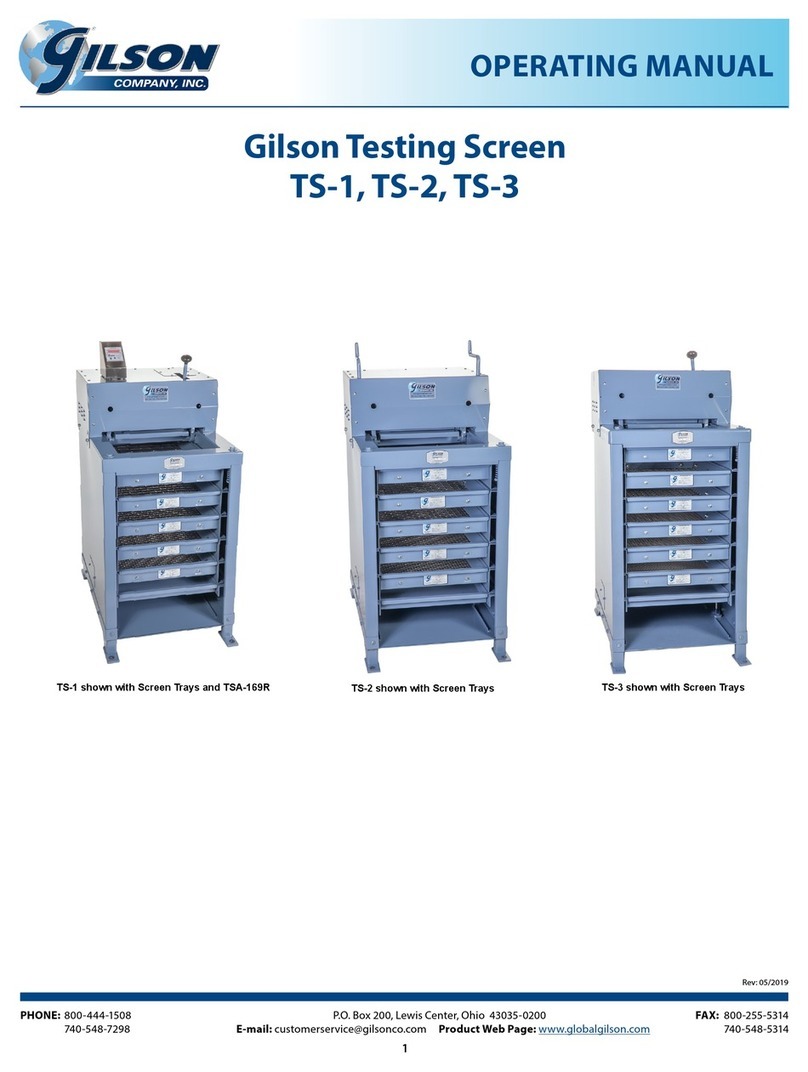
Gilson Company, Inc. Gilson Testing Screens: TS-1 & TS-2
Page 7
If the Testing Screen or the motor is overloaded, a
circuit breaker in the switch could disconnect the
power. If the machine stops in the middle of a test,
check the switch. If the RED button is halfway out,
the circuit breaker has tripped. Determine the cause
of the overload and correct it. To restart, push the
RED button all the way in, and then push the GREEN
button.
h. Turn OFF machine by pushing the RED button, and
unload the various screen trays and dust pan. Loaded
screen trays are not as light as they may appear. Use
common sense and proper equipment.
i. Unless you plan to continue operating the Testing
Screen, unplug or disconnect it, as this will eliminate
a tripping hazard and reduce electrical hazards.
4.1 Coarse Aggregates
The quantity of sample to be loaded is established by
test specifications and depends greatly on the type of
material and its particle size range. The ASTM C 136
specification for "Sieve or Screen Analysis of Fine and
Coarse Aggregates" calls for maximum screen loadings
for 14-3/4 x 22-3/4in (375x578mm) clear screen areas
as follows:
Maximum screen loading for materials denser than lime-
stoneaggregatesshouldbe adjustedaccordingly.Samples
can be run in two or more batches if necessary. The ca-
pacity of the screen for a given sample is determined by
the sample in the tray with the maximum load. A coarse
series size tray at completion of sieving should carry a
load limit equal to the amount of material needed for one
layer of particles over the wire cloth area.
If all tray slots are not required for a test, an intermediate
tray may be used to relieve loading on a critical tray and
allow the use of a larger test sample. Capacity is a function
of volume. Materials such as lightweight aggregate or coal
must be tested in somewhat larger amounts by weight.
Many light materials are also soft. Their test times should
be limited to avoid degradation of the sample.
If you get poor separation or loss of material from the trays
should first check the amount of sample on the individual
screen tray and adjust the sample size accordingly. Diag-
nosis should then proceed to checking for proper leveling
and looking for worn, broken or out-of-adjustment compo-
nents as described in Section 5.0, "Maintenance."
Remember that the ASTM minimum sample weights are
for representative samples. Initial sampling should always
be done by taking a much larger amount from several
areas in a storage bin or stockpile, then combining and
reducing the amount to a manageable size by splitting.
Gilson Sample Splitters are ideal for this purpose.
4.2 Fine Aggregates
The Testing Screen is designed primarily for operation in
the coarse size range of 4in to No.4. Separation of finer
materials is less efficient and fine particles may become
trapped behind side liners of trays causing test errors. For
separations of fine aggregates from No.8 through No.200,
loading at completion of sieving should be limited to the
ASTM C 136 level of 4g per square inch of sieving surface,
assuming a material about the density of sand. This is
equivalent to loading 1,350g (3lb) per tray and will result
in machine capacity in the fine aggregate range of under
20lb per test unless sizes are evenly distributed among
the trays. Somewhat larger amounts of material may be
loaded if the Testing Screen is used for mass separation
rather than for testing. Sharpness of separation will de-
crease as loading is increased, and overloads can cause
damage to valuable wire cloth.
For applications where test materials are limited to fine
series sizes, or where special screening problems exist
because of softness or density, the Testing Screen may
be factory-equipped with a Speed Variation Accessory.
A low-amplitude eccentric shaft is also available and
recommended when working exclusively with friable
materials.
4.0 SAMPLE CAPACITY
ASTM C 136 SAMPLE SIZES
Nominal Max. Size of Max. Screen
Particle, in (mm) Loadings, lb (kg)
No.4 (4.75mm) 5.7 (2.6)
3/8in (9.5 mm) 11.2 (5.1)
1/2in (12.5 mm) 14.8 (6.7)
3/4in (19.0 mm) 22.5 (10.2)
1.0in (25.0 mm) 29.8 (13.5)
1.5in (37.5 mm) 44.5 (20.2)
2.0in (50.0 mm) 59.5 (27.0)
2.5in (63.0 mm) 75.0 (34.0)
3.0in (75.0 mm) 89.3 (40.5)
3.5in (90.0 mm) 106.9 (48.5)
4.0in (100.0 mm) 118.8 (53.9)
5.0in (125.0 mm) 148.6 (67.4)