98 EnglishEnglish
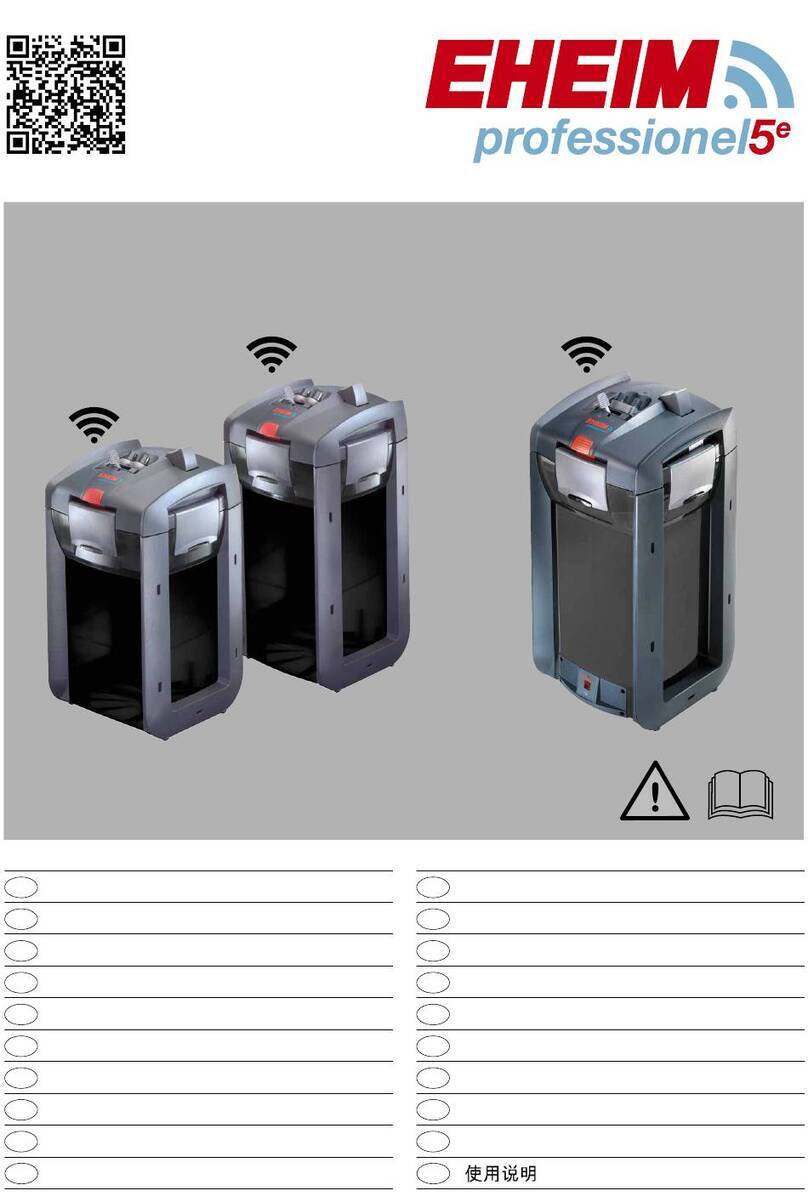
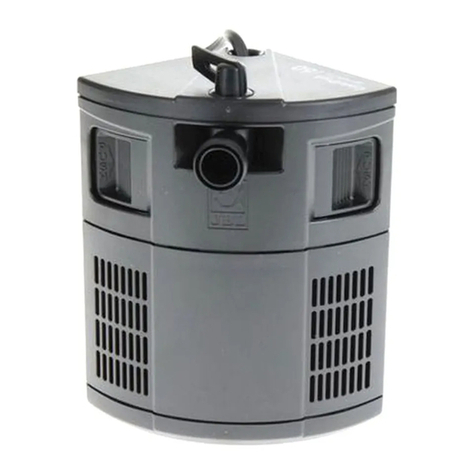
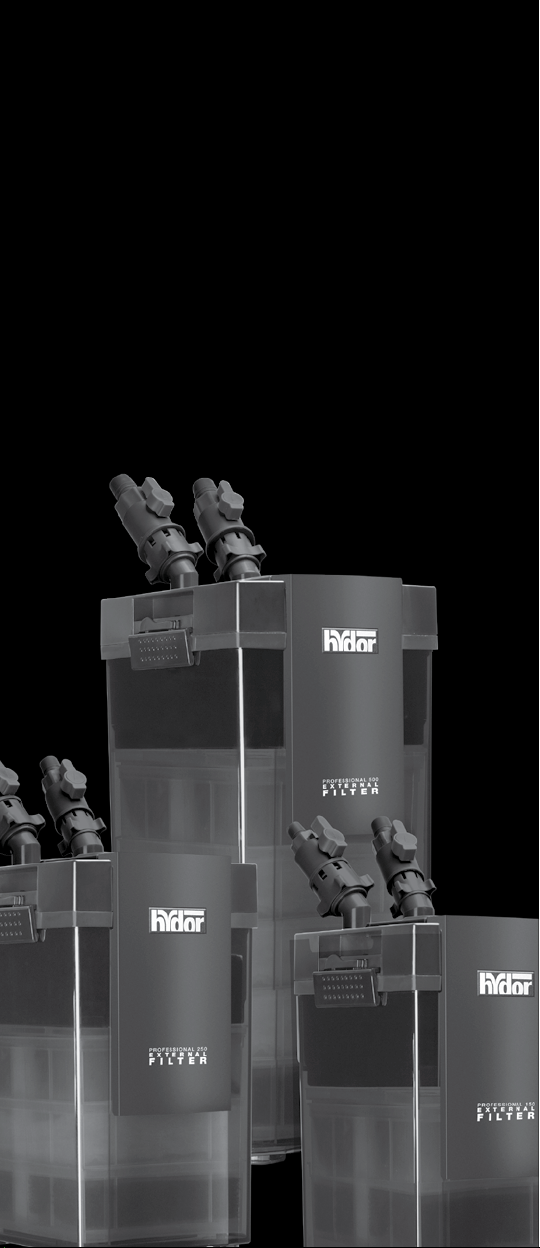
PROFESSIONAL external lter
Dear Customer,
Thankyoufor choosingthis product.The new PROFESSIONALlter oers anextremely
wide range, in which you are sure to nd the model best suited to your needs. The
PROFESSIONAL range of lters will also allow you to use the various ltering materials
available in a professional way, guaranteeing a ltering process specically tailored to
your aquarium. Please read the instructions below carefully, so you can get the best
out of your Professional lter and fully appreciate the features that make it truly one
of a kind.
Description
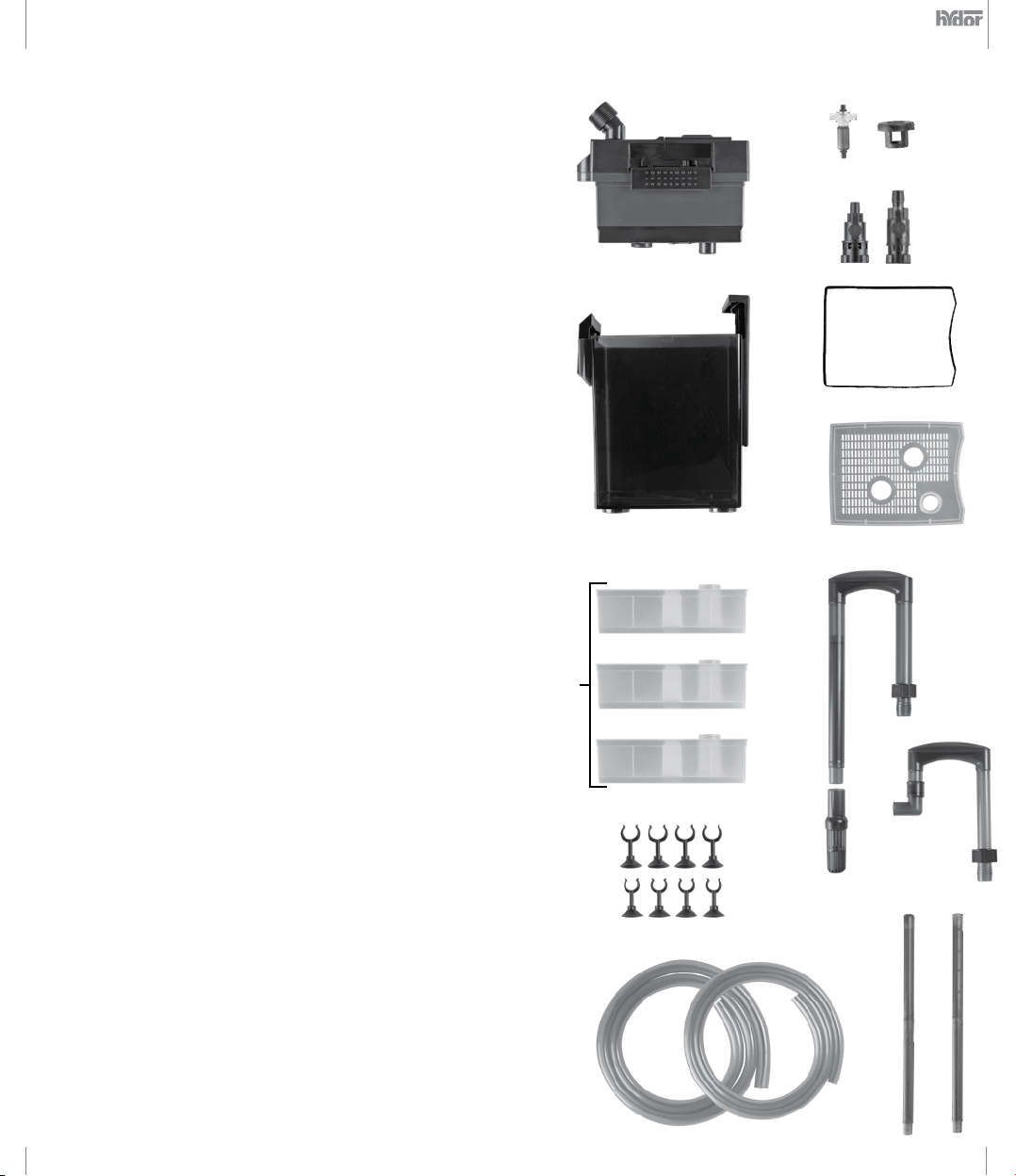
PARTS OF THE FILTER
1. Body of the lter
2. Head of the motor
3. Magnetic rotor with ceramic shaft
4. Rotating lid
5. IN - OUT taps
6. O-ring motor head
7. Lid of ltering material container
8. Filtering material container
9. U-shaped suction tube
10. U-shaped delivery tube
11. Pre-lter grid
12. Clips with suction cap
13. Flexible tubes
14. Spray bar
Installation
N.B.: before carrying out any work or maintenance on your aquarium, disconnect all electrical
appliances installed inside or outside of it. Check that the voltage indicated on the product
corresponds to that of your power supply network. The Professional lter should be below the
level of the aquarium when it is primed (g. 1).
If you wish to position it at the side, you must do so only once the lter has begun functioning.
Preparation of the lter
• Placethelterin the position identied (considerwhetherthiswillallow for easy handling ofthe
lter during ordinary maintenance operations)
• Connect the U-shaped tubes with their exible tubes, taking care to tighten the ring nuts (g .2).
• Mount the pre-lter grid onto the suction unit.
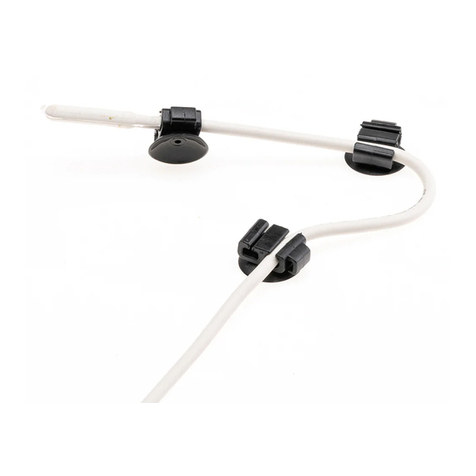
• Choose the position you consider most appropriate for the suction unit, using the clips with
suction caps (g. 3).
• Assemble the delivery unit and choose a position for it, if possible at a distance from the suction
unit, in order to ensure eective recirculation (g.4).
• If you wish, you may apply the perforated bar to improve oxygenation at a 90° angle (g.4 -5),
positioning it all in the aquarium at the surface of the water (g.6).
• Cut the exible tubes to the length required to ensure the water runs through as straight as
possible, so as to prevent possible (g.7) obstruction of the exible tubes (g. 20).
Initial installation of ltering materials
Forconvenience oftransport, the ltering materials are positioned inside the lter.Thelter must
thereforebe opened andthe required cleaningoperations carried outin order to prepare thelter
for use. Proceed as follows:
• Rotate the safety levers (g. 8-9) the unblock the pump unit.
• Leavingtheleversintheclosed position,openthe twoclosinghooksbymovingthemdownwards
and outwards, then raising them and releasing the head (g.10).
• Remove the lid of the ltering materials by inserting your ngers into the appropriate holes to
facilitate the operation (g.11).
• Take out the material containers, in which some ltering materials are still sealed (g.12).
• Open the packs of ltering materials, rinse the materials carefully (g.13-14) and place them in
the containers.The number of containers varies, depending on the model.
• We suggest placing the large-pore sponges (d) at the bottom, the material for biological ltering
(b) in the middle of the lter and the ne-ltering white lter wool (e) at the top (except for
FILTERING MATERIALS
A. Porous cylinders for biological ltering
B. Active carbon for chemical ltering
(optional)
C. Active zeolite for chemical ltering
(optional)
D. Large-pore sponge for mechanical
ltering
E. Filter wool for super-ne mechanical
ltering
F. Large-pore sponge and lter wool in
combination (model 150 only)
model 150, in which the sequence of materials is f-a).
• Repeat the opening operations in reverse, inserting the containers in the sequence dened,
taking care to stack them correctly.
• Replace the lid of the ltering materials and the head of the lter with the motor.
• Re-mount the pump unit, checking that the safety levers are in the open position and ensuring
that thehead is properly alignedwith the body ofthelter. Firstclosethetwolarge hooks (atthe
front and back) and then close the safety levers at the sides.
N.B.: before closing the hooks or forcing the safety levers, make sure that the ltering material
arein theirproperposition,thatthecontainersofthe lteringmaterialsoverlapperfectly(i.e.that
no materials protrude) and that the lid of the ltering materials (g.11) is in the correct position.
Mounting the taps
N.B.: mounting the taps is a very important operation.
We recommend you pay close attention to the position ofthetaps before carrying out anykind of
operation onthe lter: ifthe position is alignedwith the owof the water(g.15) theyare turned
on, if turned to a 90° angle they are turned o.
ALWAYS make sure the taps are turned o before carrying out maintenance
operations on the lter.
• Screw the ring nuts of the taps, without forcibly tightening, onto the slanted rotating connector
of the pump unit (g. 16).
• Connect the exible tubes, already cut to size, to the taps. Follow the same procedure used for
connecting the collector tubes, tightening the ring nuts.
N.B.: connect the delivery tube with the rotating connector marked “OUT”(on the head near the
connector) and the suction tube with the connector marked“IN”(g. 17-18).
• N.B.: it is advisable to check the connections and the hold of the ring nuts after 24
hours
Starting the PROFESSIONAL lter
The PROFESSIONAL external lter is equipped with an integrated priming system. Using the
START button, the lter can be automatically primed in just a few easy steps.
• Make sure BOTH taps are fully open (g. 19).
• Place your ngers and hands as in gure 21, in a position that allows you to press the START
BUTTON located on the top side of the lter head.
• Vigorously push the button right down a few times in rapid succession.This action will cause the
lter to ll up rapidly.
• When the lter is full of water, and after checking the level of the aquarium, all you have to do to
start the lter is insert the plug into the socket.
• When thelter starts up,it is normal forsome noise to becaused by the elimination of air pockets
and/or small bubbles trapped in the ltering material.
• This trapped air can be eliminated more quickly by gently tilting the lter to the left and right
a few times.
• The air will generally be eliminated after a few hours, allowing the lter to operate in silence.
Maintenance
N.B.: before carrying out any work or maintenance on your aquarium, disconnect all electrical
appliances installed inside or outside of it.
• Close both taps, unscrew them and disconnect them from the lter by unscrewing the ring nuts
that x them to the rotating connectors.
• N.B.: during maintenance operations the taps must ALWAYS remain connected to the exible
tubes and in the closed position.
• N.B.:when the taps are disconnected,it is normal for a smallamount of waterpresent in thetaps
to run out. Placing a cloth or absorbent material around the connectors is recommended before
disconnecting the taps. Leave the taps connected to the tubes.
• Once it has been disconnected, the lter is ready for cleaning and maintenance. We recommend
opening the lter after placing it in a basin or in the bathtub.
• Move both the safety levers of the lter to the open position (g.9).
• Position the two opening hooks as in gure 10.
• Lift the head of the lter (g.22).
• Remove the lid of the ltering materials (g.11) to access the ltering materials.
• We suggest thoroughly rinsing the sponges (d, e, f), which can be used again, while it is better
not to wash the biological materials (a) too much, to avoid destroying the colonies of bacteria
presentin thesubstratumofthelter,which takecareofthewellbeing oftheaquarium(the ideal
solution is to wash them in a little of the water from the aquarium).