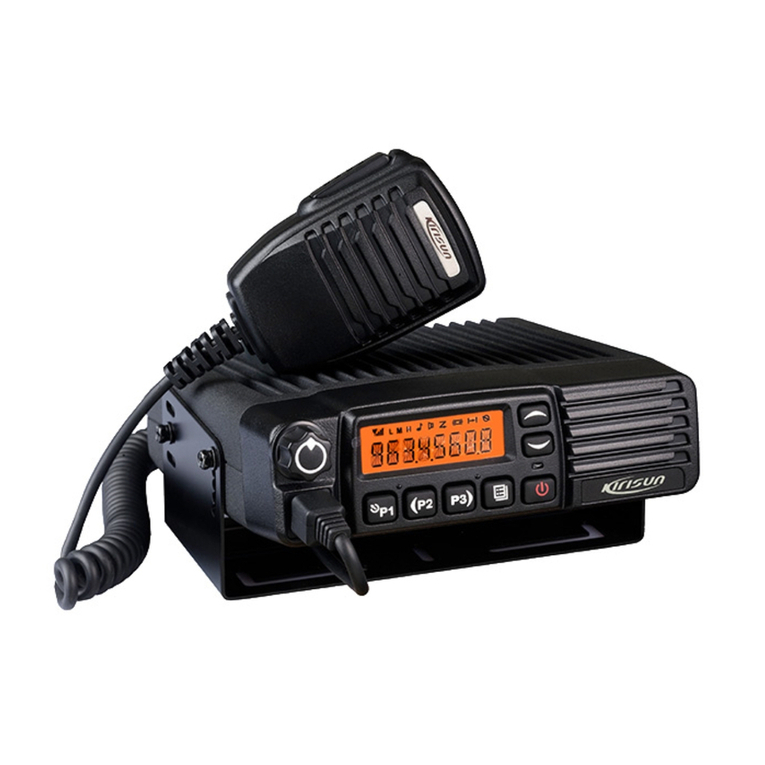
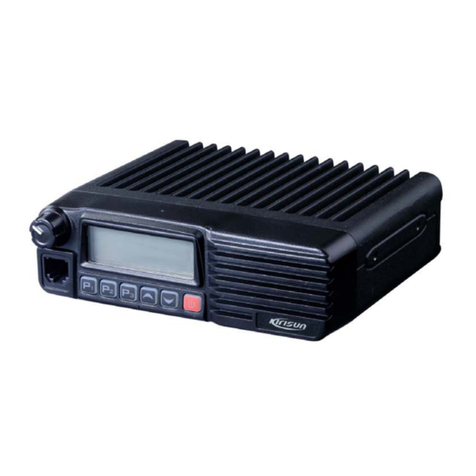
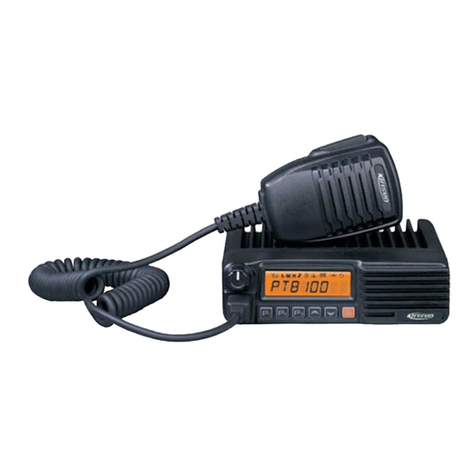
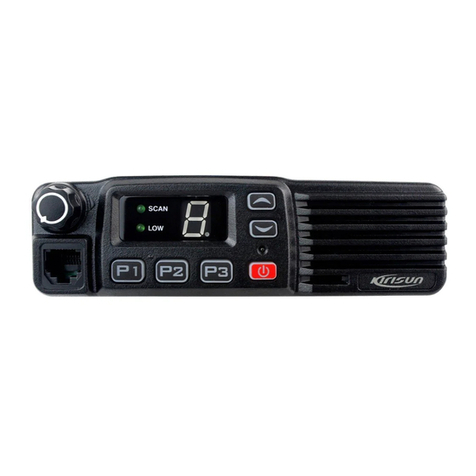
PT6808 Service Manual
The RF signal received by the antenna comes to antenna switch (D28, D29 and D26), and passes
through a BPF (L27, 36, 37, 38 and 39) which is adjusted by variable capacitance. The voltage
output from the variable capacitance passes through the voltage from the digital/analog conversion
and is modulated. The signal is amplified by RF amplifier Q35, and passes through BPF (L32, 33, 34,
35) and frequency band clear filter (L15.17) to continue to filter the unwanted signal. Then the
output signal comes to the first mixed tube (Q34), and mixes with the first local oscillator signal of
the frequency synthesizer to generate the first IF (44.85MHz).
4.3.2 IF circuit
The first IF signal passes through crystal filter (XF1 and XF2) to filter the signal coming from
the adjacent channel. The output signal is amplified by the first IF amplifier (Q12), and then comes
into IF system chip (IC12). IF system chip servers as the second mixer, the second local oscillator,
amplitude limit amplifier, quadrature detector and RSSI (receiving signal strength indicator). The
second mixer mixes the first IF signal with the second local oscillator signal (crystal part X2) of
44.395MHz, and then generates the second IF of 455 kHz.
The second IF signal passes through ceramic filter (CF: wide; CF: narrow) to continue to filter
the unwanted signal from the adjacent channel. The output signal is amplified by the voltage limit
amplifier and is demodulated by the quadrature detector with ceramic filter (CD1). The demodulated
signal then comes to audio circuit.
4.3.3 Wide/narrow band switch circuit
To set the wide/narrow band of each channel, turn on the ceramic filter CF1 (wide), CF2
(narrow).
The 99 pin of IC19 (micro-computer) outputs the wide band (high power level) and narrow (low
power level) signal.
If the circuit receives the wide band (high power level) data, Q6 disconnects and Q7 connects; if
the circuit receives the narrow band (low power level) data, Q6 connects and Q7 disconnects; if the
circuit receives high/low power level data, D5 and D7 turns on the ceramic filter.
Q9 is connected/disconnected as wide/narrow data receives. The output power level of IC12
detector varies to ensure that the output power level during the wide/narrow band switch is
invariable.
4.3.4 Audio amplifier circuit
The demodulated signal coming from IC12 passes through mute switch (Q15), and then is