7
© 2017 Kolpin Outdoors Inc. REV 02
MOUNTING THE REMOTE SWITCH
(optional on some models)
• Determine the mounting location for the remote socket. Exact position may vary depending on vehicle. Drill three holes and install
to vehicle dash panel or body panel.
• Route the wire harness to where the contactor/solenoid will be mounted. Secure the socket’s cable with the supplied cable ties.
• Using the provided wire splice, splice the end of the red 20ga wire to a key controlled, accessory circuit (power-point) of the A V/
U V or use the provided 20ga wire eyelet terminal connector to connect to a vehicle terminal strip post. he wire should only have
power when the key is in the “ON” position.
•
NOTE: If installing both switches (handlebar rocker and corded remote), both 20ga red wires must be connected together
with the provided plug connectors or spliced to a key-controlled accessory circuit of the AT /UT as described in the
above step.
WIRING THE WINCH
• Install the wiring using the diagram on the next page.
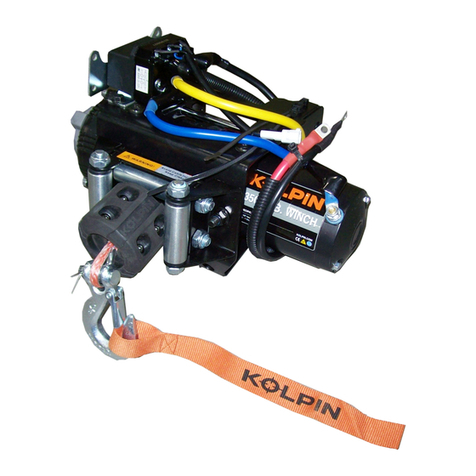
• Slip terminal boots on yellow and blue cable ends. Connect the yellow and blue cables to the color-matched motor terminals on the
winch. ighten the terminal nuts on the motor. DO NO overtighten. Seat boots over terminal. Route the other ends to the
contactor/solenoid location.
• Connect the yellow and blue cables to the contactor/solenoid (yellow to yellow and blue to blue). DO NO tighten nuts or seat
boots at this time.
• Slip terminal boots on the ring terminal ends of the black and red cables. Connect the black and red cables to the contactor/
solenoid (red to red and black to black). DO NO tighten nuts or seat boots at this time. Route red and black cables to battery. DO
NO connect cables to battery at this time.
•
Mount the contactor to the location planned in the previous steps with provided hardware. Tighten the contactor/solenoid
mounting fasteners. DO NOT overtighten.
• Adjust cables to facilitate orderly and straight routing of the cables from the contactor/solenoid. Avoid kinks or sharp bends in the
cables. Avoid crossing cables over each other for at least the first 6” of cable starting from the contactor/solenoid post. ighten the
contactor/solenoid terminal nuts. DO NO over tighten. Seat terminal boots over ring terminals and posts.
• Connect the rocker switch to the contactor/solenoid using the provided plug. Splice the end of the red wire on the rocker switch, to
a vehicle accessory circuit controlled by ignition controlled power source (keyed). he wire should only have power when the key is
in the “ON” position.
• Carefully inspect battery and winch electrical cable routing to ensure it is neat and tidy. Secure electrical cables and wiring
harnesses with provided cable ties. Cable ties should be snug, but not cutting into wire insulation. Use electrical tape, pieces of
rubber hose or electrical conduit to protect electrical cables and wire harnesses where needed to avoid electrical cable insulation
wear or abrasion.
• Connect the red lead to the positive (+) terminal of the vehicle’s 12 volt battery first. Connect the black lead to the negative (-) ter-
minal of the vehicle’s 12 volt battery second. Install protective boots as appropriate to protect connection. ighten battery terminal
fasteners as directed in the vehicle service manual to the proper torque specification.
• Check for proper drum rotation. Pull and turn the clutch knob to the “free spool” position. Pull out some cable from the drum, and
then turn the clutch knob to the “locked spool” position to engage the gears. Press the cable out button on the rocker switch. If the
drum is turning and releasing more cable, your connections are accurate. If the drum is turning and collecting more cable, then
reverse the leads on the motor. Repeat and check rotation.
• With some applications, the motor terminal posts may need to be rotated to avoid interference with other components.
CAUTION
!
NEVER route electrical cables across any sharp
edges, through and /or near moving parts, or near
parts that may become hot.
CAUTION
!
A WAYS leave some slack for electrical cable move-
ment. Battery cables should NO be drawn taut.
NOTICE
A WAYS make sure to splice into keyed accessory
wire that has power when key is turned on. You may
need to use a test light to locate a suitable wire.