Website : www.kyowa-ei.com
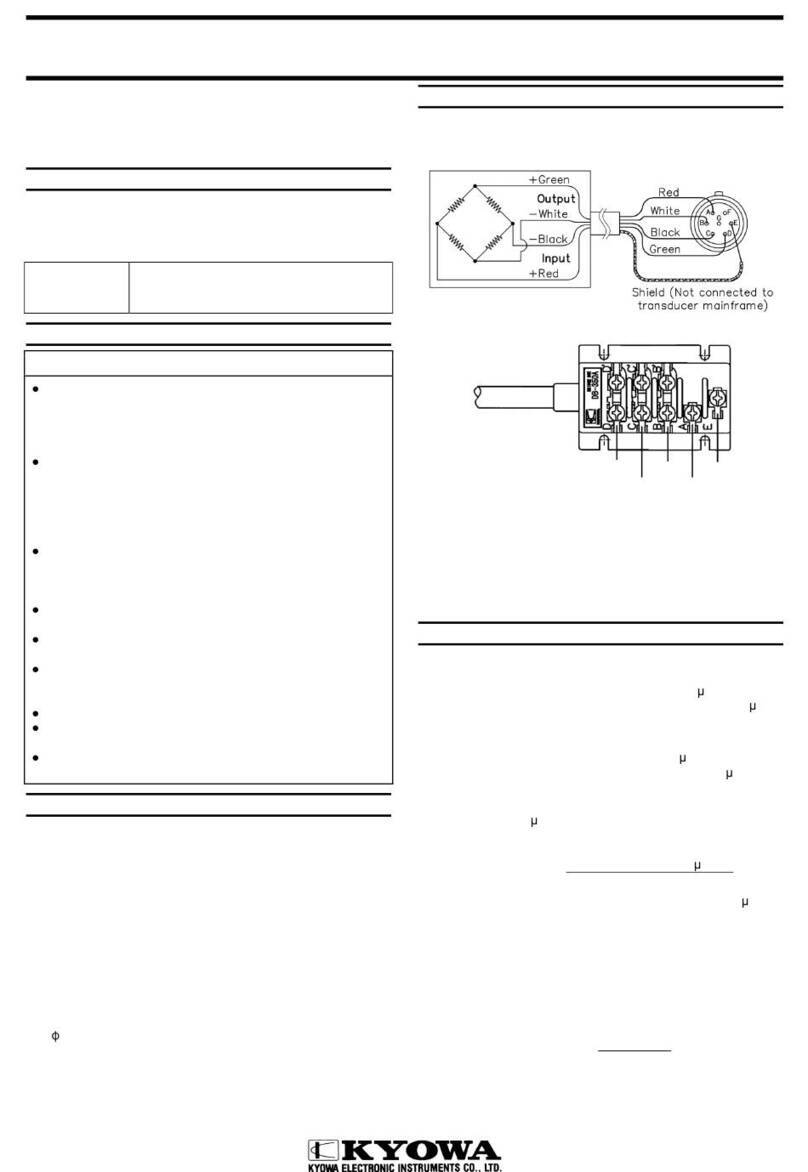
6. Connection
6.1
Connect the transducer to a measuring instrument.
6.2
When using a measuring instrument other than KYOWA,
connector plug as follows.
Note that Pin E denotes shield wire of the cable, and it is
connected to the case.
6.3
Heat run for approximately 5 minutes before starting the
measurement.
7. Conversion
7.1
Use the calibration constant described in the test data sheet to
convert a reading into a pressure value.
7.2
When a strain amplifier is in use, output reads in ×10
-6
equivalent
strain. Find a pressure value corresponding to ×10
-6
strain. Then,
obtain a pressure value through multiplication using the following
equation.
Pressure (Pa) = Strain amplifier’s output (×10
-6
strain)
x Calibration constant (Pa
/
1×10
-6
strain)
7.3
When using an amplifier of other type or a recorder, first find the
exact bridge exciting voltage applied. Second, find the pressure
value that corresponds to 1(μV) output voltage against 1(V) bridge
excitation voltage. Then, obtain the pressure value through
multiplication using the following equation.
Pressure (Pa) =
Bridge output voltage (μV) ×Calibration constant (Pa
/
1μV/V)
Bridge excitation voltage (V)
Sensitivity Decrease due to Cable Extension
If a strain-gage transducer is connected to a signal conditioner,
digital indicator or strain amplifier via extension cable, we will not
ignore the sensitivity decrease due to the extension cable
resistance which lowers the voltage applied to the transducer.
The rated output with lowered sensitivity is obtained from the
following equation:
Rated output :ε
0
=(
R
)
ε
i
R+(r × L)
R
:
Transducer’s input resistance (Ω)
r
:
Extension cable’s reciprocating resistance (Ω/m)
L
:
Extension cable length (m)
ε
i
:
Rated output written in the Test data sheet
8. Maintenance and inspection
8.1
Avoid water, oil, dust, etc. on the connector.
8.2
For storage, be sure to apply a protecting cap to the diaphragm.
8.3
Recommend calibrate the product once a year or so. (Contact
your KYOWA representative.)
8.4
If suspicious outputs have occurred, check the input resistance,
output resistance and insulation resistance. Provided that the
connector operates properly and that the insulation resistance
between the mainframe and conductors is below 100M
Ω
, the
cause may be failure.
In this case, contact your KYOWA representative.
Caution
To measure insulation resistance, apply a voltage lower than 50V
to the insulation resistance tester.
9. Specifications
Models Rated
capacity Rated Output
Natural
Frequencies
(Approx.)
1MPa 0.75 mV/V or more 50kHz
2MPa 1.1±0.25 mV/V 65kHz
PGM-50KD 5MPa
1.5 mV/V ±20%
83kHz
PGM-100KD 10MPa 113kHz
PGM-200KD 20MPa 150kHz
PGM-500KD 50MPa 250kHz
◆
Performance
Rated Capacity See table above.
Nonlinearity Within ±0.5% RO
Hysteresis Within ±0.5% RO
Repeatability 0.5%RO or less
Rated Output See table above.
◆
Environmental Characteristics
Safe Temperature -10 to 60
℃
Compensated Temperature 0 to 50
℃
Temperature Effect on Zero Within ±0.1% RO/
℃
(10 to 20KDM156:
Within ±0.15% RO/
℃
)
Temperature Effect on Output Within ±0.1%/
℃
◆
Electrical Characteristics
Safe Excitation 3 V AC or DC
Recommended Excitation 1 to 2 V AC or DC
Input Resistance 120 ±2%
Output Resistance 120 ±2%
Cable 4-conductor (0.08mm
2
) chloroprene
shielded cable,4mm diameter by 3m
long, terminated with connector plug.
PRC03-12A10-7M
(Shield wire is connected to the
case.)
◆
Mechanical Properties
Safe Overloads 150%
Natural Frequencies See table above.
Material Case: Stainless steel
Liquid-contacting part: SUS630
Weight Approx. 40g (Excluding cable)
Degree of Protection
IP52 (IEC 60529)
Mounting Screw G1/8, male
Compliance Directive 2011/65/EU,(EU)2015/863
(10 restricted substances) (RoHS)
[NOTE]
Products with CE Marking are compliant European RoHS Directive.
◆
Accessories
Gasket (Mild copper) 3
Protecting cap 1(Note)
Note: It is attached to the product at delivery.
Test Data Sheet 1
Instruction manual 1 (This book)