5. TESTING AN INSULATION TESTER
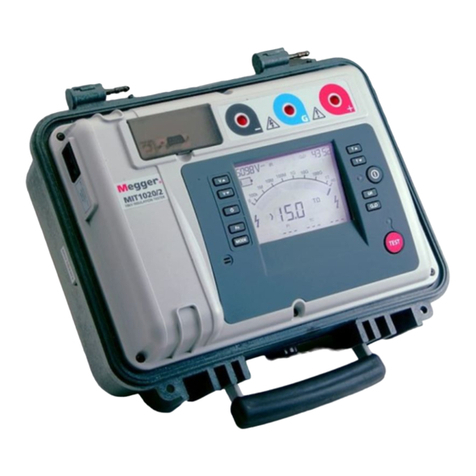
Connect the test instrument to the continuity and insulation connec-
tion sockets in the orange and red section of the test box.
Warning: Do not apply more than 1250 V d.c.
5.1 Voltage load test @ 250 V
Set the continuity and insulation test select switch to [250 V] and per-
form an insulation test with the test instrument set to 250 V output.
If the test voltage is 250 V d.c. the [V] LED will be on. If the current
delivered from the unit is greater than 1 mA the [I] LED will also be
on, showing that the test criteria have been met. A fixed resistor of
0.25 MΩ+/-3% is used to provide the test reference. The test instru-
ment should indicate a measured value of 0.25 MΩ(+/- operational
errors including the test instrument’s accuracy).
If either of the LEDs fail to light the test instrument should be re-
turned for a full calibration.
✍Record the reading on the record card.
5.2 Voltage load test @ 500 V
Set the continuity and insulation test select switch to [500 V] and per-
form an insulation test with the test instrument set to 500 V output.
If the test voltage is 500 V d.c. the [V] LED will be on. If the current
delivered from the unit is greater than 1 mA the [I] LED will also be
on, showing that the test criteria have been met. A fixed resistor
of 0.5 MΩ+/-3% is used to provide the test reference. The tester
should indicate a measured value of 0.5 MΩ(+/- operational errors
including the test instrument’s accuracy).
If either of the LEDs fail to light the tester should be returned for a
full calibration.
✍Record the reading on the record card.
5.3 Voltage load test @ 1 kV
Set the continuity and insulation test select switch to [1 kV] and per-
form an insulation test with the test instrument set to 1 kV output.
If the test voltage is 1 kV dc the [V] LED will be on. If the current de-
livered from the unit is greater than 1 mA the [I] LED will also be on,
showing that the test criteria have been met. A fixed resistor of