10 GB
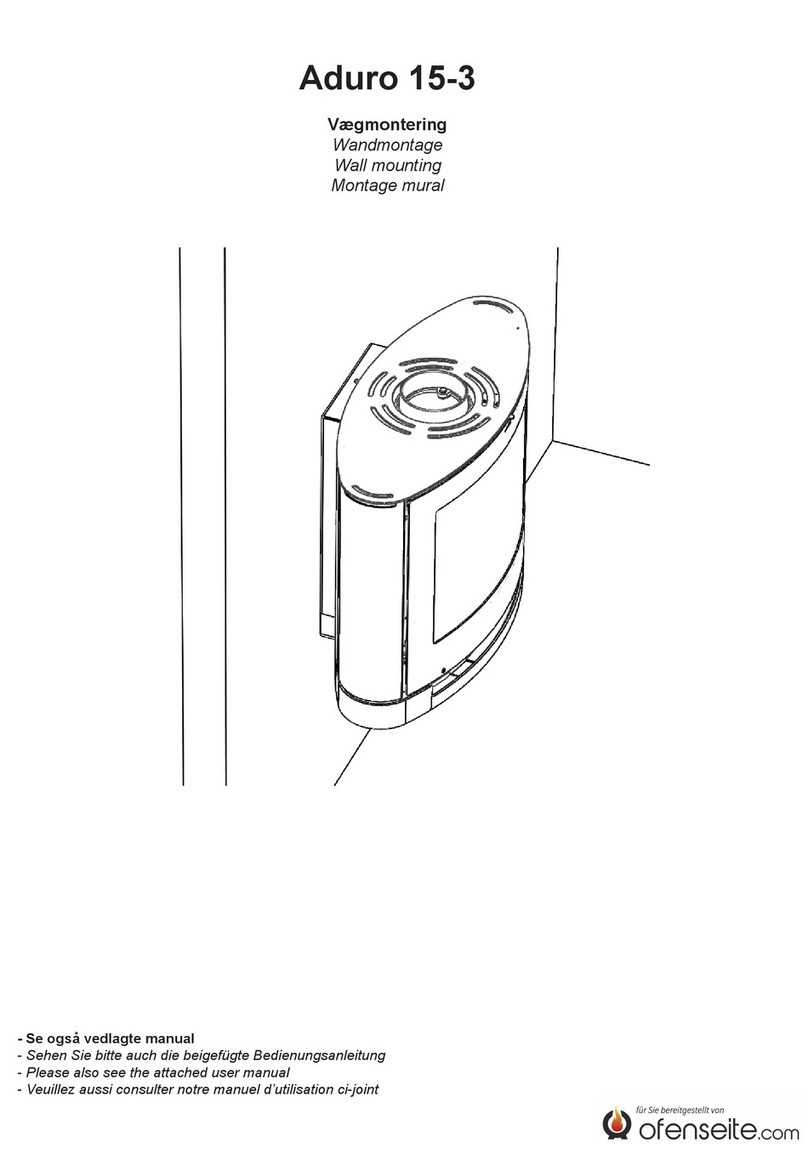
Dimensional drawing
The illustration indicates the approximate center
height of the hole for the ue. Distortions in oors
and walls may inuence the height. Place the stove
for accurate position and height of the ue/chimney
connection. We accept no liability for typographical
errors and changes.
For your own safety, comply with the assembly instructions.
All safety distances are minimum distances. Installation of the
stove must comply with the current rules and regulations of
the country where the product is installed. Nordpeis AS is not
responsible for wrongly assembled stoves.
Subject to errors and changes.
For the latest updated version go to www.nordpeis.com.
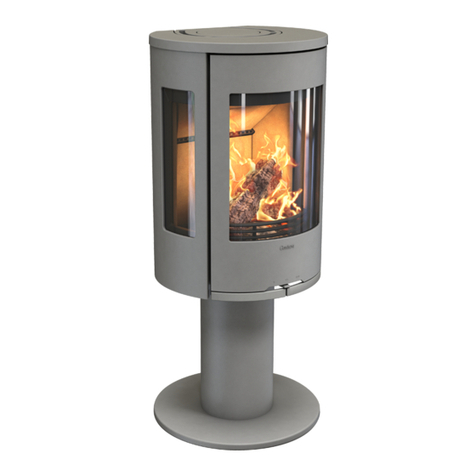
2. Technical Information
The stoves from Nordpeis have secondary combustion
and are clean burning. The combustion takes place in
two phases: rst the wood burns and then the gases
from the fumes are lit by the hot air. This ensures that
these new stoves have minimal emissions of soot
particles and unburnt gases (such as CO) and are
thus better for the environment. Clean burning stoves
require a small amount of wood in order to obtain a
good heat output. Use exclusively clean and dry wood.
We recommend seasoned hardwood with a maximum
moisture content of 20%.
Material: Sheet steel
Surface treatment
door/doorframe: Heat resistant varnish
Fuel: Wood logs, 40 cm
Operating range: 5 kW nominal
Eciency: 84,8%
CO % @ 13% O2:0,10
Draught system: Air vent control
Combustion system: Secondary combustion
(clean burning)
Heating area: 40 -110 m²
Flue outlet: Top and rear
Flue: Inner Ø 155 mm
*Alternative versions exsists due to
National requirements
Weight: 110 kg
Flue gas temperature 239 °C
Air supply
requirements (m³/h): 11
Fuel Charge 1,1 kg
Refueling interval 47min
Opening of the air
vent control 33%
Operation Intermittent*
* Intermittent combustion refers to normal use of a replace,
i.e. new wood is inserted when the previous load has burned
down to ember.
1. Prior to assembling the stove
All our products are tested according to the latest
European requirements and also to the Norwegian
standard NS 3058 and NS 3059, which include particle
tests. However, several European countries have local
regulations for installation of replaces, which change
regularly. It is the responsibility of the client that these
regulations are complied with in the country/region
where the replace is installed. Nordpeis AS is not
responsible for incorrect installation.
Important to check
(please note that this list is not exhaustive):
• distance from rebox to combustible/ammable
materials
• insulation materials/requirements between
replace surround and back wall
• size of oor plates in front of replace if required
• ue connection between rebox and chimney
• insulation requirements if ue passes through a
ammable wall
Chimney draft
Compared with older models, the clean burning stoves
of today put signicantly higher demands on the
chimney. Even the best stove will not work properly
if the chimney does not have the right dimensions or
is not in good working order. The draught is mainly
controlled by gas temperature, outside temperature, air
supply as well as the height and inner diameter of the
chimney. The diameter of the chimney should never
be less than that of the ue/chimney collar. At nominal
eect there should be a negative pressure of 12 to 25
Pascal.
The draught increases when:
• The chimney becomes warmer than the outside air
• The active length of the chimney over the hearth
increases
• Good air supply to the combustion
It can be dicult to obtain the right draught conditions
in case the chimney is too large relative to the stove,
as the chimney does not heat up well enough. In
such cases you may want to contact professional for
evaluation of possible measures. Draught that is too
strong can be controlled with a damper. If necessary,
contact a chimney sweeper.
Air supply
A set for fresh air supply is available as accessory.
This will ensure that the air supply to the combustion
chamber is less aected by ventilation systems,
kitchen fans and other factors which can create a
down-draught in the room. In all new construction, we
strongly recommend that it is designed and prepared
for direct supply of outside air. In older houses, the use
of fresh air supply set is also recommended. Insucient
air supply can cause down-draught and thereby low
combustion eciency and the problems that this entails:
soot stains on the glass, inecient use of the wood and
a soot deposits in the chimney..