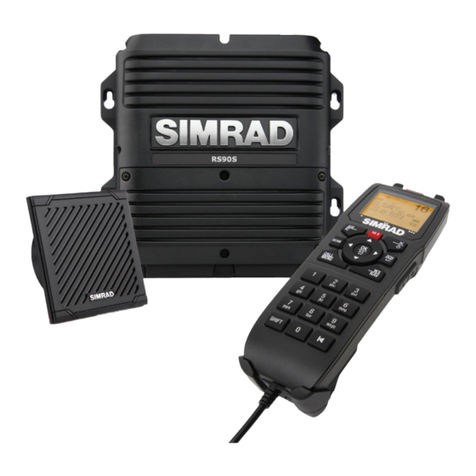
Simrad RS90 User manual

ENGLISH
RS90
Installation Manual
simrad-yachting.com


| 3
RS90 Installation Manual
Preface
Copyright © 2014 Navico. All rights reserved.
Simrad® is a registered trademark of Navico
No part of this manual may be copied, reproduced, republished,
transmitted or distributed for any purpose, without prior written
consent of Simrad Electronics. Any unauthorized commercial
distribution of this manual is strictly prohibited.
Simrad Electronics may find it necessary to change or end our policies,
regulations, and special offers at any time. We reserve the right to do
so without notice. All features and specifications subject to change
without notice.
All screens in this manual are simulated.
For free owner’s manuals and the most current information on this
product, its operation and accessories, visit our web site:
www.simrad-yachting.com
Navico Holding AS is not responsible for any changes or modifications
to the radio not expressly approved by Navico AS as the responsible
entity for its compliance. Modifications could void the user’s authority
to operate the radio.
Compliance statements
DISCLAIMER: It is the owner’s sole responsibility to install and use
the instrument and peripheral components in a manner that will
not cause accidents, personal injury or property damage. The user
of this product is solely responsible for observing safe boating
practices.
NAVICO HOLDING AS. AND ITS SUBSIDIARIES, BRANCHES AND
AFFILIATES DISCLAIM ALL LIABILITY FOR ANY USE OF THIS PRODUCT
IN A WAY THAT MAY CAUSE ACCIDENTS, DAMAGE OR THAT MAY
VIOLATE THE LAW.
Governing Language: This statement, any instruction manuals,
user guides and other information relating to the product
(Documentation) may be translated to, or has been translated from,
another language (Translation). In the event of any conflict between
any Translation of the Documentation, the English language
version of the Documentation will be the official version of the
Documentation.

4 | RS90 Installation Manual
This manual represents the RS90 as at the time of printing. Navico
Holding AS. and its subsidiaries, branches and affiliates reserve the
right to make changes to specifications without notice.
IMPORTANT
1. DSC functions will not operate on the RS90 until your MMSI has
been entered.
2. The radio channels installed into this Simrad VHF radio may
vary from country to country depending upon the model and
government or national communications authority regulations.
3. Navico recommends that you check the radio operating licensing
requirements of your country before using this Simrad VHF radio.
The operator is solely responsible for observing proper radio
installation and usage practices.
4. A DSC warning label is supplied with this Simrad VHF radio. To
comply with FCC regulations, this label must be affixed in a location
that is clearly visible from the operating controls of this radio. Make
sure that the chosen location is clean and dry before applying this
label.
5. This radio is designed to generate a digital maritime distress call to
facilitate search and rescue. To be effective as a safety device, this
radio must be used only within the geographic range of a shore-
based VHF marine Channel 70 distress and safety watch system.
The geographic range may vary but under normal conditions is
approximately 20 nautical miles.
MMSI and license information
You must obtain a user Maritime Mobile Service Identity (MMSI)
and enter it into your RS90 radio in order to use the DSC functions.
Similarly for the Automatic Terminal Information Service (ATIS)
MMSI. Contact the appropriate authorities in your country. If you are
unsure who to contact, consult your Simrad dealer.
The user MMSI is a unique nine digit number, similar to a personal
telephone number. It is used on marine transceivers that are
capable of using DSC (Digital Select Calling).
Depending upon your location, you may need a radio station
license for the RS90 You may also need an individual operator’s
license.

| 5
RS90 Installation Manual
Simrad recommends that you check the requirements of your
national radio communications authorities before operating DSC
functions.
RF emissions notice
This equipment complies with FCC radiation exposure limits set
forth for an uncontrolled environment. This device’s antenna must
be installed in accordance with provided instructions; and it must
be operated with minimum 96 cm spacing between the antennas
and all person’s body (excluding extremities of hands, wrist and feet)
during operation. Further, this transmitter must not be co-located or
operated in conjunction with any other antenna or transmitter.
FCC statement
This device complies with Part 15 of the FCC Rules. Operation
is subject to the following two conditions: (1) this device may
not cause harmful interference, and (2) this device must accept
any interference received, including interference that may cause
undesired operation.
¼Note: This equipment has been tested and found to comply with
the limits for a Class B digital device, pursuant to Part 15 of the FCC
Rules. These limits are designed to provide reasonable protection
against harmful interference in a normal installation. This equipment
generates, uses and can radiate radio frequency energy and, if not
installed and used in accordance with the instructions, may cause
harmful interference to radio communications. However, there is no
guarantee that interference will not occur in a particular installation.
If this equipment does cause harmful interference to radio or
television reception, which can be determined by turning the
equipment off and on, the user is encouraged to try to correct the
interference by one or more of the following measures:
• Reorient or relocate the receiving antenna.
• Increase the separation between the equipment and receiver.
• Connect the equipment into an output on a circuit different from
that to which the receiver is connected.
• Consult the dealer or an experienced technician for help.
• A shielded cable must be used when connecting a peripheral to the
serial ports.

6 | RS90 Installation Manual
Industry Canada statement
This device complies with Industry Canada license-exempt RSS
standard(s).
Operation is subject to the following two conditions: (1) this device
may not cause interference, and (2) this device must accept any
interference, including interference that may cause undesired
operation of the devise.
Le présent appareil est conforme aux CNR d’industrie Canada
applicables aux appareils radio exempts de licence.
L’exploitation est autorisée aux deux conditions suivantes : (1)
l’appareil ne doit pa produire de brouillage, et (2) l’utilisateur de
l’appareil doit accepter tout brouillage radioélectrique subi, même si
le brouillage est susceptible d’en compromettre le fonctionnement.
Under Industry Canada regulations, this radio transmitter may
only operate using an antenna of a type and maximum (or lesser)
gain approved for the transmitter by Industry Canada. To reduce
potential radio interference to other users, the antenna type and its
gain should be so chosen that the equivalent isotropically radiated
power (e.i.r.p.) is not more than that necessary for successful
communication.
Conformément à la réglementation d’Industrie Canada, le présent
émetteur radio peut fonctionner avec une antenne d’un type et
d’un gain maximal (ou inférieur) approuvé pour l’émetteur par
Industrie Canada. Dans le but de réduire les risques de brouillage
radioélectrique à l’intention des autres utilisateurs, il faut choisir
le type d’antenne et son gain de sorte que la puissance isotrope
rayonnée quivalente (p.i.r.e.) ne dépassepas l’intensité nécessaire à
l’établissement d’une communication satisfaisante.
Notice specic to the HS35 handset
This ISM device complies with Canadian ICES-001.
Maintain a minimum separation of 2.5 cm (1 inch) from the face.
Cet appareil ISM est conforme à la norme NMB-001 du Canada.
Maintenir une distance minimum de 2,5 cm (1 inch) de la surface.

| 7
RS90 Installation Manual
CE compliance statement
This product complies with CE under R&TTE directive 1999/5/EC.
The relevant Declaration of Conformity is available in the following
website under the model’s documentation section:
http://www.simrad-yachting.com
Important safety information
Read carefully before installation and use
Warning: Indicates a potentially hazardous situation that could result
in death or serious injury.
Caution: Indicates a potentially hazardous situation that could result in
minor or moderate injury.

8 | Contents | RS90 Installation Manual
Contents
9 About this manual
10 System Overview
10 Introduction
11 System overview diagram
12 Preparation
12 Checklist
14 Installation
14 Positioning
14 Installing the transceiver
16 Installing a wireless handset cradle
17 Installing a wired handset cradle
18 Installing a handset cable connector
19 External speakers installation options
21 Transceiver external connectors
21 Transceiver internal connectors
26 Setting up the radio
26 NMEA 2000 Network
27 NMEA 2000 Network Diagram
28 Appendix 1 - Accessories

| 9
About this manual | RS90 Installation Manual
About this manual
This manual describes the installation of the Simrad RS90 marine
VHF radio.
For instructions on operating the radio, please see the separate
manual: Simrad RS90 Marine VHF Radio Operating Manual.
This manual is organized as follows:
• System Overview
Describes the components and main features of the radio.
• Preparation
Describes the parts and tools you need to install the radio.
• Installation
Describes the mounting instructions and electrical connections.
¼Notes
• Different setups of the RS90 marine VHF radio are provided for
different countries, depending on the VHF radio regulations of each
country.
• Diagrams in this manual are not to scale.
1

10 | System Overview | RS90 Installation Manual
System Overview
Introduction
The Simrad RS90 VHF radio is a comprehensive solution for marine
VHF radio applications.
The radio comprises:
• RS90 VHF transceiver
• One wired handset as standard, and optionally up to 3 more
wired handsets. (Maximum of 4 wired handsets in total)
• One external speaker, and optionally up to 3 more external
speakers
• Up to 2 optional wireless handsets
In addition to routine ship-to-ship or ship-to-shore VHF
communications, the RS90 has many advanced features, including
NMEA 2000 and NMEA 0183 network connectivity, which allows the
radio to share information with other onboard devices, such as a
GPS antenna, a chart plotter or a multi-function display.
For detailed features and specifications, see the Appendices in
Simrad RS90 Marine VHF radio Operating Manual.
System diagram legend
1 RS90 VHF radio transceiver
2 12 VDC power supply
3 HS90 wireless handset
4 HS90 wired handset
5 External loudspeaker
6 NMEA 0183 GPS and horn button
7 AIS Data Output
8 Loud hailer speaker
9 VHF antenna with PL259 connector
10 NMEA 2000 network connection
2
Other manuals for RS90
1
Table of contents
Other Simrad Radio manuals
Simrad
Simrad RS25/AHK05 User manual

Simrad
Simrad HT50 User manual
Simrad
Simrad RD68 User manual
Simrad
Simrad RS20S User manual
Simrad
Simrad Axis30 User manual
Simrad
Simrad WR20 RemoteCommander User manual
Simrad
Simrad RT62 User manual
Simrad
Simrad RS20 User manual

Simrad
Simrad RD68 User manual
Simrad
Simrad Axis 200 User manual

Simrad
Simrad RT62 User manual
Simrad
Simrad HH36 User manual
Simrad
Simrad RD68 User manual
Simrad
Simrad SHIPMATE RS8100 User manual
Simrad
Simrad RS81 User manual
Simrad
Simrad RS10U User manual
Simrad
Simrad RS90S User manual
Simrad
Simrad RD68 User manual

Simrad
Simrad FishNet 144 User manual
Simrad
Simrad Shipmate RS8400 Reference manual