5
Scope of supply
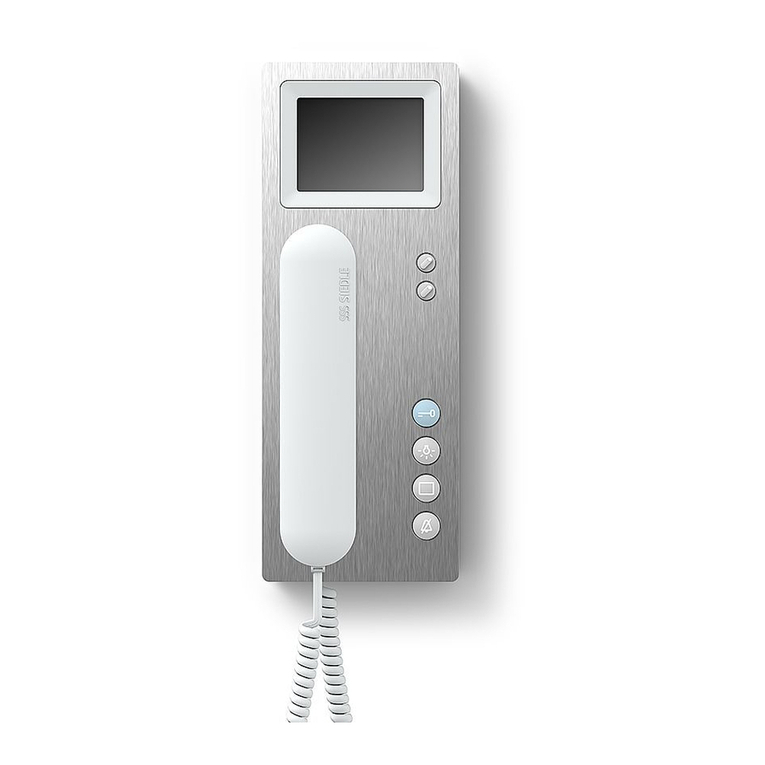
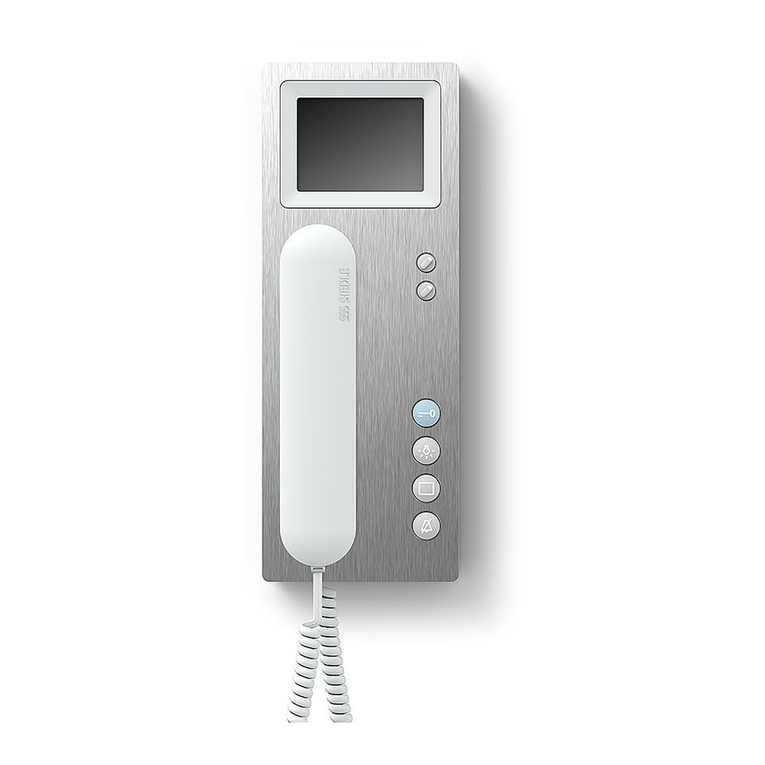
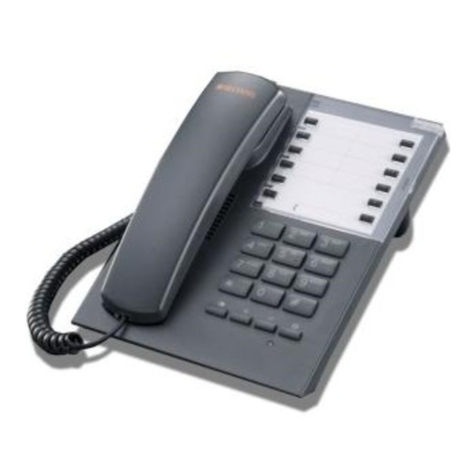
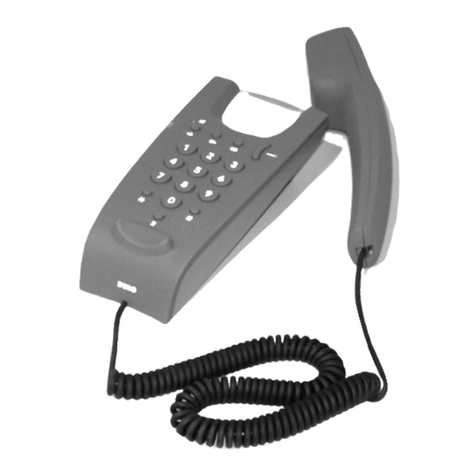
• BTCV 850-... (Base plate and
housing with circuit board)
• Receiver
• Spiral cable
•Dummy card for SD card slot
• Operating instructions for the
end user
• This product information
Mounting
Strip back cable to appr. 80 mm.
1Recommended mounting height
appr. 1.50 m to centre device.
2Open the device from the back
by releasing the base plate with the
locking lever.
3 When mounting directly on the
wall, fasten the base plate using
4 screws, paying attention that
the plate is the right way up (top
marking).
4 When mounting on a switch box,
use the screw openings in the centre
of the device, paying attention that
the plate is the right way up (top
marking).
5 Install in accordance with the AS
diagram. The cores of the installation
cable must be stored inside the free
installation space in the base plate.
6 Insert the coloured plug of the
spiral cable into the socket at the
housing. A distinct click is audible
when the plug is correctly inserted.
7Insert the other end of the spiral
cable into the receiver until the
plug clicks audibly into place.
This connection can no longer be
detached.
8 Slot the housing into the base
plate and close by applying a light
pressure.
Dismantling
9 To remove the housing, press
the lock upwards using a flat blade
screwdriver. The circuit board and
receiver remain on the upper part of
the housing.
Lettering
10 The lettering panel can be
inscribed to indicate the button
functions. The see-through panel
can be lifted at the side.
Terminal assignment
TaM/TbM = Input In-Home bus
TaM/TbM = Throughput
In-Home bus
ERT/ETb = Storey call button
+M/-M = Additional supply
20 – 30 V DC for
video memory function
and door parallel call
S1/S1 = Potential-free contact
for additional bell
Commissioning
Installation, commissioning and
programming are described in the
system manual (enclosed with the
bus video line rectifier
BVNG 650-...).
Video memory
The device‘s video memory is only
active when the bus telephone has
a supplementary power supply. It
stores the last 28 pictures taken by
the door camera. In the event of a
power failure, the video memory is
deleted.
Setting the language, date and
time
After first switching on the monitor,
the language must be selected. The
display then changes over to the
input of date and time.
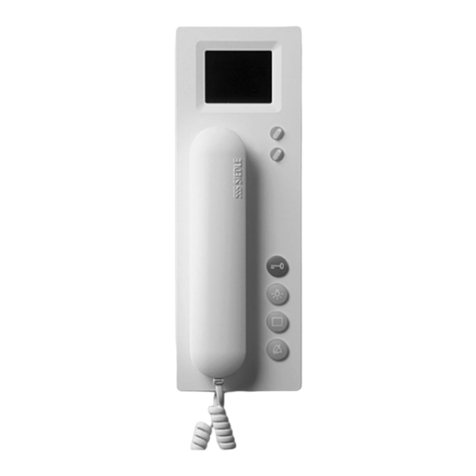
Assigning the monitor buttons
Entries are made using the 5-way
button under the monitor.
Enter button
Using the round Enter button in the
middle, the monitor is switched on
or a selected function confirmed.
Control buttons
Using the control buttons on the
right, left, top and bottom, it is
possible to navigate within the menu
levels.
The control buttons can be
assigned with different functions
depending on the monitor display.
The functions of the buttons are
indicated by a display superimposed
at the bottom edge of the monitor.
SD card
At the top of the device, an SD
memory card can additionally be
inserted to increase the memory
capacity from 32 MB to 2 GB; On
delivery, a dummy card is inserted in
the slot to act as a dust protection.
The memory card is used
• to extend the unit‘s internal video
memory and
• to transmit the pictures to a PC
with the aid of the relevant reading
unit.
On the SD card, a maximum of 255
pictures in *.tif format can be stored
with a resolution of 640 x 480 pixel
and a file size of appr. 1 MB. When
the memory capacity is exhausted,
or the maximum number of pictures
has been saved, the oldest picture
is overwritten every time a new one
is taken.
The bus telephone should be used
to format the SD card; If you wish to
format at the PC, the FAT 16 format
should be used.
Saved pictures are subject to the
same copyright restrictions as
photographs.
Accessories for BTCV 850-...
• ZTCV 850-... table-top accessory
for conversion from a wall-mounted
to a table-top device.
Specifications
• The device is supplied via the
In-Home bus if the video memory is
SD card appr. no of
pictures
32 MB 32
64 MB 64
128 MB 128
256 MB 255
512 MB 255
1 GB 255
2 GB 255