English
7
5.3. Oxygen enrichment - see
I
Administer oxygen according to medical indications.
I8.1: Oxygen connector (6 mm - this opening may only be
occluded if a closed reservoir is mounted using an adapter),
8.2: Inlet connector (this opening may never be occluded),
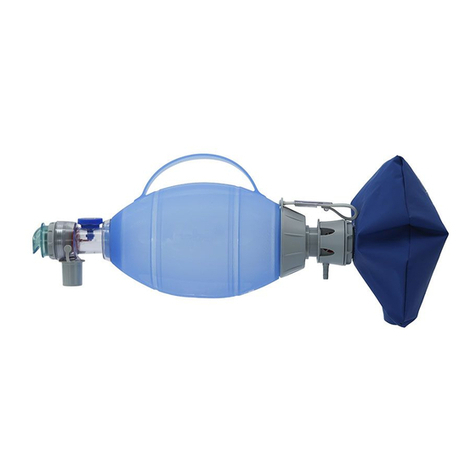
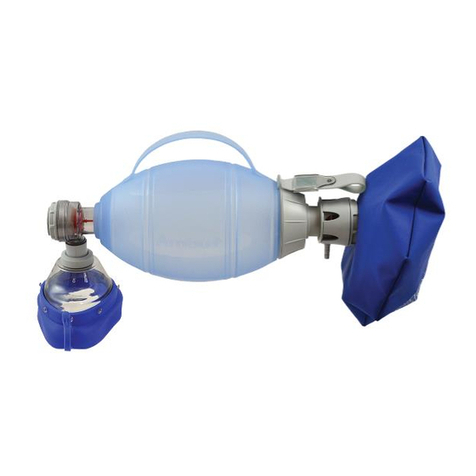
8.3: Oxygen reservoir tube, 8.4: Adapter,
8.5: Oxygen reservoir bag, 8.6: Oxygen connector on oxygen
reservoir bag (6 mm).
Oxygen enrichment is performed by connecting the oxygen supply
tube to the connector on the back of the inlet valve and connect-
ing the oxygen reservoir tube to the inlet connector.
When using the oxygen reservoir bag, use an adapter. Place the
adapter over the inlet connector and close the oxygen connector
using the cap (see O). Oxygen supply takes place through the
oxygen connector on the reservoir housing. Obtainable oxygen
concentrations using an oxygen reservoir bag are as minimum
what can be obtained by using the oxygen reservoir tube, see {.
Oxygen enrichment of the inspiratory air in case of spon-
taneous respiration
• Without an oxygen reservoir tube:
Attach a mask to the resuscitator, set the oxygen flow to
between 2 and 4 l/min, and place the mask over the child's
mouth and nose, creating an airtight seal. If the spontaneous
respiration is sufficient, an oxygen concentration close to 100%
will be obtained.
• With an oxygen reservoir tube:
The end of the resuscitator with the oxygen reservoir tube that
normally faces away from the patient can also be used for oxy-
gen enrichment of the inspiratory air in case of spontaneous res-
piration. Again, the oxygen flow should be set to between 2 and
4 l/min, and the free end of the oxygen reservoir tube (1.3)
should be held as tightly as possible against the child's head.
Again, the oxygen concentration will be very close to 100% at
the end of the tube. Depending on the distance between the
reservoir tube and the child's head, there will be significantly
more or less inhalation of atmospheric air, and thus lower oxygen
concentrations should be expected.
5.4. Oxygen concentrations - see
{
In case of controlled ventilation, the inspiratory oxygen concentra-
tion depends on frequency and tidal volume. The oxygen concen-
tration which is normally desirable (of 30-50%) can usually be
obtained without oxygen reservoir. If higher concentrations are
indicated, the oxygen reservoir must be connected to the bag's
inlet valve.
Examples of oxygen concentration that can be obtained using an
oxygen reservoir at different volumes and frequencies, are shown
in {.
A simplified table is printed in the oxygen reservoir bag for fast
guidance (see P). The oxygen concentrations indicated are
obtained as a minimum as long as the minute ventilation is equal
to or less than 300 x 20 = 6 l/min.
Example:
Administer 2 l/min of oxygen through the inlet of the oxygen
reservoir bag. With a tidal volume of max. 300 ml and a compres-
sion frequency of max. 20 per minute, a child receives an oxygen
concentration of at least 40%.