LATCHED
DE-ENERGIZED UNLATCHED
ENERGIZED
PILOT
EXH
PILOT
PRESSURE
PILOT
PISTON
CYLINDER
EXH
PRESS
‘2’ ‘1’
AUX
CYL
PILOT
EXH
PILOT
PRESSURE
PILOT
PISTON
CYLINDER
EXH
PRESS
‘2’ ‘1’
AUX
CYL
MANUAL RESET
MAIN VALVE
PILOT VALVE
‘3’ ‘3’
Page 2 of 4 I&M No. V_9602_R2
©ASCO Valve, Inc.160 Park Avenue, Florham Park, New Jersey 07932 www.ascovalve.com
ANPT
1/4”
1/2”
.31 [8]
”D”
”F”
ANPT
PRESS EXH
ANPT
D
2.09 [53]
2.18 [55]
CYL
”E”
Ø.28 [7]
4 MOUNTING HOLES
E
1.25 [32]
1.66 [42]
F
4.05 [103]
4.26 [108]
Figure 1. Mounting dimensions (partial view)
Unlatched - Solenoid Energized: With solenoid energized, the
handle will now return to the (down) unlatched position. The
pressure port of the main valve will close and flow in the main
valve will be from cylinder to exhaust.
NOTE: When piped in the electrically tripped (TSO) mode,
loss of auxiliary pressure will cause the operator to return to the
unlatched position - Main valve pressure will close and exhaust
will open.
Flow Diagrams for Electrically Tripped
INSTALLATION
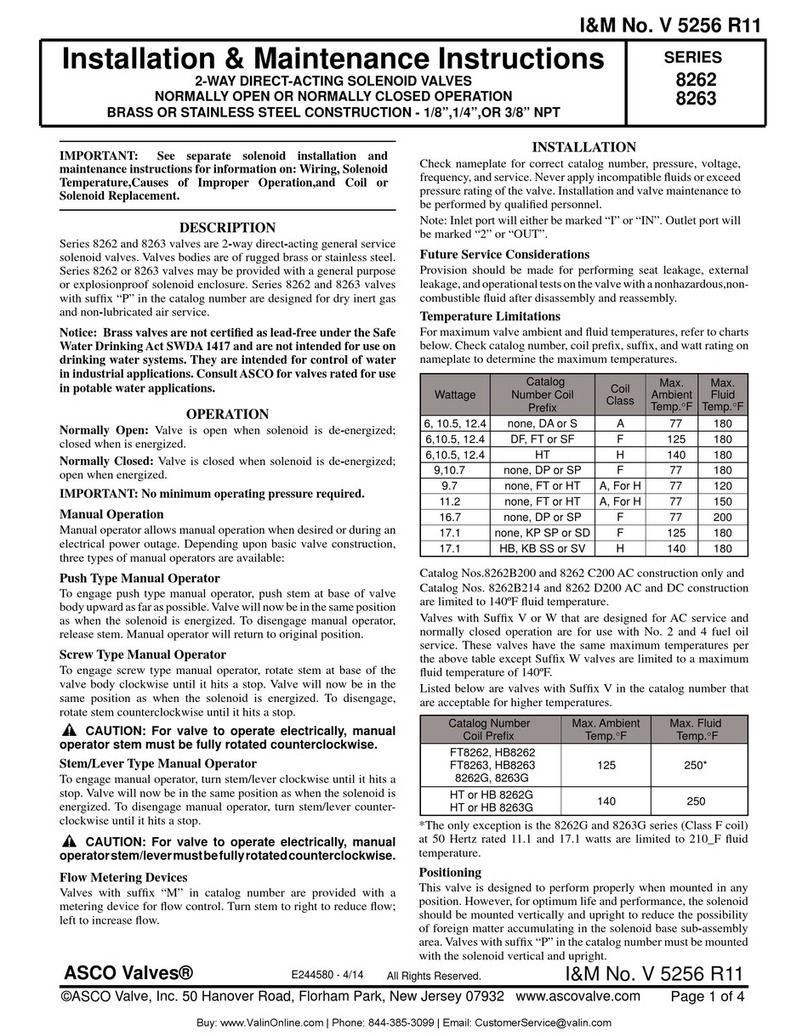
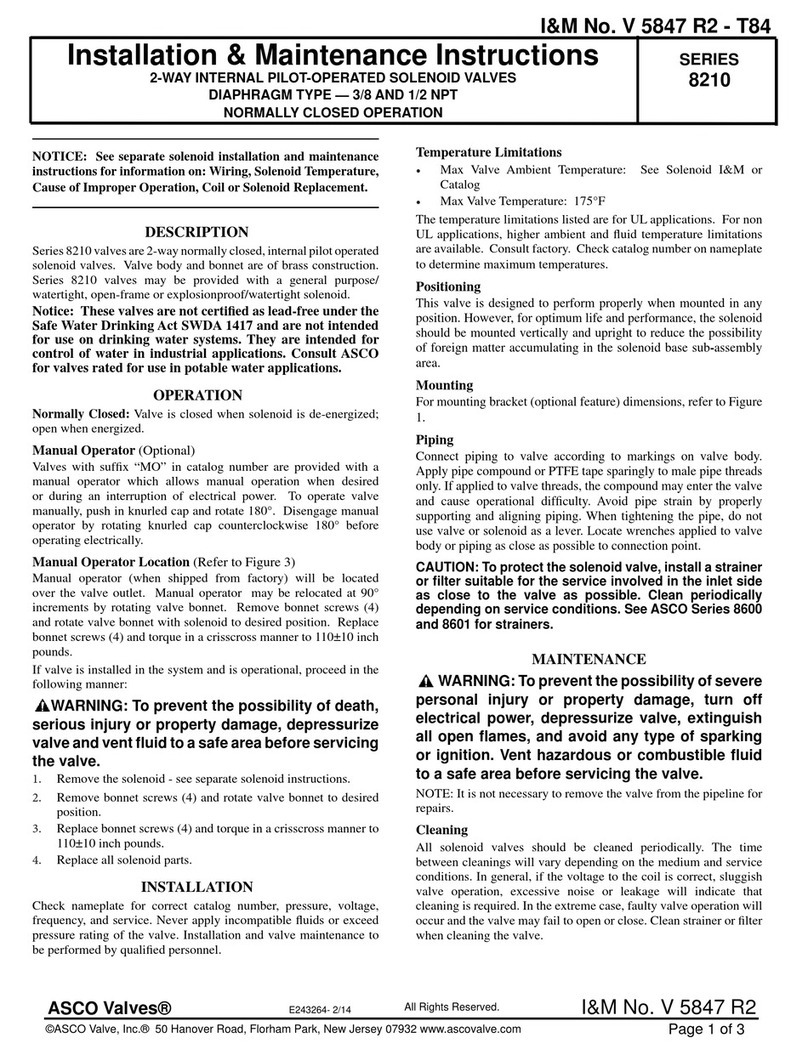
Check nameplate for correct catalog number, pressure, voltage,
frequency, and service. Never apply incompatible fluids or exceed
pressure rating of the valve. Installation and valve maintenance
to be performed by qualified personnel only.
Temperature Limitations
Please refer to chart below, or as limited by solenoid approvals.
See solenoid installation and maintenance instructions.
Temperatures Pilot Valve Main valve
Fluid Min. -4°F (-20°C) -4°F (-20°C)
Max. 140°F (60°C) 140°F (60°C)
Ambient Min. -4°F (-20°C) -4°F (-20°C)
Max. 140°F (60°C) 140°F (60°C)
Positioning
Valve may be mounted in any position. For optimum performance
mount with operator vertical and upright.
Mounting
For valve body mounting refer to Figure 1.
Piping
There are three exhaust flow modes: pilot valve, auxiliary pilot
and main valve exhaust. For pilot valve and auxiliary pilot exhaust
use a muffler to vent to atmosphere or connect to main exhaust
system if the air or inert gas cannot be exhausted directly to the
atmosphere.
Connect piping or tubing to valve according to markings on valve
body. Refer to flow diagrams in OPERATION section and Figure
2 Valve Port Connections. Apply pipe compound sparingly to
male pipe threads only. If applied to valve threads, the compound
may enter the valve and cause operational difficulty. Avoid
pipe strain by properly supporting and aligning piping. When
tightening the pipe, do not use valve or solenoid as a lever. Locate
wrenches applied to valve body or piping as close as possible to
connection point.
CAUTION: These solenoid valves are intended for
useoncleandryair,inertgasornaturalgas,filteredto40
micrometresorbetter.Thedewpointofthemediashould
be at least 10°C (18°F) below the minimum temperature
to which any portion of the clean air/inert gas system
could be exposed to prevent freezing. If lubricated air is
used, the lubricants must be compatible with FKM and/
or Nitrile elastomers. Diester oils may cause operational
problems. Instrument air in compliance with ANSI/ISA
Standard 7.0.01-1996 exceeds the above requirements
and is, therefore, an acceptable media for these valves.
ATTENTION : Ces électrovannes doivent être
utilisées avec de l’air sec, du gaz inerte ou gaz naturel
propre, filtré jusqu’à 40 micromètres ou plus. Le point
de rosée du fluide doit être d’au moins 10ºC inférieur
à la température minimale à laquelle toute partie du
système d’air/gaz inerte propre pourrait être exposée,
afin d’éviter le gel. En cas d’utilisation d’air lubrifié,
les lubrifiants doivent être compatibles avec le FKM
et/ou élastomères nitrile. Les huiles diester peuvent
engendrer des problèmes de fonctionnement. L’air
d’instrumentation conforme à la normeANSI/ISA 7.0.01-
1996 dépasse les exigences ci-dessus et constitue, par
conséquent, un média acceptable pour ces vannes.