3.5 Pulse input terminals
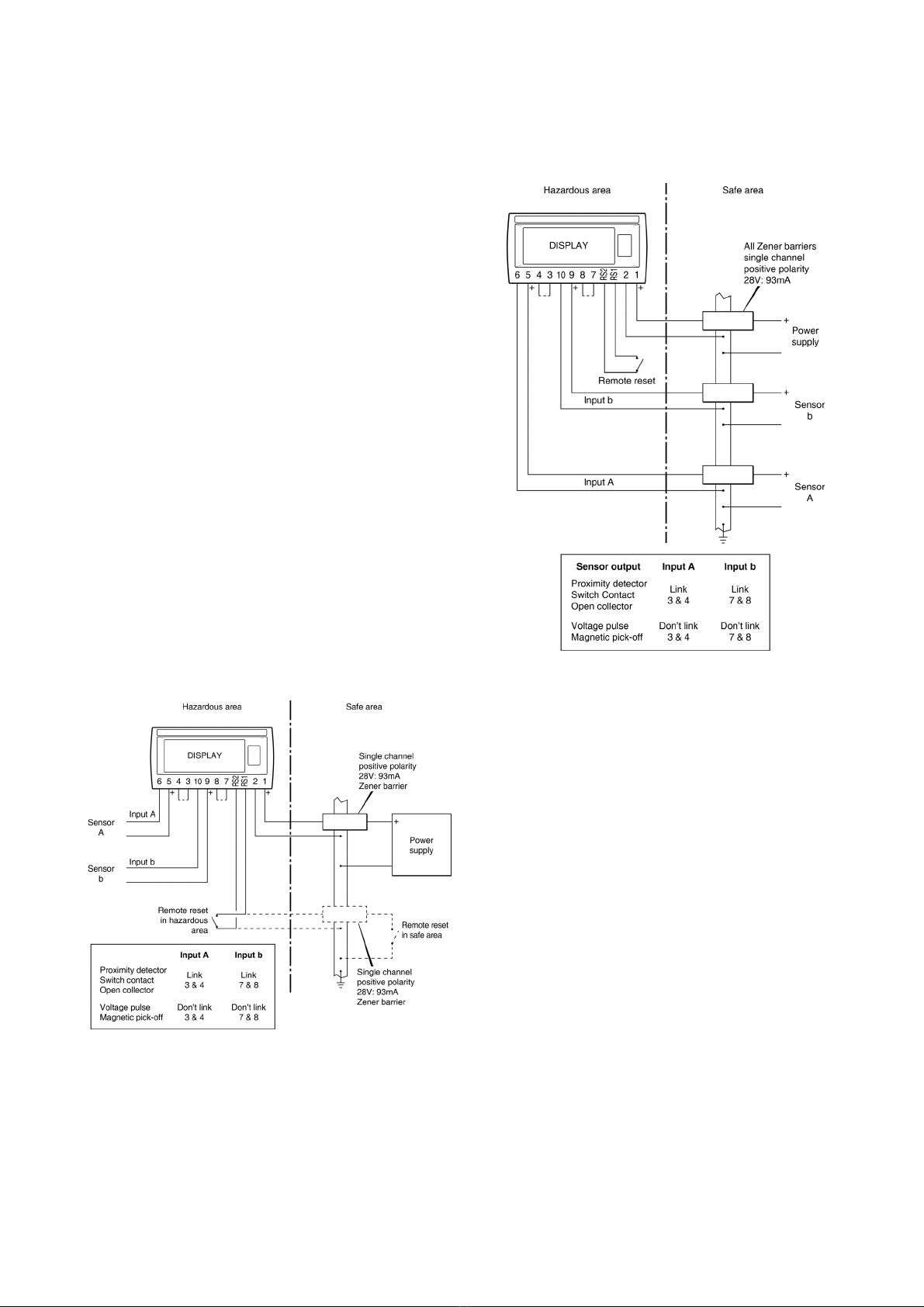
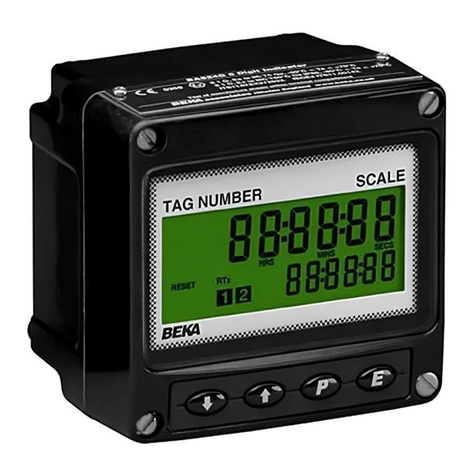
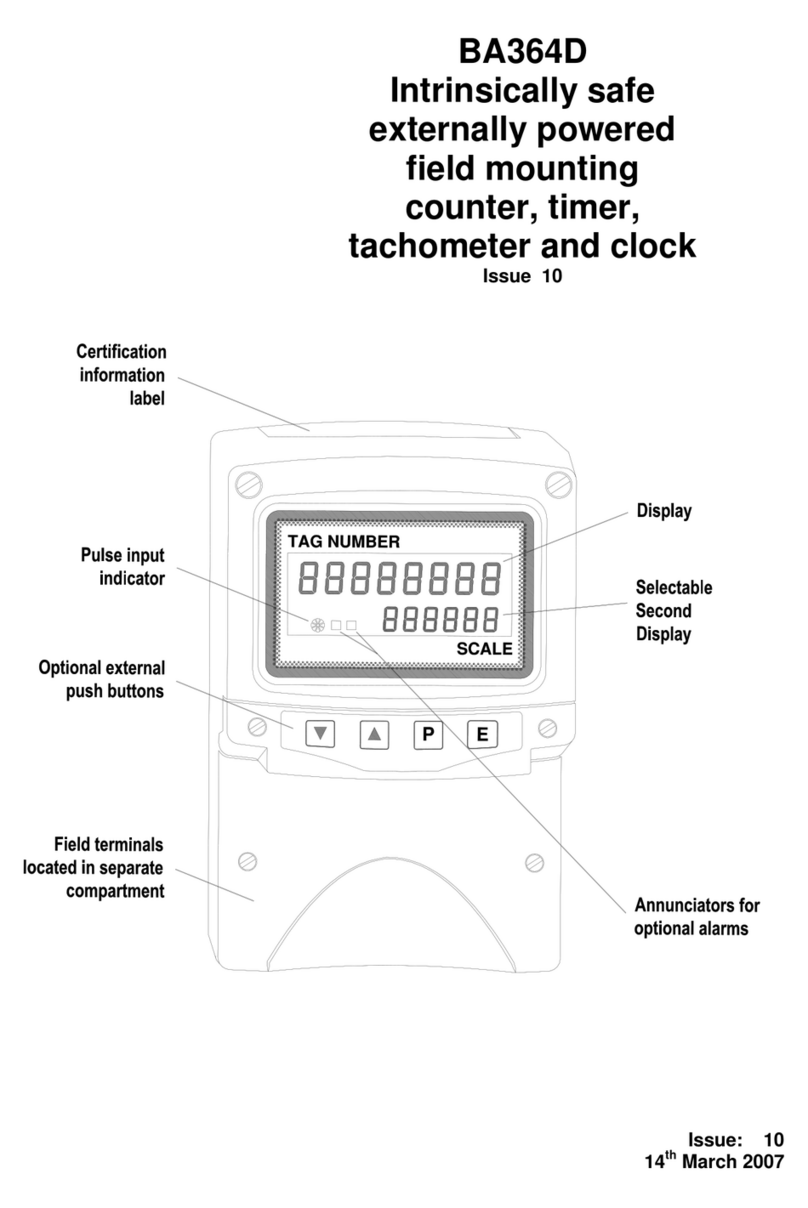
The BA368E Counter has two pulse inputs, A and b,
that may be individually configured for use with most
types of sensor. Each input is a separate
intrinsically safe circuit, although the negative side of
each input is internally connected to the negative
side of the power supply and reset terminal RS2.
See Fig 1. The two inputs should not be connected
in parallel.
Some types of sensor that may be connected to the
BA368E inputs, such as a switch contact or a 2-wire
proximity detector, require energising to determine
their state. For sensors requiring energising fitting
an external link between terminals 3 & 4 of the
BA368E for input A and between terminals 7 & 8 for
input b, connects an internal 7V, 6mA supply to the
respective input. Energising is not required when a
BA368E input is connected to a voltage source.
Fitting an energising link changes the output safety
parameters of each BA368E input as shown in the
following table which also shows the types of sensor
requiring energising (link fitting).
Output safety
parameters of each
input.
Type of input Link* Uo Io Po
Switch contact Yes 10.5V 9.2mA 24mW
Proximity detector Yes 10.5V 9.2mA 24mW
Open collector Yes 10.5V 9.2mA 24mW
Magnetic pick-off No 1.1V 0.5mA 0.2mW
Voltage input (low) No 1.1V 0.5mA 0.2mW
Voltage input (high) No 1.1V 0.5mA 0.2mW
*For input A link terminals 3 and 4
*For input b link terminals 7 and 8
3.5.1 sensors that do not require energising
Magnetic pick-offs and voltage pulse inputs do not
require energising, see section 3.5. For intrinsic
safety purposes, sources of energy with output
parameters less than 1.5V; 100mA and 25mW are
considered to be simple apparatus (Clause 5.7 of
EN60079-11), which allows them to be ignored and
not documented when assessing an intrinsic safe
system.
When terminals 3 & 4 and terminals 7 & 8 are not
linked, the associated BA368E Counter input
complies with the requirements for simple
apparatus. This allows the output parameters of the
pulse input to be ignored when assessing the safety
of the sensor connected to a Counter.
This allows almost any certified intrinsically safe
voltage pulse or certified magnetic pick-off to be
directly connected to one of the BA368E Counter
inputs.
The BA368E EC-Type Examination Certificate
specifies that the equivalent capacitance and
inductance of each BA368E Counter input are:
Ci = 2nF
Li = 4H
To determine the maximum permissible cable
parameters these figures should be subtracted from
the maximum permitted cable parameters specified
for the sensor connected to the input terminals of the
Counter. However, the Counter input parameters
are very small and they are unlikely to make any
significant difference to the allowable cable
parameters.
3.5.2 sensors that require energising
Switch contacts, proximity detectors and open
collector inputs require energising as described in
section 3.5. When energised, the output parameters
of each BA368E Counter input are:
Uo = 10.5V
Io = 9.2mA
Po = 24mW
These parameters do not comply with the
requirements for simple apparatus and should be
included when assessing the safety of the circuits
connected to the inputs of the BA368E Counter.
Any certified intrinsically safe sensor or simple
apparatus may be connected to an energised
BA368E Counter input providing that the sensor's
input parameters are equal to, or greater than, the
output safety parameters of the BA368E Counter
input which are shown above. This is not restrictive
and most sensors will comply.
This allows most mechanically operated switch
contacts, open collector transistors and certified
intrinsically safe NAMUR proximity detectors to be
directly connected to a BA368E Counter input
providing the sensor and associated wiring can
withstand a 500V rms insulation test to earth and
both are located within the same hazardous area as
the Counter.
The maximum capacitance and inductance that may
be safely connected to each Counter input when
energised (link connected) is:
Co = 2.4µF
Lo = 200mH
Again this is not restrictive and most sensors will
comply.
7