SURGE
PROTECTOR
BOUNDARY
WiRE
#10
AWG
Or
Heavier,
Solid
Ground
Wire
1.
Locate the surge
protector
outdoors
where
the
zip wire
from
the
transmitter
exits
the
garage
or
house.
2.
Bring
the wires
through
the rubber gasket
(it
will
need
to
be
cut) and
connect
each
end of
the
zip
cord
from
the
transmitter
to
the inside
point
of
each
connector
and
to
the
binding
post of
the
surge
protector.
3.
Bring
the ends
of
twisted wire
going to
the
boundary
loop
through
the rubber
gasket
and
connect
each
end to
the
outside
point
of
each
connector
post.
4.
Connect
one
end of
#10
AWG
or
heavier ground
wire to
the
ground
connector
post
of
the
surge
protector
(making sure the
end
is
clean
and shiny) and
exit
through
the
rubber gasket.
5.
Install
an 8
foot
ground
rod
(not
included)
outside
of
the
building
near
the surge
pro
tector.
Note:
If
the surge
protector
is
located
near
the house
electrical
service
ground
rod,
this
rod
should
be
used instead
of installing
a
second ground
rod.
Run
ground
wire
in
the
shortest
straight
path
to
the
ground
rod,
cutting
off
excess
length.
Avoid
sharp bends
in
wire.
Always
run
in
a
downward
slope
towards
earth.
6.
Connect
the
other
end of
the
ground
wire to
the
ground
rod
using
a
ground
rod
clamp
(not
included).
Planning
•
It
is
important
to
carefully
plan
the
installation of
the
boundary
wire.
•
Consider the
location
of gardens,
plants, pools,
pathways, and
driveway
crossings.
Utilize
the
natural
boundaries
of
your
property.
This
will
help
in
your
dog’s
training.
•
Plan
the
path
of
the
twisted wire
to
the
boundary
wire.
The
wire
must
form
a
continu
ous
loop.
•
Avoid sharp
comers,
as
they
will
produce
irregular
radio
signals.
Avoid
creating
alleys
or
bottlenecks where
the
wire
is
less than 20’
from
itself.
•
Never
place the
wire
in
a
metal
conduit.
•
If
your
neighbor
has
a
DogWatch Hidden Fence System,
allow
10’
between
wires.
•
Avoid
placing the
boundary
wire
too close
to
your
house
to
prevent
the signal
from
entering
through
the
walls.
Avoid laying the
wire
parallel
to
any
underground
cables
o
metallic
pipes.
These
cables
or
pipes should
be
crossed
at
a
900
angle.
The
wire
can
be
laid
beneath
rocks,
brick,
or
flagstone without
affecting the
signal.
Installing
Determine
where
you
want
the inside
edge
of
the signal
field
to
be
and
mark
it
with
your
DogWatch training
flags.
Rags
should
be
10
feet
apart.
They mark
the
edge
of
the signal
field and
act
as
a
visual
aid
for you
and
your
dog
during training.
When
you bury the
wire,
first inspect the
path
for
rocks,
root,
underground
cables,
pipes,
etc.
Cut
a
narrow groove
3”
to
4”
deep
using
a
straight
edged
spade
or lawn
edger.
Place
the
boundary
wire
in
the
groove
and
cover
it
completely. Splice
each
enc
of
the
twisted wire
to
each
end of
the
boundary
wire.
Be
sure
to
make separate
splices
with strong
and
waterproof
connections.
Avoid
laying
the
wire
parallel
to
any
underground
cables
or metallic
pipes.
These
cables
or pipes should be
crossed at
a
90’
angle.
When crossing
asphalt
driveways
or
sidewalks,
make
a
1/2”
deep cut
in
the surface
using
a circular
saw
with
a
masonry
blade.
Place
the
wire
in
the
cut
and
seal
with
an
asphalt
sealer.
When crossing concrete driveways
or
sidewalks,
place
the
wire
in
an
expansion joint and
seal.
Testing
•
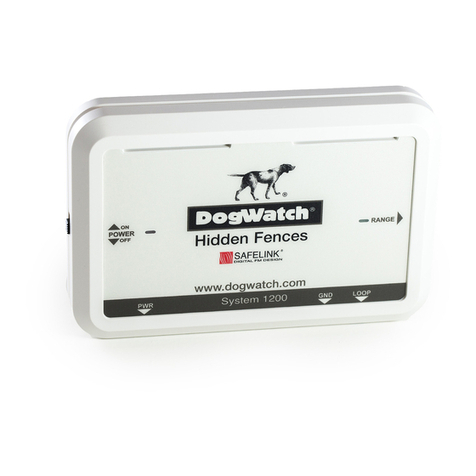
Turn
the
Power
switch
on.
The
red
Power
light
and
the
green
Loop
light
on
the
cove
of
the
transmitter
will
come
on.
•
Test
the radio signal
by
carrying
the receiver
collar
with
the test
light
towards the
boundary
wire.
Repeat this
in
several locations
around
the
property.
Lightning
power
surges can cause damage
to
your
Dog
Watch
transmitter
Your
surge
protector
will
help
to
prevent
this
from happening.
It
will only
be
effective
if
your
system
is
properly
grounded.
If
you
have
questions
about
whether
you
have
a
proper
ground,
consult
your
ilcensed
electrician.
Boundary
Loop
Wires
_
Zip
CordTo
Transmitter
•
To
adjust
the system,
refer to
Before Starting
in
the
training
section,
page
16.